No single canonical creation myth for the cuélebre is attested in the cited sources. Sources describe it as a longstanding element of Asturian and Cantabrian dragon/serpent lore and include narrative motifs such as a tale fragment in which a maiden is transformed into a cuélebre and can only revert if met by a particular kind of knight (Dragnix legend excerpt). The cuélebre is also placed in broader eschatological/migratory motifs: though described as effectively immortal, it is said to eventually depart to a mythical paradise called Mar Cuajada beyond the sea (Wikipedia).
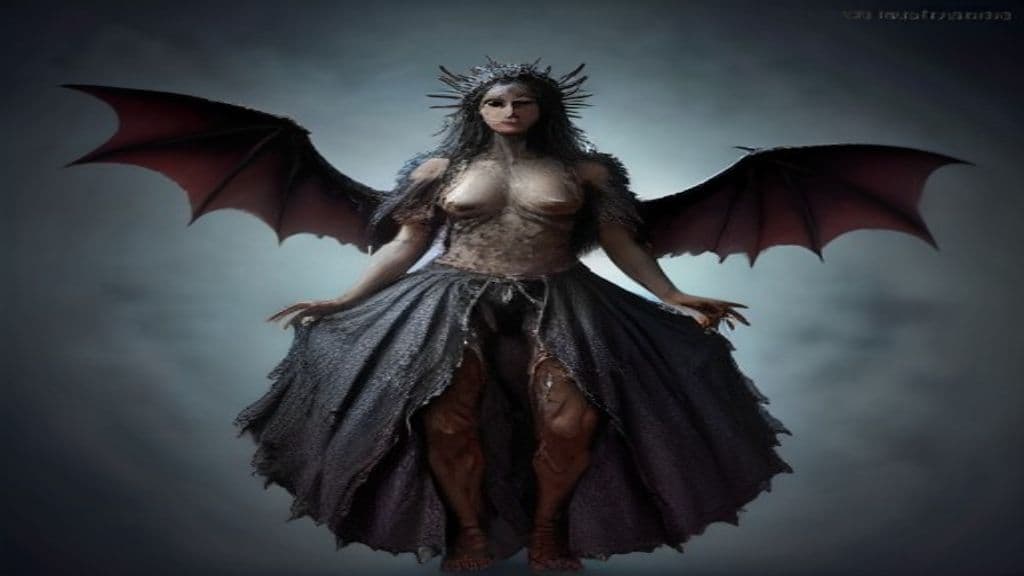
Folkloric descriptions depict the cuélebre as a giant serpent or dragon‑like reptile. Sources report that in maturity bat‑like wings develop on its body and that its scales thicken over time, becoming described as impenetrable; accounts also attribute great size (capable of eating cattle and people and of holding xanas captive). A narrative fragment records a tale in which a girl's body grows into a cuélebre as part of a transformation motif (Dragnix).
Within regional lore the cuélebre functions as a guardian of caves, subterranean and liminal watery places, and treasures; it is also described as keeping xanas (anjanas) captive. It is said to be effectively immortal yet to age physically (scale thickening, wing development) and ultimately to fly away to Mar Cuajada. It normally remains motionless in its lair, but when it moves it is reported to do so to prey on cattle and people. Folklore attributes a magical byproduct to it: its spit is believed to harden into a stone with reputed healing powers. Folklore also records specific folk‑methods for killing it (for example, feeding it a red‑hot stone or bread filled with pins).
Weaknesses
- substancered‑hot stone (fed to the cuélebre to cause its death)
- substanceloaf of bread filled with pins (fed to the cuélebre to cause its death)
- conditionMidsummer / Night of San Juan vulnerability (spells lose power in some regional variants)
Wards
- conditionAvoidance of lairs (implicit preventive practice of not disturbing cave/treasure sites)
- conditionActing on Midsummer / Night of San Juan to challenge or confront the cuélebre when its spells are said to weaken
- substanceFeeding harmful items (red‑hot stone or bread with pins) as a countermeasure
Cult of Dionysus
A cult associated with the Greek god Dionysus, patron deity of wine, fertility, theater, and ecstasy. (Note: 1. Factual claim: The article states that Dionysus's original name 'Dionysus' (Διόνυσος) is derived from Linear B tablets as 𐀇𐀺𐀝𐀰 (di-wo-nu-so). However, the source material does not support this )
Cunizza da Romano
Cunizza da Romano (c.1198–1279) is a historical Italian noblewoman of the da Romano family who appears as a named soul in Dante Alighieri’s Divine Comedy (Paradiso Canto IX), located among the blessed of the heaven of Venus and presented as an exemplum of lives shaped by love.
Cupid
Cupid (Latin: Cupīdō or Amor) is the Roman god of desire, erotic love, attraction, and affection, depicted in classical and later Western art and literature as a youthful, often winged figure whose arrows inspire love or aversion.
Curetes
The Curetes (Greek Κουρῆτες, Kouretes) are a named group of ritual attendants or minor divine retainers associated with Aegean and Anatolian mother-goddess cults—primarily Rhea and Cybele. They are attested in ancient sources and modern reference works as dancing servants or ritual personnel whose name also survives in urban toponymy (e.g., Kouretes/Curetes Street at Ephesos).
Curupira
A Tupi–Guarani–area forest spirit who protects woods and wildlife by misleading, punishing, or rewarding humans according to their behavior; widely attested across Brazil and neighboring regions with many regional variants.
Cusco Quechua
Cusco Quechua (Qusqu qhichwa simi / Qusqu runasimi) is a regional variety of Southern Quechua spoken in the city and Department of Cusco, Peru. It is part of the Southern Quechua grouping (including Puno and Bolivian varieties) and is the variety used and promoted by the Academia Mayor de la Lengua Quechua in Cusco; sources note debates over vowel analysis and orthography and list the variety as vulnerable in language-vitality metadata.
Cyane
Cyane (Ancient Greek Κυάνη, Kuánē, 'dark blue') is a Sicilian water-nymph (naiad) associated with a spring or pool near Syracuse. In myth she attempts to block Hades' abduction of Persephone, pleads by citing her own consensual relationship with the river-god Anapus, and—after failing—dissolves into the waters of her pool; the spring is thereafter sacred and named for her.
Cyanippus
Cyanippus (Greek: Κυάνιππος) is a personal name attested for at least three distinct mortal men in Greek mythic traditions: an Argive/Achaean warrior-king connected to the Trojan Horse cycle, a Thessalian hunter whose dogs kill his wife, and a Syracusan who omitted worship of Dionysus and whose divinely induced crime leads to oracle-driven expiation. He is presented as human rather than as a supernatural being.
Cybele
An Anatolian mother goddess (Phrygian Matar Kubileya) whose cult centers on mountains, city protection, fertility, and wild nature; adopted and reinterpreted by Greek and Roman religion where she became associated with ecstatic rites, a eunuch priesthood (the Galli), and the Roman Magna Mater cult.
Cybernary
Cybernary is a fictional comic-book character and the title of a WildStorm series; presented as a cybernetically enhanced human whose body and systems carry or host other consciousnesses. Originating in 1990s American comics, Cybernary functions as a cybernetic anti‑heroine and narrative construct within post‑apocalyptic / cyberpunk superhero fiction.
Cyborg
A cyborg is an organism that incorporates technological, feedback-capable components into its body so that biological functions are restored or capacities enhanced. The term originated in 1960 and is used across medical, theoretical, and fictional contexts to describe hybrids that blur boundaries between living beings and machines.
Cyborg Superman
A fictional comic-book supervillain identity in the DC Comics universe: a technomorphic hybrid that blends organic (including Kryptonian-derived tissue in some incarnations) and cybernetic components. Most famously embodied by Hank Henshaw, the role functions as an impostor/replacement of Superman and as a transhuman antagonist operating on terrestrial and cosmic scales.
Community Record
- [1]Cuélebre. Wikipedia: 'Cuélebre... is depicted as a giant, winged serpent-dragon that inhabits caves and guards treasures, often keeping anjanas... captive.'wiki
- [2]The Cuelebre (legend excerpt). Dragnix legend excerpt containing a tale fragment of a maiden turned into a cuelebre.folk
- [3]Archive: Dragones (regional listing). Archive anthology passage listing regional dragon variants including the cuélebre.other
- [4]Mitología Asturiana por J. C. Alvarez Cabrero (archive). Archive resource on Asturian mythology that situates the cuélebre in regional tradition.other
- [5]What are the creatures in the Iberian folklore (blog). Popular blog noting cuélebre's guardian role and contrasting moral ambivalence with child‑scaring bogey figures.folk
- [6]Peek‑a‑Boo Magazine interview: Cuelebre. Interview description calling the cuélebre 'a big winged serpent' typical of northwestern Iberia.folk
- [7]Cuélebre | Cryptid Wiki. Fandom/cryptid summary echoing folkloric claims such as healing stone from spit and lethal countermeasures.wiki
- [8]Driving the off-road track to Lago Cuélebre in Somiedo. Modern travel reference noting place‑name Lago Cuélebre and local topographical association.other