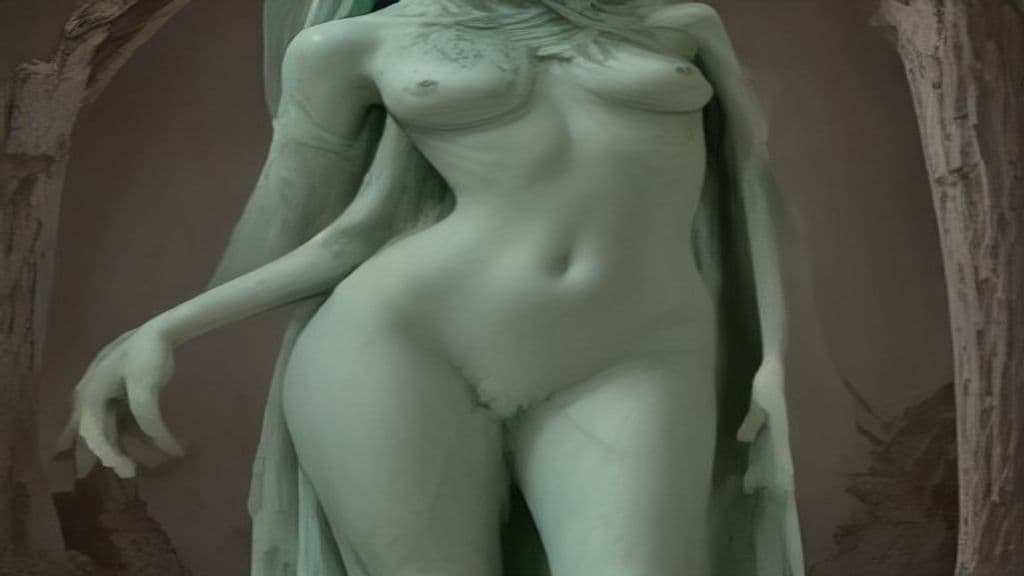
In the epic tradition preserved and summarized from Statius' Thebaid, Dercetis is presented as a Naiad of Boeotia who encounters a handsome youth named Lapithaon and forcibly couples with him despite his youth. From this union is born Alatreus, who later figures among the younger warriors connected to the cycle of the Seven against Thebes. The episode is transmitted in Roman epic as an anecdote used by a narrator within the Thebaid to supply background on participants in the Theban conflict (Statius, Thebaid; summarized in Theoi and Wikipedia).
Classical summaries identify Dercetis as a female Naiad of Boeotia but supply no detailed physical description. The sources emphasize her identity as a nymph (a freshwater spirit) and her sexual behaviour rather than describing hair, clothing, stature, or other bodily traits; no direct ancient physical attributes are attested in the provided materials.
The only attested action in the literary record is Dercetis' sexual aggression toward the mortal youth Lapithaon, resulting in conception of their son Alatreus. The supplied sources do not ascribe other supernatural powers, speech acts, or cultic functions to her; no additional abilities are recorded in the available summaries of Statius' account.
Demons in Mandaeism
In Mandaean cosmology, 'demons' are the hostile inhabitants of the World of Darkness, a structured underworld of kings, paired rulers, guards and lesser spirits that oppose the beings of Light. They appear throughout Mandaean scriptures (notably the Right Ginza and Diwan Abatur) as named personages, consorts, matarta (gate) guards, devourers and other functionaries encountered in mythic descent narratives.
Demophon of Athens
Demophon (Δημοφῶν / Δημοφόων) is a legendary Athenian hero and king of the heroic age whose narrative links the Theseus-cycle, the post‑Trojan War returns, and foundation stories for Athenian institutions. He appears in varied traditions as a Trojan War veteran, host to the Heracleidae, founder of the court of the Ephetae after an accidental homicide, and as party to the Phyllis/Acamas cycle of tragic return.
Demoptolemus
Demoptolemus (Ancient Greek: Δημοπτόλεμος) is a mortal figure named among the suitors of Penelope in the Homeric epic tradition. He is listed as one of the suitors present in Odysseus’s hall and is reported in the narrative tradition to have been killed during Odysseus’s slaughter of the suitors (Odyssey Book XXII).
Denethor II
Denethor II is the twenty-sixth Ruling Steward of Gondor in J. R. R. Tolkien's legendarium: a human political leader of great will and foresight whose secret use of a palantír and ensuing despair lead to his tragic self-destruction during the War of the Ring.
Deoha
Deoha is the name of a river — a tributary of the Ramganga — that rises in the Shivalik Hills and flows through Uttarakhand into the plains of Uttar Pradesh, where it is known by the name Deoha and further downstream as the Garra. The supplied sources contain no documentation of a supernatural household guardian or offended spirit called Deoha or Deoha‑Rooh.
Deor
A poet and subject of an Old English poem found in the Exeter Book, reflecting on misfortune attributed to him. (Note: 1. Power tier should be Primordial, as it's an Old English poem and subject, not a supernatural entity with defined abilities. 2. Add description of Deor's reflection on misfortune from Source 1 as se)
Deriades
Deriades (Ancient Greek: Δηριάδης) is a mythic Indian king in Nonnus of Panopolis’s late antique epic the Dionysiaca. He is the principal human antagonist to the god Dionysus during the poem’s account of the Indian campaign, a mighty mortal ruler of divine parentage who commands vast armies and ultimately is driven into the river Hydaspes.
Dero
Dero refers to two distinct referents in the provided material: (1) an ancient Greek Nereid, Δηρὼ, listed among the fifty sea-nymph daughters of Nereus and Doris; and (2) a modern twentieth-century fringe/pulp concept (often written "dero" or rendered as "detrimental robots") describing small, malicious subterranean beings or machine-users from Richard Sharpe Shaver's mythos and later fringe literature.
Destroying angel
A divinely commissioned heavenly agent in the Hebrew Bible and later Jewish traditions sent by God to execute judgment, death, or punishment. The figure functions as an instrument of divine justice (mal'āḵīm / memitim / mashḥit) and appears in narrative episodes of plague, wartime slaughter, and in rabbinic and Enochic writings connected to postmortem or eschatological punishment.
Deucalion
Deucalion (Ancient Greek: Δευκαλίων) is a mortal culture-hero in Greek myth who survives a divinely-sent primeval flood and, with his wife Pyrrha, re-populates the world by throwing stones that become humans. He is portrayed as a king, founder of cities and temples, and son of Prometheus in many traditions.
Deucalion of Crete
Deucalion of Crete is a mytho-historical Cretan king in Greek tradition, named among the Argonauts and the Calydonian Hunters and placed in genealogies as a son (often eldest) of Minos. He functions as a heroic/dynastic figure within the Age of Heroes rather than as a divine or supernatural being.
Deutsche Mythology
A collection of mythological narratives representing the collective myths, legends, and beliefs of ancient Germanic cultures. (Note: 1. Power tier: Primordial (Deutsche Mythology as a collective mythological narratives does not have supernatural abilities and behaviors attributed to it; rather, it contains those of individual Germa)
Community Record
- [1]Dercetis. Wikipedia, entry 'Dercetis' (accessed source set)wiki
- [2]DERKETIS (Dercetis) - Boeotian Naiad Nymph of Greek Mythology. Theoi Project, 'DERKETIS (Dercetis)' (summary of classical references)literary
- [3]Statius, Thebaid (book reference via summaries). Primary episode attested in Statius' Thebaid (Book 7 referenced in secondary summaries)literary
- [4]Dercetis (fish) — taxonomic reuse noted. Wikipedia entry for the fossil genus 'Dercetis' (not a supernatural referent; name reuse noted)wiki