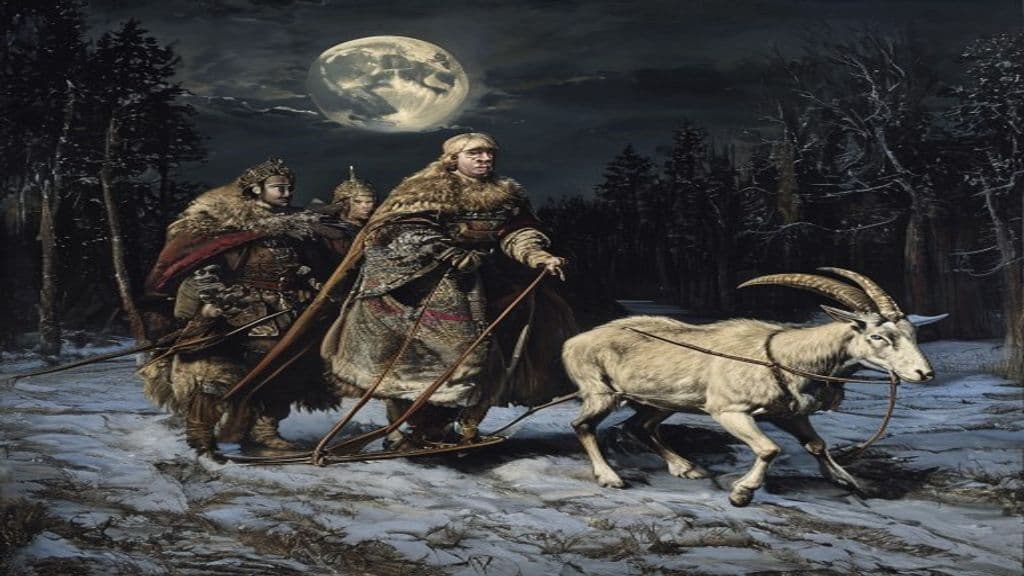
In the saga tradition Disa appears as the daughter of the chieftain Sigsten of Venngarn (Uppland) in a mytho-historical past when a ruler (in different retellings named the god-king Freyr or king Sigtrud) planned to cull part of the population to remedy famine after prolonged peace. Disa mocks the plan, accepts an impossible set of conditions for visiting the king, and by her wit overturns the proposed democide. Later sources in the early modern period (e.g. Olaus Magnus, Messenius, Rudbeck and later poetic and visual retellings) present her judgment as giving rise to a drawing of lots and the resettlement of part of the population to the north (later called Norrland), and state that many disputes were thereafter "relegated to her" at the Midwinter blót (called Disablot) and at the Disting.
The saga account gives a striking tableau used to meet the king's test: Disa arrives harnessing two young men to a sled, accompanied by a billygoat, with one leg over the goat and the other in the sled, and wearing a net as clothing, arriving at dusk during a full moon on the third day after Yule. Early modern visual culture cited in the sources (paintings and tapestries at Venngarn Castle based on etchings) depict scenes from the saga, and commentators have noted a recurring image of Disa clad in a net.
The supplied saga material emphasizes Disa's intellectual and rhetorical abilities: she composes and performs a riddle-like solution to an impossible set of restrictions imposed by the ruler and thereby changes state policy. Behaviorally she challenges authority, offers alternative policy (cancelling the culling and prescribing drawing lots), and is depicted as an adjudicator to whom disputes were brought at ritual-legal moments (Midwinter blót / Disablot and the Disting). The tradition highlights legal reasoning, strategic use of liminal timing, and institutional influence rather than supernatural powers.
Dios Buhawi
Sobriquet applied to Ponciano Elofre, a late 19th-century cabeza de barangay in Zamboanguita, Negros Oriental, who led a politico-religious revolt combining anti‑tax resistance with a revival of pre‑Spanish babaylan rites. Sources treat Dios Buhawi as a historical social and religious leader rather than a supernatural being.
Dioscuri (Castor and Pollux)
The Dioscuri, commonly rendered Castor and Pollux (Dioskouroi in Greek), are the twin half-brothers of Greek and Roman mythology who function as a paired mythic duo in classical literature and later cultural memory. They appear throughout ancient sources and have been reused as a durable cultural emblem of twinship, partnership, and martial or civic guardianship in art, monuments, and modern institutions.
Dioxippe (Heliades)
Dioxippe (Ancient Greek: Διωξίππη) is a named figure in Greek myth most commonly attested as one of the Heliades — daughters of Helios and the Oceanid Clymene — appearing in mythographic name-lists. The same personal name 'Dioxippe' also occurs for several unrelated female figures in Greek tradition (a Danaid, an Amazon, a wife of Agenor) and even as the name of one of Actaeon’s dogs in various sources.
Dip
In Catalan popular tradition the Dip is an evil black hellhound and emissary of the Devil that sucks the blood of cattle and humans. Tied specifically to the village of Pratdip, the Dip appears in local images (altarpieces, escutcheon) and in oral legend as a nocturnal predator whose tales were used to frighten drunken night‑goers.
Dirce
Dirce (Ancient Greek Δίρκη) is a figure of Greek myth traditionally remembered as a queen of Thebes, wife of Lycus, whose cruel treatment of Antiope led to her being killed by Antiope's sons, Amphion and Zethus. Her violent death — being tied to a bull and dragged to death — becomes aetiological for a spring associated with Dionysus and a site of local Theban ritual memory.
Dire Wraith
The Dire Wraiths are a Marvel Comics extraterrestrial species, described as an evolutionary offshoot of the Skrulls. Within the comics' internal cosmology they are a sentient, shape‑shifting race with a history of exile to a home called Wraithworld, internal gendered factionalism (technology‑oriented males and magic‑oriented females), and recurring antagonism toward the Spaceknights and Earth.
Dispater (Dis Pater)
Dispater (classical Dis Pater) is a chthonic Roman deity originally associated with fertile soil and subterranean mineral wealth who in modern fantasy and gaming traditions is reinterpreted as Dispater, an arch‑devil and lord of the Iron City of Dis, a high‑ranking ruler within layered infernal cosmologies.
Diti
Diti (Sanskrit: दिति) is a Puranic mythological woman of divine lineage: a daughter of the Prajapati Daksha, wife of the sage Kaśyapa, and the ancestress of the daityas. In Puranic narratives she functions as a progenitor whose pregnancies and ascetic acts produce powerful adversaries of the devas and so figure in origin-stories of cosmic conflict.
Diting
Diting (Chinese: 谛听; pinyin: Dìtīng) is a divine mythical creature in Chinese Buddhist hagiography traditionally described as the steed and attendant guardian of the bodhisattva Kṣitigarbha (Dizang). Described as a composite beast with extraordinary hearing and discernment, Diting is associated in legend with guarding hell and distinguishing truth from falsehood in support of Kṣitigarbha's salvific activities.
Div (Dīv)
Div (Persian: دیو dēw / dīv) are monstrous, often sorcerous antagonists in Persian epic and folkloric tradition, best known from the Shahnameh where they oppose heroes such as Rustam. Scholarly sources trace their cultural history to a re‑interpretation and demonization of older Indo‑Iranian divine figures (devas).
Div-e Sepid
A powerful demon and chieftain of the Divs (demons) of Mazandaran in Persian mythology, known for his mastery over elemental forces and control over spirits or the dead. (Note: - Power tier: Greater (Div-e Sepid is not described as having deity-level abilities, but rather as a powerful demon chieftain) - Abilities: corrects "control over spirits or the dead" to be more speci)
Divona
Divona is the Gaulish name applied to sacred springs and the divinised presence that works through them; attested in classical sources (notably Ausonius for the Bordeaux spring) and preserved in several place-names. The term etymologically means 'the divine one' or 'the goddess', and may function either as a theonym for a particular spring-deity or as a generic epithet for any female water-deity in ancient Gaul.
Community Record
- [1]Disa (Wikipedia). Wikipedia, "Disa"wiki
- [2]Disa (plant) (Wikipedia) — note on naming after the saga. Wikipedia, "Disa (plant)" (noting botanical name suggested to reference the legend)wiki
- [3]Disa — Wikidata entry Q599025. Wikidata, Q599025other
- [4]Archive references to Venngarn Castle Disasal paintings (summary). Archive item referencing imagery and cultural memory related to Disaother