
The name 'Dios Buhawi' functions in the sources as a sobriquet adopted by or applied to Ponciano Elofre (sometimes spelled Elopre), a cabeza de barangay of Zamboanguita, Negros Oriental. In the late 19th century Elofre rallied people against forced taxation and expanded his movement to include religious freedom, directing a revival of the ancient rites of the babaylan. One source glosses the epithet as Hiligaynon for 'Tornado/Whirlwind God,' but the provided materials present the label as an honorific or title within a politico-religious movement rather than as the origin of a supernatural cosmology.
Contemporary accounts emphasize Elofre's personal presentation: he reputedly dressed in female clothing and was described as effeminate in the manner associated with asog shamans. The supplied sources do not give any supernatural or nonhuman physical description for 'Dios Buhawi.'
The recorded 'abilities' of Dios Buhawi are political and ritual: charismatic leadership, organizing armed resistance against Spanish colonial authorities, rallying followers (the babaylanes—reported at roughly 2,000 in one account), and directing the revival and celebration of pre‑Spanish babaylan rites. The sources do not attribute supernatural powers or magical feats to him.
Weaknesses
- othermilitary suppression by colonial forces
Wards
None recorded.
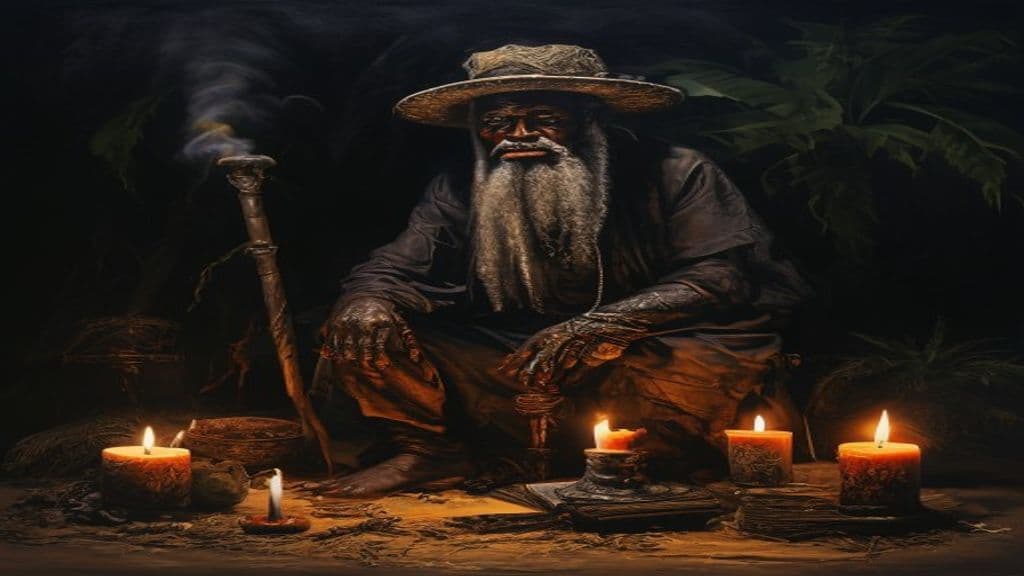
Papa Legba
The loa (spirit) of the crossroads in Haitian Vodou — gatekeeper between the human world and the world of the spirits. No other loa can be contacted until Papa Legba is first greeted and asked to open the gate.
Papa Legba
The loa (spirit) of the crossroads in Haitian Vodou — gatekeeper between the human world and the world of the spirits. No other loa can be contacted until Papa Legba is first greeted and asked to open the gate.
Diogeneia
Diogeneia (Ancient Greek: Διογένεια) is a personal name borne by multiple mortal women in Greek myth and later reused in civic and modern contexts. In ancient sources the name identifies distinct genealogical figures (daughters, wives, mothers) rather than a single supernatural being; a later civic festival and modern events and groups also bear the name.
Diogenia
Diogenia is an Attic naiad attested in classical genealogical sources as a daughter of the river-god Cephisus who, by marriage to Phrasimus, became mother of Praxithea and thereby linked river-divinity to the royal house of Erechtheus in Athenian legendary history.
Diomedes
Diomedes (Ancient Greek: Διομήδης) is a hero of Greek myth, foremost among Achaean warriors in the Trojan War, later a king of Argos and a legendary founder of cities in Italy; some traditions report he received cult after death. The name also appears for other historical and modern persons and places but within the supplied sources refers primarily to the mortal heroic figure(s) of classical tradition.
Dione
Dione is primarily a proper name attested in ancient Greek myth (Διώνη, 'she who is under the authority of Zeus') borne by multiple mythological women, and is also used in modern taxonomy and astronomy (notably a moon of Saturn). The supplied sources do not present Dione as a single, consistent folkloric supernatural being with rituals or warding traditions.
Dionysus
Dionysus (Ancient Greek: Διόνυσος) is a major ancient Greek deity associated with wine and winemaking, vegetation and fertility, festivity and theatre, ritual ecstasy and possession, and liminal links with death and the underworld. He is an epiphany-god who travels between worlds, whose cult includes ecstatic rites and mystery initiation.
Diores
Diores (Ancient Greek: Διώρης, Diṓrēs) is not a single supernatural entity but a recurring personal name borne by several distinct mortal figures in Greek and Roman epic and mythographic tradition. The name appears attached to at least four human characters — fathers, leaders, princes, and husbands — across Homeric, mythographic, and Virgilian narratives.
Dioscuri (Castor and Pollux)
The Dioscuri, commonly rendered Castor and Pollux (Dioskouroi in Greek), are the twin half-brothers of Greek and Roman mythology who function as a paired mythic duo in classical literature and later cultural memory. They appear throughout ancient sources and have been reused as a durable cultural emblem of twinship, partnership, and martial or civic guardianship in art, monuments, and modern institutions.
Dioxippe (Heliades)
Dioxippe (Ancient Greek: Διωξίππη) is a named figure in Greek myth most commonly attested as one of the Heliades — daughters of Helios and the Oceanid Clymene — appearing in mythographic name-lists. The same personal name 'Dioxippe' also occurs for several unrelated female figures in Greek tradition (a Danaid, an Amazon, a wife of Agenor) and even as the name of one of Actaeon’s dogs in various sources.
Dip
In Catalan popular tradition the Dip is an evil black hellhound and emissary of the Devil that sucks the blood of cattle and humans. Tied specifically to the village of Pratdip, the Dip appears in local images (altarpieces, escutcheon) and in oral legend as a nocturnal predator whose tales were used to frighten drunken night‑goers.
Dirce
Dirce (Ancient Greek Δίρκη) is a figure of Greek myth traditionally remembered as a queen of Thebes, wife of Lycus, whose cruel treatment of Antiope led to her being killed by Antiope's sons, Amphion and Zethus. Her violent death — being tied to a bull and dragged to death — becomes aetiological for a spring associated with Dionysus and a site of local Theban ritual memory.
Dire Wraith
The Dire Wraiths are a Marvel Comics extraterrestrial species, described as an evolutionary offshoot of the Skrulls. Within the comics' internal cosmology they are a sentient, shape‑shifting race with a history of exile to a home called Wraithworld, internal gendered factionalism (technology‑oriented males and magic‑oriented females), and recurring antagonism toward the Spaceknights and Earth.
Disa
Disa is a legendary Swedish saga heroine and wise woman whose clever solution to a king's impossible test averts a planned mass culling and leads to a policy of drawing lots and resettlement. In the saga tradition her counsel becomes associated with the Midwinter blót (Disablot) and the Disting, and later early modern authors and artists memorialized her role in lawgiving and ritual memory.
Community Record
- [1]Dios Buhawi. Wikipedia, 'Dios Buhawi'wiki
- [2]Pulahan. Wikipedia, 'Pulahan' (contextual comparison: 'dios-dios')wiki
- [3]Wikidata: Dios Buhawi. Wikidata entry for Dios Buhawi / Ponciano Elofreother