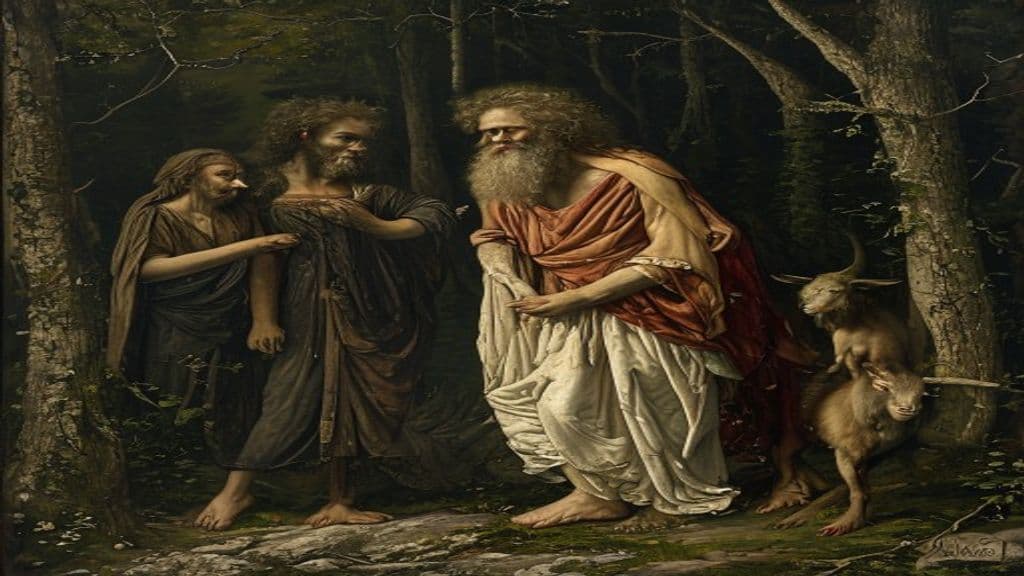
The term dusios (plural dusii/dusioi) appears in late‑antique Latin texts as a Gaulish name for a class of rustic, fertility‑related spirits. Christian authors (notably Augustine and Isidore) identify them with the Greek Pans and Roman Fauni/Inui/Silvani and reinterpret them as incubi or demonic seducers. Medieval hagiographic sources (e.g., the Life of St. Richarius) place beings called dusii or related names among aerial, crop‑raiding powers. Etymological proposals recorded in the sources include Isidore's medieval gloss linking the name to Latin adsidue ('persistently'), and modern scholarly suggestions of cognates with Baltic words for 'spirit/phantom' or 'vapor' (Lithuanian dvãse, dùsas), Breton duz, or links to roots for ecstatic fury; these proposals are discussed in secondary summaries rather than attested origin myths.
Late‑antique descriptions associate dusii by analogy with Pan and Faunus — traditionally hairy, rustic, and goat‑linked — and Isidore explicitly groups them among the 'hairy ones' (pilosi). Augustine reports that such beings have 'often appeared to women as wicked men,' indicating they can assume human male guise. Textual evidence emphasizes ambiguity: they are described as 'aerial in substance' yet capable of taking bodily form, so accounts vary between bestial/Pan‑like imagery and reports of human‑appearing seducers.
Sources attribute to the dusii sexual interaction with humans (notably nocturnal intercourse with women) and with animals (paralleling Faunus/Inuus' power to fertilize livestock). Augustine and Isidore stress persistent seduction and nocturnal visitations (the Christian authors render them as incubi). Hagiography and medieval compilations place them among aerial crop‑raiders that steal or damage orchards and fields (cf. the Life of St. Richarius and Magonian/mane traditions). The fig/faun material (Papias/Pliny summaries) presents an image of 'figgy fauns' and 'ficarii' whose swarming, serial acts of fertilization have been used to interpret dusii as potentially multiple, swarm‑like actors; Augustine's remark that they are 'aerial in substance' and yet can take form underpins accounts of mobility and atmospheric habitation.
Weaknesses
- otherChristian doctrinal/exorcistic response
Wards
- ritualInvocation of Christian authority (prayer/exorcism/saintly intervention)

Faunus
Faunus is an ancient Roman rustic deity and tutelary nature god of forests, plains, and fields, protector of agriculture and cattle. He functions as an oracular and fertility power, head of a plurality of lesser fauni (place-spirits), and was celebrated in festivals such as the Faunalia and associated with the Lupercalia rites.
Incubus (Jewish Tradition)
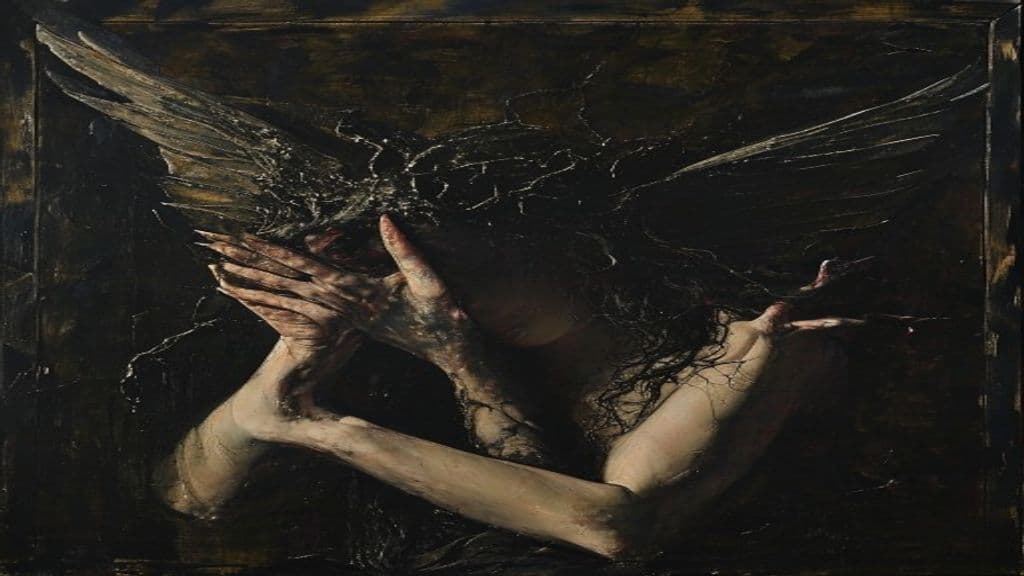
A male demon that preys on female humans in their dreams, seducing them and leading to physical interactions. (Note: 1. Power tier should be Primordial (cosmic) is too high; a more fitting power tier would be Greater (deity-level), given its ability to manipulate humans' dreams and lead to physical interactions. 2. )

Manes
In ancient Roman religion the Manes (Latin: mānēs) are a collective class of chthonic divine dead — the subterranean spirits of deceased persons — who are propitiated in household, funerary, and civic rites (e.g., Parentalia, Feralia, and foundation rites involving the lapis manalis). They appear in inscriptions (D.M., Dis Manibus) and literary commentary as an institutionalized category of the dead rather than as a single named being.
Durgamasura
An asura king in Hindu mythology, often depicted as powerful and malevolent, who engages in struggles against the gods. (Note: - Summary: accurate - Power tier: Greater (as a powerful regional being, lower than Primordial) - Abilities: too vague; needs more specific details on what abilities are associated with Durgamasura in)
Durgasur
Durgasur (also Durgama or Durgamasura) is an asura king in Hindu mythic narratives whose threat to cosmic order is answered by the mother‑goddess Durga (and in some variants other forms such as Shakambhari or Kalaratri). His defeat is invoked in multiple sources to explain aspects of the goddess’s name and cultic authority.
Durinn
Durinn is an early named dwarf (Old Norse: dvergr) attested in the medieval Norse corpus; counted as the second-created dwarf after Mótsognir and associated in saga tradition with exceptional smithcraft, including a role in forging the magic sword Tyrfing.
Durukti
In Hindu mythology, Durukti is the sister and wife of the asura Kali, associated with the complexities of human society. (Note: * The power tier is likely incorrect, considering Durukti's association with an asura (a type of demonic being) but not explicitly described as cosmic or deity-level. * Appearance and abilities are mi)
Dushana
Dushana is a named rakshasa (demon) attested in Ramayana-cycle materials as one of the forest chiefs allied to Khara and counted among Ravana's kin; he is reported slain in encounters with Rama's party during the exile (Aranya/Panchavati episodes).
Dushara
Dushara is a principal pre-Islamic Nabataean deity, venerated as a city and mountain-linked patron god (notably of Petra and Hegra). Represented commonly by aniconic stone symbols, he was the focus of petitionary cult practice (notably animal sacrifice) and was syncretized by classical authors with Greco‑Roman gods.
Duwende
A Filipino folkloric small humanoid being described in source materials as 'smaller people'—normal-looking humans of miniature stature—often compared in English-language descriptions to elves or leprechauns.
Duzakh
In Persian mythology, Duzakh is a place of punishment and suffering in the afterlife. (Note: 1. Power tier should be adjusted to "Lesser" as Duzakh is a specific place of punishment, not a cosmic entity. 2. The origin story and appearance are missing. 3. Abilities could be more specific about)
Dvalinn
Dvalinn is an Old Norse mythic name attested in the Poetic Edda and several sagas applied to at least two distinct figures: a named dwarf among the dwarf-kind (craftsman, rune‑figure, leader in some lists) and one of the four harts/stags that feed among the branches of the world‑tree Yggdrasill. The corpus does not reconcile these uses of the same name into a single coherent biography.
Dvipa (Hindu)
In Hindu tradition, a Dvipa is one of seven islands or continents surrounding an ocean within the multicontinental model of the universe. (Note: 1. Power tier should be "Ancient" as Dvipas are described as part of a multicontinental model and regions of the cosmos, suggesting they have deity-level power. 2. Origin story is accurate but could b)
Dwarf (folklore)
A type of supernatural, human-shaped being in Germanic tradition associated with subterranean places, craft (notably metalwork), and a liminal role between nature and culture. In Norse mythic sources dwarfs function as artisan-makers of powerful objects for gods and occasionally appear in folktales as magical servants bound to objects.
Dwarves (Middle-earth)
A distinct, long-lived mortal people of J. R. R. Tolkien's legendarium, created by the Vala Aulë, famed for subterranean dwelling, exceptional craft and masonry, and martial stubbornness. They play a persistent cultural and historical role across the Ages of Middle-earth, notably as miners, smiths, and builders of great halls and treasures.
Community Record
- [1]The Gauls and Their Demons (St. Augustine). Augustine, as cited in provided notes (discussion of Silvani, Pans, incubi; 'aerial in substance' quote).literary
- [2]Isidore (Etymologies) — references in supplied notes. Isidore's gloss grouping 'pilosi' with Pans, Incubi, Inui and reporting the Gaulish name 'Dusii' with etymologizing comment ('they seduce relentlessly'), as summarized on the Wikipedia entry provided.wiki
- [3]Dusios — Wikipedia. Summary article compiling primary quotations and scholarly discussion on dusii, Papias/Pliny fig/faun material, Life of St. Richarius, and etymological proposals (source of synthesized notes).wiki
- [4]Life of St. Richarius (vita) — summary in supplied notes. Eighth‑century hagiographic vita cited in the summary as recording dusii (hemaones/manes in some recensions) stealing crops and damaging orchards.literary
- [5]Papias / Pliny material on fig‑fauns (as summarized). Summarized references to Papias and Pliny connecting 'ficarii' (fig‑flies) and caprificus to 'figgy fauns' and to swarming, serial fertilization used in comparative discussion of dusii.wiki