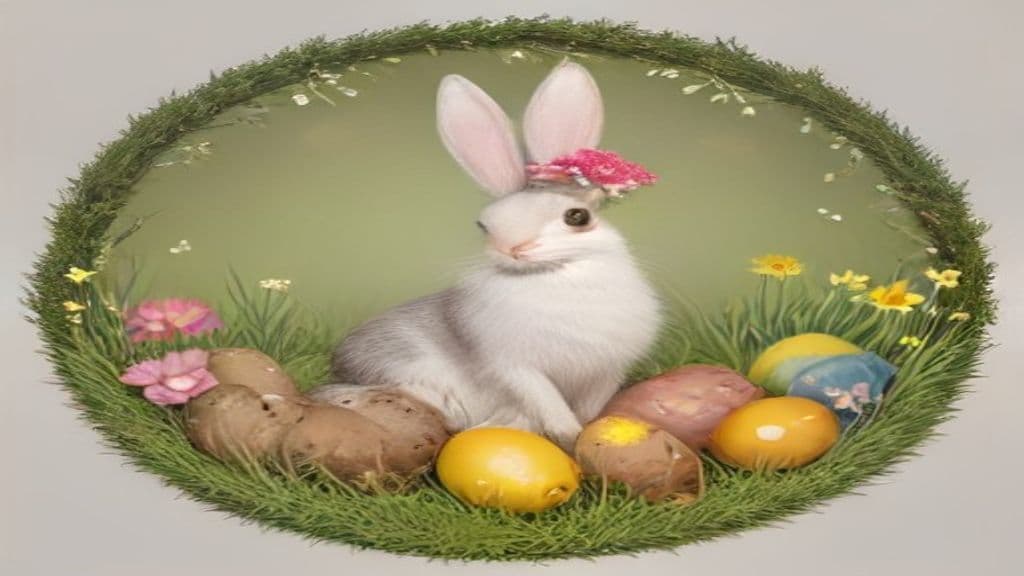
The Easter Hare tradition is first attested in southwest Germany in the 17th century (recorded in De ovis paschalibus by Georg Franck von Franckenau in 1678) and developed among German Lutheran popular custom as a domestic seasonal figure that delivered colored eggs to children. The Pennsylvania Dutch name Osterhase (Oschter Haws) and associated nest-making custom were carried to the United States by German immigrants in the 18th century. Later popular and commercial print culture in the 19th century expanded the figure's visual and material presence. Claims that the hare is sacred to the Anglo-Saxon goddess Ēostre or that the tradition derives directly from pre-Christian cult are presented in later popular accounts but are explicitly contested in scholarly sources; Bede himself does not link Ēostre with any animal and there is no solid evidence for a direct pre-Christian liturgical origin in the provided sources.
Descriptions vary regionally and historically but center on a hare or rabbit figure. Early vernacular references emphasize a hare (German Hase) rather than a tame rabbit; later anglophone usage commonly uses 'bunny' or 'rabbit.' Visual representations from the 19th century onward show variations: an ordinary hare image, an anthropomorphic clothed hare, and a hare carrying a basket of colored eggs. The Easter Hare appears widely in material culture—Easter cards, toys, and children's books—without a single canonical look; depictions range from naturalistic hare imagery to fully clothed, humanlike figures used in children's media and commercial goods.
In folkloric accounts the Easter Hare's principal behaviors are delivering or hiding colored eggs, candy, and small treats in nests or baskets for children to find at Easter. Early German tradition includes an evaluative role in which the Easter Hare judged whether children had been good or disobedient and distributed eggs accordingly. A longstanding explanatory folk motif recorded in European sources held that hares could lay eggs, an explanatory belief for decorated eggs found in gardens in spring; sources treat this as folk belief rather than biological fact. In practice the figure is credited with the ability to leave or hide eggs overnight or to fill nests prepared by children.

Eacus (God)
Weather god associated with forces of nature in Basque tradition. (Note: * Power tier should be Ancient, not Primordial, as Eacus is described as a specific god associated with a particular region (Iberian Spain) rather than a cosmic entity. * The article should indicate t)
Eadgils (Aðils / Adils)
Eadgils is a semi-legendary 6th-century Swedish king of the Yngling/Skilfing dynasty attested in Old Norse skaldic poetry and sagas and in the Anglo-Saxon epic Beowulf. Sources present him as a dynastic figure whose exile, restoration, and conflicts (notably with Onela/Áli and later associations with Hrólfr Kraki) explain succession and inter-kingdom violence; he is treated as a mortal ruler rather than a supernatural being.
Eagle (Middle-earth)
In J. R. R. Tolkien’s legendarium, the Eagles or Great Eagles are exceptionally large avian beings depicted as more than ordinary animals: described in some sources as 'spirits in the shape of hawks and eagles,' they act with intelligence and occasional independent agency, intervening episodically in key events as rescuers or omens.
Eanmund
Eanmund is a semi-legendary Swedish prince of the Scylfing dynasty attested in the Old English epic Beowulf. Portrayed as a mortal claimant to the Swedish throne whose exile and death precipitate inter-kingdom conflict and later vengeance by his brother Eadgils, he functions as a genealogical and political figure within the Scandinavian heroic cycle rather than a supernatural being.
Earth Mother
An archetypal mother-goddess category personifying the earth, nature, fertility, and life-giving forces; presented in comparative sources as a generative, sustaining cosmological figure often paired with a complementary sky/father principle and invoked in both ancient mythic frameworks and contemporary political-environmental discourse.
Earth deity
An earth deity is the personification or deification of the Earth in a culture's cosmology, often tied to fertility, the ground/land, chthonic or underworld aspects, and communal protection of territory or Dharma. Specific named examples include Papa (Polynesian/Maori), Geb (ancient Egyptian), and Prithivi (in Buddhist textual contexts).
Easter witch (påskkärring / påskhäxa / trulli)
A Swedish and Finnish folkloric figure of an old-woman witch associated with Holy Week who, in traditional belief, flies on brooms to a diabolic gathering at Blåkulla/Blockula on Maundy Thursday and returns at Easter; in modern practice the image has become a benign costume tradition in which children dress as witches to go door-to-door for greetings and treats.
Eate, Storm God in Basque Tradition
Eate is a storm god worshipped by the ancient Basques, associated with powerful weather events and control over fire and ice. (Note: - Power tier should be Ancient, as the source describes Eate as a "storm god", implying a more deity-level power. - Abilities: add "possibly" is unnecessary; rephrase to make it clear that control ove)
Ebu Gogo
A set of small humanlike beings in the oral tradition of the Nage people of central Flores, Indonesia, remembered in village tales as short, hairy, gluttonous dwellers of caves and forests who interacted with humans in ancestral times. Some researchers have hypothesized a link between these tales and the fossil hominin Homo floresiensis, but that connection is debated.
Ecbasus
Ecbasus (Greek: Έκβασος) is a minor figure in Greek mythic genealogies, presented as a son of Argus and an ancestor within the ruling houses of Argos. He functions primarily as a connective ancestral link between better-known mythic figures (Argus, Agenor, Argus Panoptes, Pelasgus) rather than as an active heroic or supernatural agent.
Ece
Ece is documented in the provided sources primarily as a Turkish feminine personal name meaning "queen." A single cross-reference in the material links the name to Umay (noting Umay is "also known as Ece"), but the supplied sources do not provide mythic narratives, attributes, or rituals for a supernatural entity called Ece.
Ecgþēow
Ecgþēow is a human figure in the Old English poem Beowulf, presented as the father of the hero Beowulf and a member of the Wægmundings. He functions in the poem as an exemplar of warrior status, kin obligations, and the social mechanisms (wergild, exile, fosterage, and oath‑bonding) that settle blood‑feuds and create inter‑household loyalties.
Community Record
- [1]Easter Bunny. Wikipedia, 'Easter Bunny' entry (selected excerpts provided in research notes).wiki
- [2]De ovis paschalibus (About Easter Eggs) — Georg Franck von Franckenau (1678) (referenced). Historical attestation cited in secondary source (Wikipedia) referencing Georg Franck von Franckenau's 1678 De ovis paschalibus as earliest attestation in southwest Germany.other
- [3]Archival examples of modern cultural uses (event listings and media). Archive.org listing: 'Easter Brunch With The Bunny' (example of contemporary cultural usage noted in research notes).other
- [4]Archival example: Marblehead Wolfpack Easter Bunny Dip 2026. Archive.org event listing showing contemporary public use of Easter Bunny motif (cited in research notes).other
- [5]Archival example: Funny or Die Video 'Easter Slumb'. Archive.org comedic video listing cited in research notes as an instance of modern media usage of the Easter Bunny figure.other