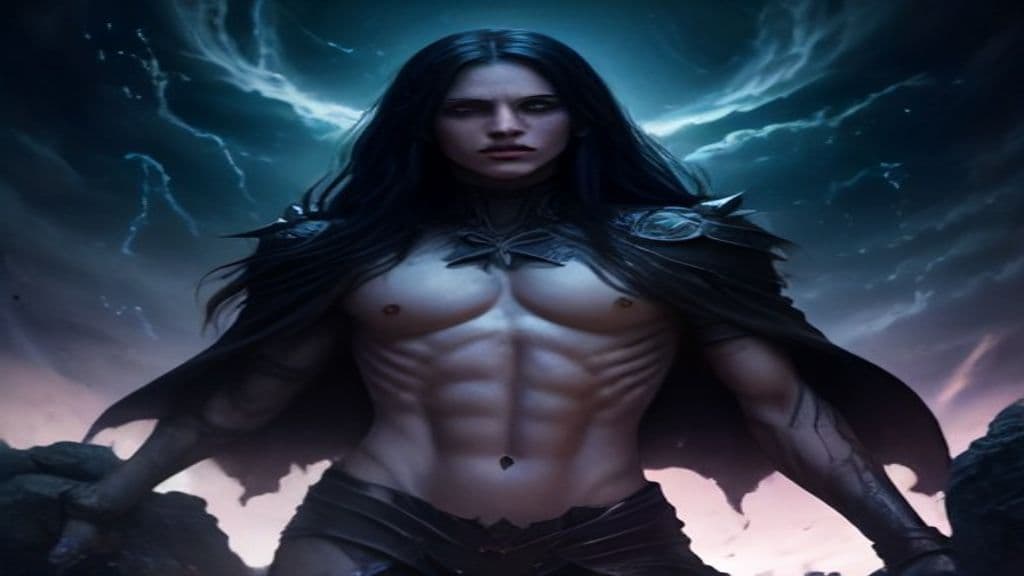
Within Moorcock's fictional cosmology, Erekosë is not an originally independent supernatural being but one face of the Eternal Champion — an archetypal hero who is reincarnated across the Multiverse whenever rare conjunctions of planes or dimensions occur. Role‑playing material summarizing Moorcock's settings describes these awakenings as tied to alignments of the ensemble of planes (“conjonction rare des plans et dimensions”), and the Champion's recurring role is to intervene in decisive conflicts between metaphysical poles (originally Law and Chaos; later formulations introduce a Balance). In the novel The Eternal Champion the mundane man John Daker is presented as an incarnation of that archetype and the name Erekosë is the identity the calling voice gives him.
Sources provide little consistent, detailed physical description specific to the Erekosë incarnation. In published summaries Erekosë functions as the Eternal Champion and, in The Eternal Champion novel, appears as the identity associated with John Daker; Moorecock's broader corpus shows the Champion manifesting in many differing bodies (for example Elric, Corum, Hawkmoon), so physical traits vary by incarnation. The supplied excerpts do not record fixed outward features unique to Erekosë.
Documented attributes in the provided materials emphasize function rather than discrete supernatural powers: Erekosë is a recurrent incarnation of the Eternal Champion who is reborn to play a decisive role in cosmic struggles. The incarnation is summoned or compelled by a calling (a voice that addresses John Daker as Erekosë and which Daker attempts to answer), and the Champion is drawn into conflicts between metaphysical forces (Law vs Chaos, and later Balance). The sources do not enumerate specific magical powers or limits for this named incarnation beyond its participation in the Multiverse's destiny and the compulsive summons that drives it.
Weaknesses
- conditioncompulsion / limited agency (the incarnation feels bound to answer the call)
Wards
None recorded.
Erato
Erato (Ancient Greek: Ἐρατώ) is one of the nine Muses of ancient Greek religion, traditionally associated with erotic lyric poetry and imitation. As a daughter of Zeus and Mnemosyne she functions as a divine inspirer invoked by poets seeking the voice and affect appropriate to love-themed verse.
Erda
Erda is a polyvalent modern name attested in the provided sources with multiple unrelated referents: a toponym (Erda, Utah), a mythic/operatic figure in Richard Wagner’s Der Ring des Nibelungen (linked on a disambiguation page to Urðr and Jörð), a Marvel Comics adaptation of a Wagnerian figure, and several institutional or fandom uses (acronyms, fanwiki entries). The supplied materials do not document a single, continuous folkloric supernatural entity called Erda.
Erdhenne
The Erdhenne (German: 'Earth Hen') is a German house spirit from Alpine, Upper Palatinate, and Bavarian folk tradition that usually remains unseen but communicates by loud clucking to warn households of danger. When it becomes visible it is regarded as an omen of death—tradition records death within a year, often of the person it shows itself to.
Erebus
Erebus (Ancient Greek: Ἔρεβος) is the primordial personification of darkness and gloom in Greek myth and a name used for the subterranean darkness or region of the underworld. He functions both as an originating cosmic principle in several theogonies and as a topographical/ontological term for the darkness through which the dead pass.
Erec
Erec is a human knight of the Round Table in the Arthurian literary tradition, best known as the protagonist of Chrétien de Troyes' romance Erec and Enide. He appears across medieval redactions (Old French, German, Norse, Middle English, and prose cycles) as a heroic figure whose narratives examine knighthood, love, reputation, and encounters with enchantment.
Erechtheus
Erechtheus is a mythic-heroic foundational figure of ancient Athens whose identity blends an autochthonous, earth-born ancestor-king with a localized cultic name often syncretized with Poseidon; he functions as eponymous progenitor of the Erechtheidai and as the focus of ritual memory on the Acropolis (the Erechtheion).
Ereshkigal
Ereshkigal is the Mesopotamian goddess-queen of the netherworld (Kur/Irkalla), portrayed in literary myths as sovereign of the Land of the Dead who judges and controls access to the underworld. She appears prominently in narrative texts (notably the Descent of Inanna and the Nergal marriage myth) though archaeological cult evidence for widespread popular worship is limited.
Ergene İyesi
Ergene İyesi is a Turkic underground protector/guardian spirit of mine pits and subterranean workings, keeper of gems, crystals, and precious metals. It guides and protects respectful miners, warns of danger with cat-like sounds or whistling, and punishes those who insult or offend it.
Erginus
Erginus (Ancient Greek: Ἐργῖνος) is a personal name borne by several distinct mortal figures in Greek myth and later legendary-historical tradition — including a king of the Minyans of Orchomenus, an Argonaut, a Theban defender in the Seven against Thebes cycle, a later descendant of Diomedes associated with stealing the Palladium, and a historical/anecdotal person mentioned in Plutarch's Life of Aratus.
Eriboea
Eriboea is a personal name borne by multiple distinct women in Greek myth (at least three attested in modern compilations). Figures called Eriboea appear as an Amazon, as a foster-mother to the Aloadae in some traditions, and as other minor mythic women connected to heroic cycles rather than as a single supernatural class.
Eric O'Grady
Eric O'Grady is a fictional human character from Marvel Comics who becomes the third individual to use the Ant-Man identity. Introduced in The Irredeemable Ant-Man #1 (2006), he is portrayed as an opportunistic, morally compromised S.H.I.E.L.D. agent who steals Hank Pym's Ant-Man suit; after his death his corpse is used to create a Life Model Decoy that later calls itself Black Ant.
Erichthonius of Athens
Erichthonius is a legendary early ruler and culture-hero of Athens in Greek tradition, credited with civic innovations (notably the quadriga/chariot) and serving as an ancestral figure in Athenian royal genealogies; he is linked to Hephaestus and to Athena and figures in festival memory and art rather than as a malignant supernatural being.
Community Record
- [1]Eternal Champion (Wikipedia). Wikipedia entry, 'Eternal Champion' (summary of Moorcock's recurring archetype and incarnations).wiki
- [2]The Eternal Champion (novel) — Wikipedia. Wikipedia entry for the novel 'The Eternal Champion' noting John Daker and the name Erekosë.wiki
- [3]Stormbringer [JDR FR][PACK] (archive excerpt). French Stormbringer role‑playing text excerpt summarizing the Young Kingdoms cosmology and noting reincarnation on rare conjunctions of planes and the Law vs Chaos framing.other
- [4]Wikiplot synopsis (wikiplot_122) — 'The voice calls him Erekose' quote. Plot synopsis noting that 'The voice calls him Erekose. Daker hears the voice on several other occasions and makes an effort to hear it better and answer its call...'.other
- [5]Phoenix in Obsidian (Wikipedia). Wikipedia page referencing related Eternal Champion works and the broader recurring‑incarnation theme within Moorcock's fiction.wiki