
The category of 'familiar spirit' appears in multiple cultural registers. In English and European early modern contexts it designates spirit helpers attached to witches and cunning folk. In Biblical usage the English phrase translates Hebrew אוֹב (ob), a word glossed in some reference works as applied to necromancers or conjurers who call the dead; that same reference notes אוֹב originally names a leathern bottle or water-skin and was metaphorically applied to a person imagined as a vessel for an inspiring demon. In Islamic/Arab comparative writings the qarīn/qarīna is treated as an attendant companion spirit whose origins 'probably go back' to animistic beliefs in ancient Egypt and Arabia, indicating a long-standing cultural substrate for personal spirit companions.
European early modern accounts report familiars manifesting in numerous forms, most commonly as animals but also sometimes as human or humanoid figures; these apparitions are described as clearly defined, three-dimensional, vivid in colour, movement, and sound, distinguished from the smoky vagueness attributed to ghosts. Biblical references in the supplied materials treat the term more as an occupational designation for conjurers (אוֹב) and do not supply stable visual descriptions of an independent entity. The reviewed discussion of the qarīn in the supplied sources does not give a consistent physical description beyond its status as an attendant spirit.
Across the documented traditions familiars function as personal supernatural aides or intermediaries. In European folklore they are believed to protect and assist witches and cunning folk in magical practice, divination, and spiritual insight. In Biblical contexts the phrase 'familiar spirit' describes practitioners who profess to call up the dead to answer questions (i.e., necromantic mediators). Comparative Islamic/animistic discussion regards the qarīn as an attendant companion spirit, part of an animistic taxonomy of personal spirit allies. The supplied sources emphasize their role as mediators of knowledge, guidance, or power rather than as purely abstract forces.
Weaknesses
- conditionscriptural/ethical prohibition (targets practitioners rather than spirit)
Wards
- ritualavoidance and condemnation per scriptural injunctions against necromancy
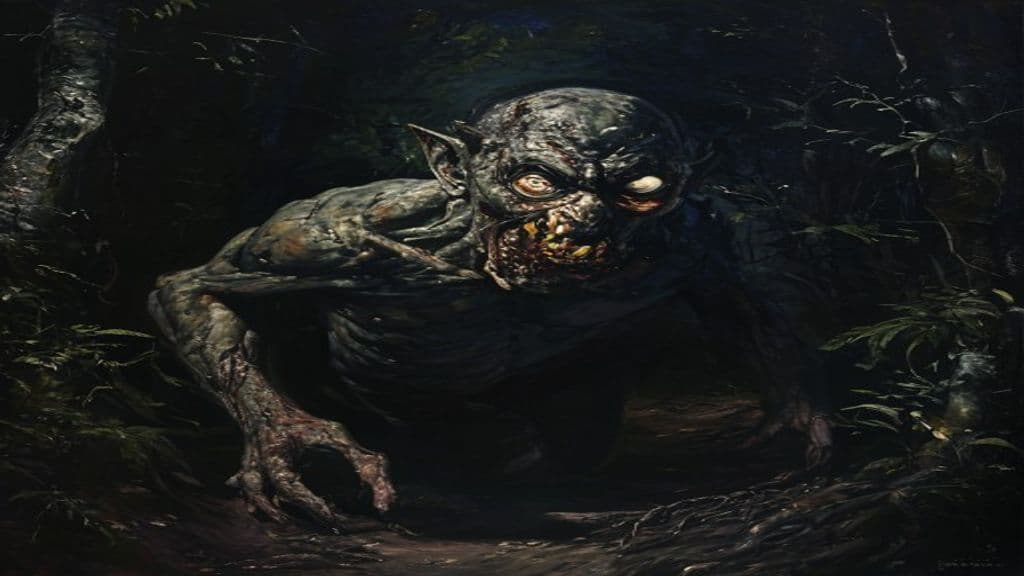
Pishacha
Flesh-eating spirits of Hindu mythology that haunt cremation grounds and are associated with disease, madness, and possession. The lowest class of demon in the Vedic hierarchy.
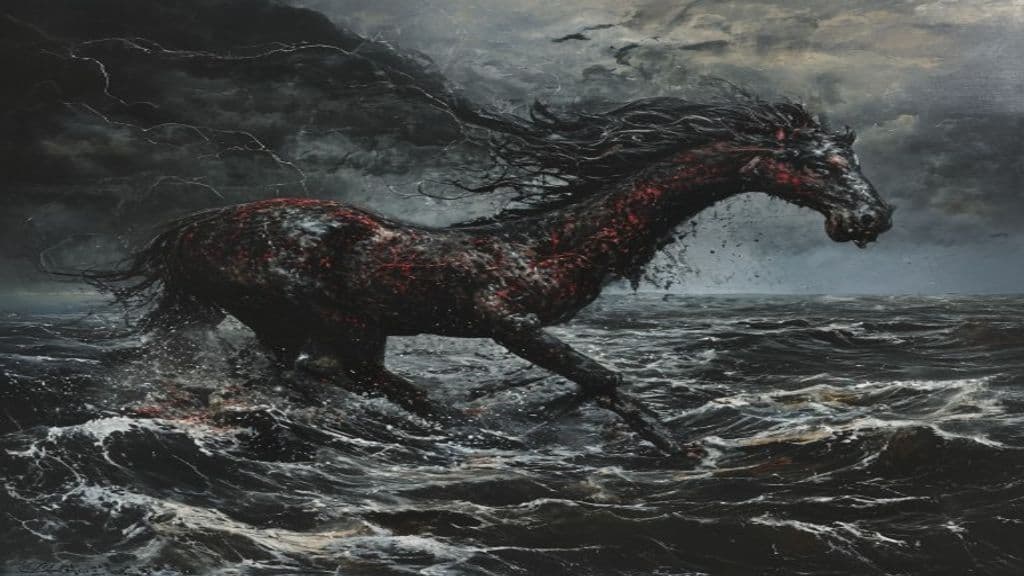
Nuckelavee
The most terrifying creature of Orcadian folklore — a skinless, horse-headed demon of the sea whose breath spreads plague and whose presence causes crops to wither. It cannot cross fresh water.
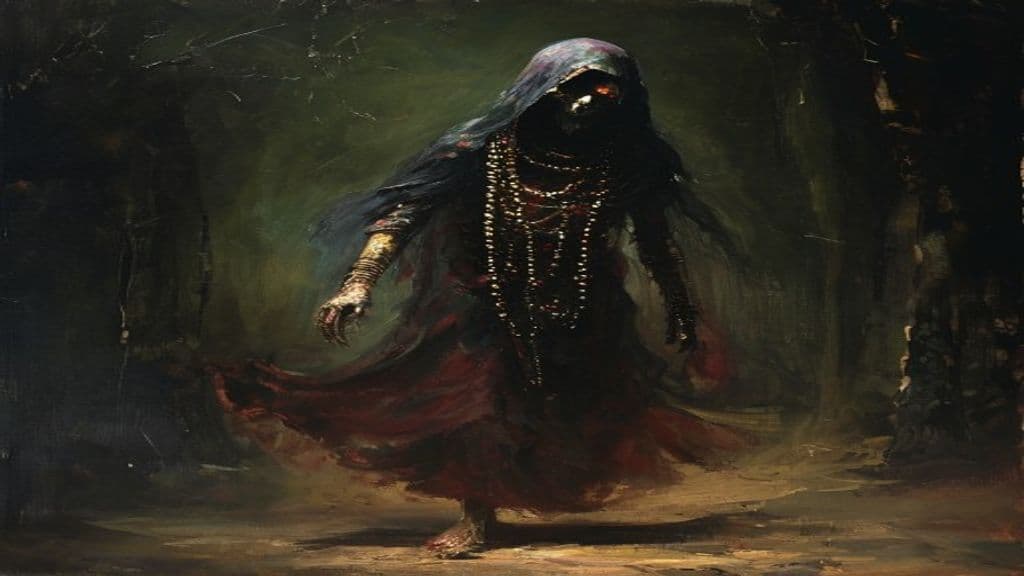
Bhoot (bhoota)
A bhoot (also bhoota, bhoot, bhut) is the culturally specific term across parts of the Indian subcontinent for a perturbed, restless spirit generally understood to be the ghost of a deceased person. Sources describe bhoots as arising when a person's death or post-death circumstances prevent them from moving on — for example violent death, unresolved affairs, or failures in funerary rites — and the term appears frequently in modern South Asian media and discussions.
Fairy Queen
A female sovereign figure who rules over fairies or fairy courts across diverse folkloric and literary traditions. Depictions range from benevolent and gift-giving to ambivalent or dangerous; she appears both as a local hill-associated ruler in Celtic traditions and as a literary sovereign in Continental and English writings.
Fakafifine
Fakafifine is a Niuean, culturally specific gender category referring to people assigned male at birth who adopt a feminine gender expression and who are understood within Niuean culture as occupying a third gender role. The term is used in contemporary social, cultural, and activist contexts in Niue and Niuean diaspora communities.
Fakaleitī
A culturally specific Tongan gender category for persons assigned male at birth who express feminine gender identity and/or take on feminine social roles. Fakaleitī occupy family, social, entertainment, and community-organizing roles within Tonga and are framed in scholarly literature as a regional indigenous gender category rather than a supernatural being.
Falak
Falak is an enormous serpent in Arabian legendary material, described in summaries of One Thousand and One Nights and popular treatments of Islamic folk cosmology as dwelling beneath other cosmic animals (notably Bahamut) and forming part of a layered under‑cosmos. Sources present Falak as a terrifying, foundational monstrous presence rather than a discrete heroic or moral agent.
Falhófnir
Falhófnir is a named horse in Old Norse sources listed among the steeds ridden by the Æsir when they go to make judgments at Yggdrasil. The name is glossed as "pale-hoofed" or "the one with the fallow hooves," but the surviving sources preserve only roster-like attestations rather than a narrative or cultic role.
Fallen angel
A heavenly being expelled from the divine court for transgression; a cosmological status found in Second Temple Jewish, Christian and contested Islamic materials. In Enochic literature the Watchers descend to earth, corrupt humans and transmit forbidden knowledge; later Christian theology uses the motif to explain the origin of moral evil.
Family Trees of the Norse Gods
The complex relationships between Norse gods, as portrayed in the Eddas and other sources, reveal a network of family ties and kin connections that shape their interactions and powers. (Note: 1. Power tier should be Primordial (too general) -> change to Ancient=deity-level. 2. The statement that no sensory cues are explicitly described in the source material is misleading, as it implies no)
Fand
Fand is an otherworldly female figure from early Irish tradition associated with the sea and an Otherworld island. In the Ulster Cycle tale Serglige Con Culainn she appears as an enchanted sea-bird and later as an Otherworld woman who both afflicts and heals the hero Cúchulainn; she is portrayed as wife of the sea-lord Manannán in that narrative and as part of a network of sea/Otherworld women in Irish myth.
Far darrig (fear dearg)
A solitary Irish faerie-class trickster traditionally called fear dearg ('Red Man'), the far darrig is noted for practical—and sometimes gruesome—jokes, a reputed connection to changelings and nightmares, and a characteristic red coat and cap. Accounts portray it as an ambivalent domestic/liminal being that can bring good luck if placated but imaginative punishments if offended.
Faramarz
Heroic figure in Persian epic tradition, son of Rustam and protagonist of the Faramarz-nama. (Note: - Power tier: Lower, based on source material (heroic figure, son of Rustam), should be at least Greater=powerful regional spirit - Origin story: Only mentions relationship to Rustam, no Primordial or)
Faramir
Faramir is a fictional human noble of J. R. R. Tolkien's legendarium: younger son of Denethor II, brother of Boromir, captain of Gondor who commands forces in the War of the Ring, later Steward under King Aragorn. He is notable for resisting the temptation of the One Ring and for being healed by Aragorn with athelas in the Houses of Healing.
Farangis
Farangis is a human literary character in the Persian epic the Shahnameh: the eldest daughter of Afrasiab of Turan, the second and favourite wife of the Iranian prince Siyâvash, and the mother of the hero and later king Kai Khosrow. Her role in the epic is genealogical and political, marked by loyalty, mourning, and participation in dynastic succession.
Community Record
- [1]Familiar. Wikipedia, 'Familiar' (summary of European medieval and early modern folklore describing familiars as supernatural entities assisting witches and cunning folk)wiki
- [2]Familiar Spirit - Biblical Cyclopedia. Biblical Cyclopedia entry 'Familiar Spirit' (glosses Hebrew אוֹב (ob), treats the term as applied to necromancers/conjurers who call the dead; notes metaphor of leathern bottle/vessel)other
- [3]The Influence of Animism on Islam — Chapter VI: THE FAMILIAR SPIRIT OR QARINA. Zwemer, chapter on animism in Islam discussing the qarīn/qarīna as an attendant companion spirit and arguing it 'probably goes back' to ancient Egyptian or Arabian animistic beliefsacademic
- [4]Cunning Folk and Familiar Spirits. Wikipedia entry referencing studies of early modern British cunning folk and their familiar spirits (contextual study title cited in the research notes)wiki
- [5]What is meant by 'familiar spirits' in Isaiah 19:3, 29:4?. Hermeneutics StackExchange discussion (interprets biblical usage and scriptural context where familiar spirits are condemned alongside idols and charmers)other
- [6]MOODY MANUAL - FAMILIAR SPIRITS AND SPIRITS OF IDOLATRY. Polemical Christian manual referencing biblical passages and framing confession/repentance as defenses; included in supplied materials as an interpretive source on scriptural responses to familiar spiritsother