
No narrated origin story for Hanbi survives in the provided material. The attestation available in modern summaries is classificatory: Hanbi appears chiefly as a named progenitor or senior authority within Mesopotamian taxonomy of harmful entities (Udug), most notably identified as the father of the spirit Pazuzu. Because references are brief and genealogical rather than narrative, scholars infer Hanbi's role as a patriarchal or umbrella figure for a class of evil forces, but the primary cuneiform evidence for any fuller origin narrative is not supplied in the provided sources.
The supplied sources do not preserve an authoritative physical description of Hanbi. Modern secondary commentary includes the phrase "a shadow born in the underworld," but this wording appears in interpretive comparisons made by later authors and is not established as a primary, contemporary depiction from Mesopotamian texts. Therefore the only available appearance-note is that there is no detailed, primary-source account of Hanbi's form in the provided material.
In the available summaries Hanbi's functional attribute is classificatory and authoritative: he is described as "the lord of evil" and "lord of all evil forces (Udug)." He is also named as the father of Pazuzu, which situates him within a generational hierarchy of harmful spirits. Beyond these taxonomic statements, the provided sources do not describe particular acts, specific powers, interactions with humans, or narrative deeds attributed to Hanbi.
Weaknesses
- othernot attested in provided sources
Wards
- othernot attested in provided sources
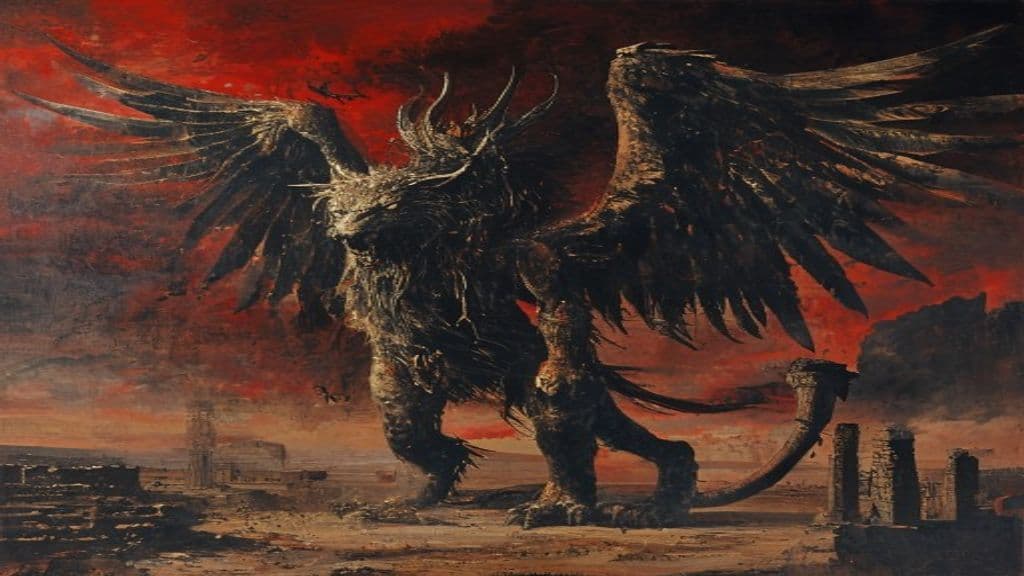
Pazuzu
The king of the wind demons of ancient Mesopotamia, lord of the southwest wind — paradoxically invoked as a protector against Lamashtu and other demons despite being evil himself.
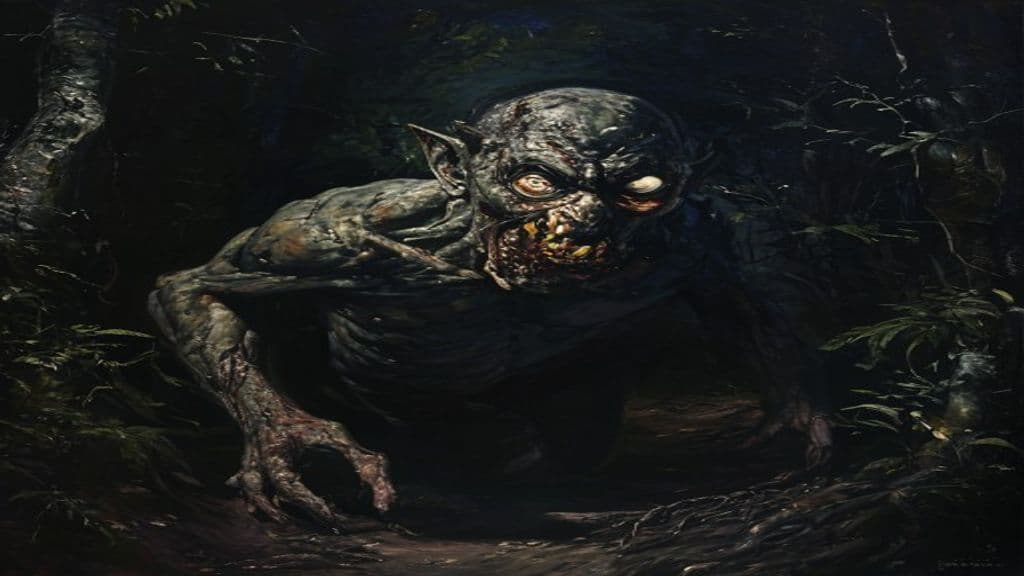
Pishacha
Flesh-eating spirits of Hindu mythology that haunt cremation grounds and are associated with disease, madness, and possession. The lowest class of demon in the Vedic hierarchy.
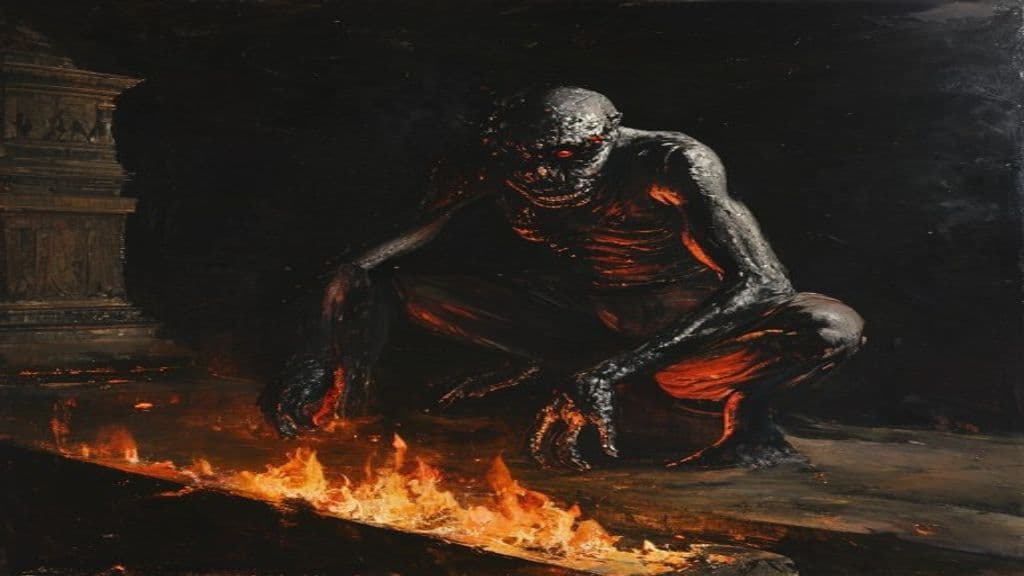
Pishach
Among the oldest classified demon-types in Hindu tradition — flesh-eating entities of the cremation ground first named in the Atharva Veda. The Pishach inhabits fresh corpses and possesses the living, causing the specific Ayurvedic condition of 'pishachabadha': madness, speaking in unknown languages, consuming impure things.
'Ain Samiya Goblet
Silver cup from the Middle Bronze Age I, discovered in a tomb at Ain Samiya. (Note: 1. Power tier should be "None", but add a note explaining that historical artifacts don't fit into the typical power tier classification. 2. Add a description of its appearance based on it being a sil)
Adapa
Adapa is a mythic figure from ancient Mesopotamian (Sumerian and Akkadian) literature: a mortal fisherman and temple sage of Ea at Eridu endowed with exceptional wisdom. He appears in a fragmentary tale in which he breaks the wings of the south wind and is summoned to the divine court; his name was later invoked in exorcistic and ritual contexts as an authoritative identity.
Aga of Kish
Aga of Kish (Aga, Agga, Akka) is an Early Dynastic Mesopotamian king recorded in the Sumerian King List, the Tummal Inscription, epigraphic objects, and the Sumerian poem "Gilgamesh and Aga." He functions in texts as a historical/legendary political actor who attempted hegemonic demands on Uruk and was ultimately captured and released by Gilgamesh.
Akhkhazu
Akhkhazu (also Ahhazu; Sumerian Dimme-kur) is an Akkadian-era Mesopotamian malignant spirit described as a demon of jaundice who 'seizes' victims, brings fever and plagues, and is cited in later summaries as one member of a triad with Labasu and Labartu. Later popular summaries also describe her as preying on nursing infants while mothers slept.
Alalu
Alalu (also Alala/Alal) is a primordial, ancestral god attested in Mesopotamian, Hurrian and Hittite sources. He appears in genealogical lists as an early progenitor of later sky-gods and in Hurrian myth (the Kumarbi Cycle) as a former 'king in heaven' overthrown and forced to flee to the underworld.
Alulim
Alulim is the legendary antediluvian 'first king' of Eridu in Mesopotamian tradition, presented in king lists and mythic compositions as the initial ruler appointed by the gods. He functions etiologically to explain the origin of kingship and, in late ritual texts, is invoked in agricultural incantations associated with driving off field pests.
Alû (Alu)
A named lemma attested in modern reference lists as 'ALU / Alu', but for which the supplied research corpus contains no substantive primary- or secondary-source information about nature, appearance, powers, or rituals in Mesopotamian tradition.
Amurru (Martu)
Amurru, Sumerian Martu, is a Mesopotamian deity who functions as the divine personification of the Amorites. Originating in Mesopotamian textual practice, he is associated with the steppe and mountains, depicted with a crooked staff, portrayed in hymnography as warlike and lightning-armed, and from the Old Babylonian period acquires a prominent exorcistic cultic role.
Ancestors of Enlil (Enki-Ninki deities)
A sequence of Sumerian divine pairs (en-/nin- names) conceived as the primordial ancestors culminating in Enlil; chiefly attested in god lists and invoked as authoritative primordial names in ritual, especially in incantations and exorcisms.
Anshar
Anshar is a Mesopotamian primordial deity whose name (Cuneiform AN.ŠÁR) literally means "whole sky" or "the whole heaven." He functions as an abstract ancestral figure in theogonic genealogies (not actively worshiped as a regular cult deity) and appears in literary contexts—most notably the Enūma Eliš—and in god lists where he legitimizes later supreme gods.
Anu
Anu (Sumerian An; Akkadian Anu/Anum) is the divine personification of the sky in ancient Mesopotamian religion, traditionally ranked at the top of god‑lists as the source of heavenly authority (anûtu/anuti) and the fount of legitimate rule for gods and kings. Though supreme in genealogies and astronomical schema, many periods portray him as a relatively passive or figurehead deity whose active cultic role is limited until a late Seleucid reinvention in Uruk.
Anunnaki
A variable collective of major deities in ancient Sumerian, Akkadian, Assyrian and Babylonian religious literature, described as offspring or descendants linked to the sky god An (Anu) and an earth/mother figure (Ki/Ninhursag). Texts portray them as participants in the divine assembly, decreers of human fate, and in some traditions a group of seven underworld judges; their number, membership, and functions vary across sources.
Community Record
- [1]Hanbi. Wikipedia contributors. "Hanbi." Wikipedia, The Free Encyclopedia.wiki
- [2]HanbitSoft (Wikidata entry — unrelated company). Wikidata entry Q5646973 (HanbitSoft). Included here to note a similarly named modern entity; not a source on the mythological figure.other
- [3]Archive: Childhood's End, Bohemian Grove and the return of the Giant Atlanteans (video). Archive.org upload referencing a public video (included among provided materials); does not supply primary Mesopotamian textual evidence about Hanbi.other
- [4]Archive: TRYWIALIZACJA HOLOCAUSTU ... (video). Archive.org upload (included among provided materials); not a primary source on Hanbi.other