
Daughter of King Cepheus and Queen Cassiopeia of Aethiopia, Andromeda becomes embroiled in divine punishment after Cassiopeia boasts against the Nereids. To appease Poseidon—who sends a flood and the sea monster Cetus—the oracle of Ammon decrees that Andromeda be exposed as a human sacrifice, chained to a rock by the sea. Perseus arrives after slaying Medusa, rescues Andromeda (using either his sword or Medusa's petrifying head according to variant traditions), and marries her; in some accounts Athena later sets her among the stars as the constellation Andromeda.
Classical sources present Andromeda as a royal daughter and sacrificial victim, depicted in narrative and visual tradition as stripped and bound with limbs outstretched on a coastal rock. Ancient texts do not provide a detailed physical description of face, complexion, or costume in the supplied sources; later artistic traditions commonly render her in the chained, outstretched rescue posture, and the Catasterismi explicitly notes a constellation pose resembling her bound posture.
Andromeda is portrayed as a mortal without supernatural powers; her role is narrative and passive—victim, bride, and bearer of offspring in some accounts. Her story functions to occasion the actions of divine and heroic agents (Poseidon's punishment, the oracle's decree, Cetus's threat, and Perseus's rescue using Medusa's head or martial prowess). Her posthumous-catasteristic placement in the sky gives her an immortalized commemorative status but not active power in the provided sources.
Weaknesses
- conditionmortal vulnerability
Wards
- otherheroic intervention (Perseus with sword / Medusa's head)
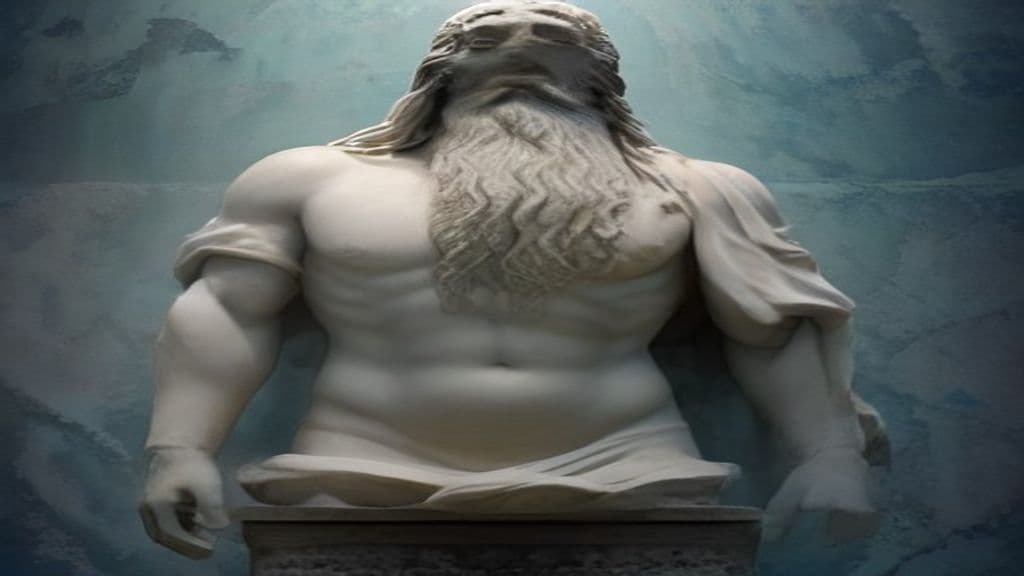
Poseidon
Poseidon is a principal deity of the ancient Greek pantheon, counted among the Twelve Olympians; he presides over the sea, storms, earthquakes and horses and functions as protector of seafarers and guardian of cities and colonies.

Athena
Athena is a major ancient Greek goddess associated with wisdom, handicraft (notably weaving), and warfare; she serves as a tutelary protector of cities—most prominently Athens—and is central to myth, cult, and civic identity in the Greek world.

Medusa (the Gorgon)
Medusa, also called Gorgo or the Gorgon, is one of the three Gorgons in ancient Greek mythology. She is described as a mortal woman whose hair is composed of living snakes and whose gaze turns onlookers to stone; she is usually named as a daughter of the sea-associated figures Phorcys and Ceto and sister to Euryale and Stheno.
Aconteus
Aconteus (Ancient Greek: Ἀκόντιος, Akóntios, lit. 'javelin') is a personal name borne by several distinct mortal figures in Greek myth: an Ethiopian chief turned to stone by Medusa's head at Cepheus' court, an Arcadian warrior killed in the Seven against Thebes, and Acontius of Ceos who used a trick with an apple to secure marriage to Cydippe. The name functions as a human actor across heroic-age narratives rather than a single supernatural class.
Amphitrite
Amphitrite is an ancient Greek sea-divinity, queen of the sea and consort of the sea-god Poseidon; in poetry her name is often used metonymically for the sea itself. She is counted among the daughters of Nereus and Doris in Hesiod and in some accounts is also listed among the Oceanids, and appears chiefly in mythic narrative and iconography rather than as an independent civic cult figure.
Ceto
Ceto (Ancient Greek: Κητώ, Kētṓ) is a primordial sea goddess in Greek mythic cosmology, daughter of Pontus and Gaia, primarily notable as the maternal progenitor of various named monstrous beings (e.g., the Graeae and Gorgons) by Phorcys. Her name is etymologically linked to the common Greek term for sea-monster (kētos), and she functions chiefly as a genealogical and cosmological figure rather than an active, individualized actor in surviving narratives.
Cyrene
Cyrene is an eponymous ancient Greek mythological heroine associated with the North African city of Cyrene and remembered chiefly as a mortal lover of the god Apollo and as an aetiological figure whose name is applied to place and artistic types in Greco-Roman culture.
Euphemus
Euphemus is a hero of ancient Greek mythic tradition, often counted among the Argonauts and Calydonian hunters, commonly described as a son of Poseidon and associated with seafaring, a miraculous clod-of-earth episode, and the foundation-ancestry of colonies such as Thera and Cyrene.
Heliades
In Greek myth, the Heliades are the daughters of the sun-god Helios (by the Oceanid Clymene) whose intense mourning for their brother Phaëthon leads to their metamorphosis into poplar trees; their tears are said in the tradition to become amber.
Hyades
A sisterhood of mythic figures in ancient Greek tradition identified with an open star cluster in the constellation Taurus; popularly called 'the rainy ones' because their seasonal risings and settings were associated with rain and the rainy season. They appear in myth as nurses/escorts (notably caring for the infant Dionysus) and in astronomy as the Hyades star cluster.
Lamia
In ancient Greek mythology, Lamia is described as a child-eating monster who, in later tradition, came to be regarded as a type of night-haunting spirit or 'daimon'. The supplied sources do not provide a full physical description or detailed mythic genealogy, and some modern fictional portrayals recast her with serpentine features which are not attested in the provided classical summary.
Piras
Piras (Ancient Greek: Πειρᾶς) is an Argive king in Greek mythic genealogies, known primarily by name and familial connections rather than by individual deeds or cult. He appears in variant forms (Piren, Peiren, Peirasus, Piranthus) and is attested as a son of Argus and Evadne.
Andromache
Andromache (Ancient Greek Ἀνδρομάχη) is a human figure of ancient Greek literary tradition: the wife of Hector of Troy who exemplifies virtuous fidelity, ritual mourning, and the losses suffered by women in war. She appears in Homeric epic and later classical sources as grieving spouse, captive concubine after Troy's fall, and later queen in post-war narratives.
Andromalius
Andromalius is a named spirit from post-medieval grimoire tradition (Ars Goetia–style catalogues) presented as a ranked officer who recovers stolen goods, exposes thieves and dishonest dealings, and punishes wrongdoers. He appears primarily in modern occult reference compilations derived from the Goetia; ritual details and physical description are not attested in the supplied grimoire excerpts.
Andron
Andron (Ancient Greek: Ἄνδρων) is an ancient Greek personal name attested for multiple historical individuals (writers, a dancer/composer, historians, a sculptor, a physician) in classical biographical and bibliographical sources; it also appears as a modern given name/surname in contemporary records. The provided sources do not present Andron as a supernatural being.
Community Record
- [1]Andromeda (mythology) — Wikipedia. Wikipedia, 'Andromeda (mythology)' article — summary of classical traditions, etymology, catasterism, and reception.wiki
- [2]Clash of the Titans (1981, Full Movie) — Archive. Archive entry noting modern cinematic adaptation and reception of the Perseus–Andromeda story.other
- [3]Perseus & Andromeda (1983 interactive fiction) — Archive. Archive listing documenting late-20th-century interactive adaptations that draw on the classical narrative.other
- [4]The legend of Perseus: a study of tradition in story custom and belief. Scholarly/collected treatment referenced among sources for Perseus–Andromeda tradition and variants.academic
- [5]SkyEye: Andromeda (constellation). Astronomical/constellation reference aligning the mythic catasterism with the Andromeda constellation.other
- [6]Patricia Yaker Ekall — criticism cited in Wikipedia. Mention in Wikipedia of modern critique (Patricia Yaker Ekall) concerning racialized artistic depictions of Andromeda versus classical textual indications.wiki