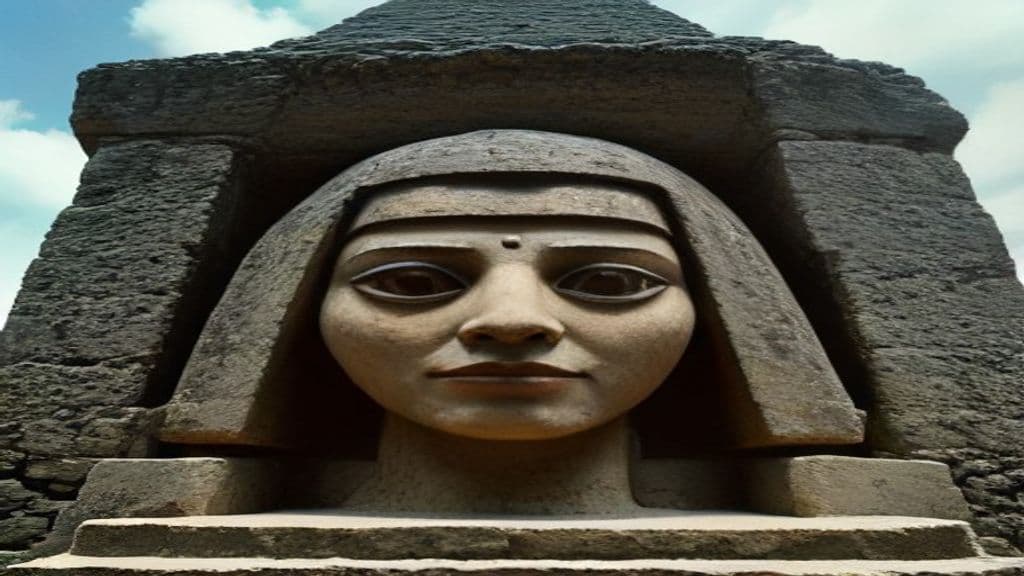
In Kʼicheʼ foundation tradition (as represented in the Popol Vuh and related Kʼicheʼ documents) the first peoples gathered at the mythic Tollan to receive their gods; Mahucutah, one of the gathered Kʼicheʼ lords, received Jacawitz. The deity is integrated into Kʼicheʼ origin and political narratives as a patron of the Ahaw Kʼicheʼ lineage and as part of a triad of principal deities whose reception at foundation places legitimized lineage authority.
No consistent anthropomorphic portrait of Jacawitz is recorded in the supplied sources. Archaeological and historical evidence centers on a temple-pyramid complex at Qʼumarkaj and on symbolic associations (notably a Mam-language cognate meaning 'yellow wasp' that served as an emblem of the deity and its lineage). Any specific bodily description is uncertain in the available material.
Jacawitz is semantically and ritually tied to mountains and to fire (highland Kʼicheʼ qʼaqʼawitz = 'fire mountain'); within Kʼicheʼ cosmology he functions as patron protector of a ruling lineage and as a companion deity to Tohil, sharing foundation and cultic roles within the triad (Tohil–Jacawitz–Awilix). Sources indicate it is likely that Jacawitz received human sacrifice, implying a role as a powerful recipient of costly offerings, but concrete supernatural powers beyond mountain/fire association, lineage patronage, and cultic prominence are not detailed in the provided material.

Camazotz
Camazotz is a bat-associated spirit in Late Post‑Classic Kʼicheʼ Maya narrative (notably the Popol Vuh) and a recurring bat motif in Classic Maya iconography. In the Popol Vuh Camazotz appears as bat-like beings serving the lords of Xibalba who attack the Hero Twins; Classic imagery links leaf‑nosed bats to night, death, disease, and nahual (way‑spirit) functions.
Hun Hunahpu
Hun Hunahpu is a mythic ancestral figure in the Kʼicheʼ Maya Popol Vuh narrative: one of two brothers (with Vucub‑Hunahpu) who were lured into Xibalba, sacrificed, and whose severed head was suspended in a trophy tree and changed to a calabash. The calabash-head's juice impregnates Xquic, producing the Hero Twins (Hunahpu and Xbalanque); later the Twins recover their fathers' remains but cannot fully resuscitate them. Some scholars compare Hun Hunahpu with the Classic-period Tonsured Maize God, though this identification is debated in the sources provided.
Huracán (Hunraqan / U Kʼux Kaj)
Huracán (Mayan: Hunraqan), often rendered in Kʼicheʼ as U Kʼux Kaj ('Heart of Sky'), is a Kʼicheʼ Maya creator deity associated with wind, storm, fire, and lightning. He takes part in the cosmogonic attempts to create humanity and is the agent of the Great Flood who calls land up from the waters.
Maya Hero Twins (Hunahpu and Xbalanque)
Central culture-hero brothers of the Kʼicheʼ Popol Vuh and Classic Maya iconography, Hunahpu and Xbalanque undergo trials, avenge earlier wrongs, defeat the lords of Xibalba by trickery and a ballgame, transform other beings, and are finally transformed into celestial bodies associated with sun and moon. They mediate between human society, the maize cosmos, and the underworld and appear in both colonial textual tradition and Classic Maya art.
Išḫara
Išḫara is a polyvalent ancient Near Eastern goddess first attested at Ebla in the third millennium BCE, later incorporated into Mesopotamian, Hurrian, Hittite and other regional religious traditions. She functioned as a tutelary royal deity, an authority over love and the institution of marriage, an oath- and divination-linked divine figure, and was associated symbolically with reptiles and, in some Mesopotamian contexts, scorpions.
JATO Rocket Car
A modern Anglophone urban legend and meme about a Chevrolet Impala fitted with a JATO unit that achieves extreme speeds and crashes spectacularly; circulated widely on Usenet, email lists, hacker zines, and popular media and subsequently debunked by authorities and experimenters.
Jabiru
Jabiru primarily denotes a large Neotropical stork species (Jabiru mycteria). The word, from Tupi–Guaraní meaning "swollen neck," is also used as a place-name (Jabiru, Northern Territory) and as a modern commercial/technical name (e.g., Jabiru Aircraft, rocket/vehicle names, and a bacteriophage). The provided sources do not document any supernatural or mythic entity named Jabiru.
Jabru
Jabru is a rarely attested theonym recorded in Mesopotamian sources as an Elamite high god-name. Mesopotamian god-lists and ritual commentaries equate Jabru (or the variant Yabnu/dia-ab-na) with major Mesopotamian sky-deities (Anu or, in one list, Enlil), and he also appears in an Assyrian underworld/vision text as a guardian of a royal corpse.
Jack Pumpkinhead
A constructed, magically animated humanoid from L. Frank Baum's Land of Oz, created by the application of the Powder of Life to a body of wood and a carved pumpkin head. Treated as a social resident of Oz, he gardens pumpkins for replacement heads and appears across Baum's sequels and later continuations and adaptations.
Jack the Giant Killer
A cycle of Cornish/British folktales about a clever young man named Jack who, during the reign of King Arthur, outwits, ambushes, and kills a number of man- and livestock-eating giants, freeing captives and appropriating wealth. The tales place Jack in an Arthurian, magical landscape populated by giants, sorcerers, enchanted persons, and magical objects.
Jack-o'-lantern
A jack-o'-lantern refers both to a carved, hollowed vegetable lantern (commonly a pumpkin in North America; historically turnips, mangelwurzels or rutabagas in Britain and Ireland) used at seasonal festivals such as Halloween, and to an older English dialect name for wandering peat-bog lights (ignis fatuus / will-o'-the-wisp). The carved object and the atmospheric phenomenon are related in folk imagination: the older name for ghost-lights helped supply the name and some meanings of the carved lantern used at liminal festivals.
Jackal (folklore)
A liminal canid figure in multiple cultural traditions, the jackal functions as a symbol and occasional ritual embodiment connected to desolation, funerary contexts, cunning wisdom, and in some tantric contexts a manifestation of the goddess Kali. Sources treat it primarily as an animal with layered symbolic and mythic uses rather than a consistently personified independent supernatural agent.
Community Record
- [1]Jacawitz (Wikipedia). Wikipedia contributors, 'Jacawitz', Wikipedia, The Free Encyclopedia.wiki
- [2]Tohil (Wikipedia). Wikipedia contributors, 'Tohil', Wikipedia, The Free Encyclopedia.wiki