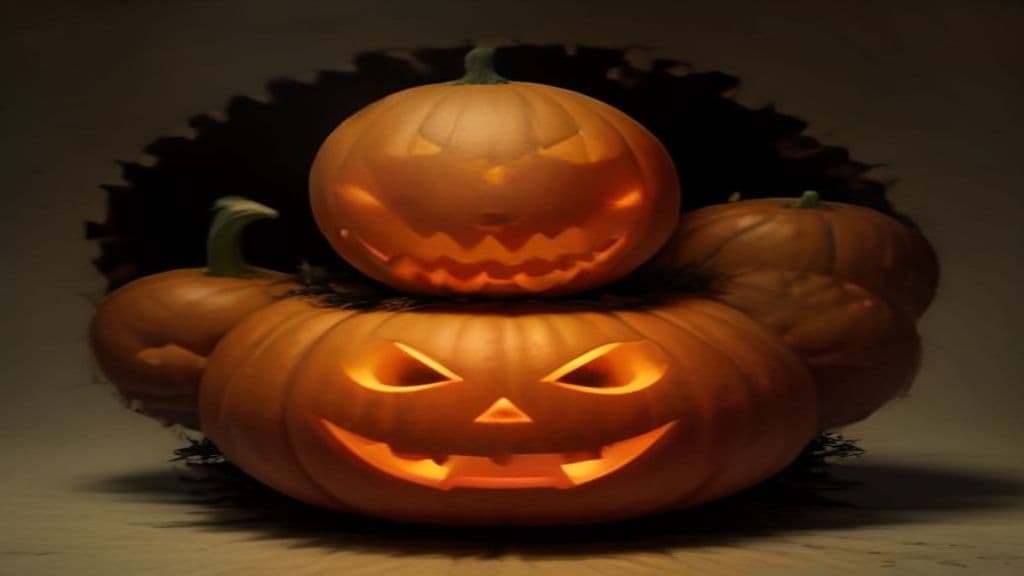
The term jack-o'-lantern originally denoted the atmospheric phenomenon ignis fatuus (Latin 'foolish fire'), the will-o'-the-wisp — strange, flickering lights seen over peat bogs — with recorded English usage from the mid-17th century (OED citations and early uses c. 1658–1660s). Over time the compound also referred to a man carrying a lantern (e.g., night watchmen). The application of the name to a carved vegetable lantern appears later; the carved-vegetable sense is first attested in nineteenth-century sources (the earliest cited carved-vegetable date in the provided notes is 1837, and 1836–1837 period Dublin/English sources discuss similar customs). As Irish, Scottish and English seasonal customs migrated and adapted, in North America the hollowed pumpkin (rather than the older turnip or mangelwurzel) became the common material for carved lanterns, and the lanterns acquired roles as festival ornaments, playful devices, and apotropaic objects associated with Halloween and harvest-night observances.
As a crafted object, a jack-o'-lantern is made by cutting a lid from the top of a pumpkin (in North America) or historically of a turnip, rutabaga or mangelwurzel (in parts of Britain and Ireland), scooping or hollowing out the interior, carving a face or image into the rind—often grotesque, scary, or humorous—and placing a light source such as a candle or tallow within before replacing the lid. Nineteenth-century British and Irish examples commonly used grotesque faces carved into root vegetables. The atmospheric form (the older sense) is described in the sources as strange, flickering lights seen over peat bogs and marshy ground (the will-o'-the-wisp/ignis fatuus); the supplied excerpts do not give further detailed visual description of the lights beyond their classification as 'atmospheric ghost lights.' Contemporary variants include electric or artificial lights used inside carved pumpkins, but the documented folk procedure emphasizes candle or tallow illumination.
As a material folk object, carved jack-o'-lanterns function primarily as sources of illumination (housing a candle or tallow) and as symbolic objects in seasonal practice: makers and communities have regarded them as representations of spirits or supernatural beings, as devices to frighten or play with others during Halloween festivities, and as apotropaic objects deliberately placed (for example on windowsills) to keep harmful spirits away from the home. The atmospheric jack-o'-lantern (ignis fatuus) is reported in dialect sources as wandering, flickering lights over bogs and marshes; within the provided excerpts the phenomenon is described but not attributed explicit agency such as leading travelers astray. The sources do not supply accounts of active supernatural agency or personhood for the carved object beyond its representational and protective uses, nor do they provide ritualized spells or exorcisms tied to encounters with the bog-lights.
Weaknesses
- otherNo documented vulnerabilities in provided sources; the jack-o'-lantern functions as a crafted object and a name for a natural atmospheric phenomenon rather than a documented supernatural being with listed weaknesses.
Wards
- ritualPlace carved jack-o'-lantern on windowsill
- symbolGrotesque carved face on root vegetable or pumpkin (displayed at Halloween/harvest to frighten or deter spirits)
JATO Rocket Car
A modern Anglophone urban legend and meme about a Chevrolet Impala fitted with a JATO unit that achieves extreme speeds and crashes spectacularly; circulated widely on Usenet, email lists, hacker zines, and popular media and subsequently debunked by authorities and experimenters.
Jabiru
Jabiru primarily denotes a large Neotropical stork species (Jabiru mycteria). The word, from Tupi–Guaraní meaning "swollen neck," is also used as a place-name (Jabiru, Northern Territory) and as a modern commercial/technical name (e.g., Jabiru Aircraft, rocket/vehicle names, and a bacteriophage). The provided sources do not document any supernatural or mythic entity named Jabiru.
Jabru
Jabru is a rarely attested theonym recorded in Mesopotamian sources as an Elamite high god-name. Mesopotamian god-lists and ritual commentaries equate Jabru (or the variant Yabnu/dia-ab-na) with major Mesopotamian sky-deities (Anu or, in one list, Enlil), and he also appears in an Assyrian underworld/vision text as a guardian of a royal corpse.
Jacawitz
Jacawitz is a Postclassic Kʼicheʼ Maya mountain-and-fire deity, patron of the Ahaw Kʼicheʼ lineage and member of a triad with Tohil and Awilix. Associated with a temple-pyramid at Qʼumarkaj and with foundation myths locating the gods at Tollan, Jacawitz indexes mountain, fire, and lineage symbolism and likely received demanding offerings in ritual practice.
Jack Pumpkinhead
A constructed, magically animated humanoid from L. Frank Baum's Land of Oz, created by the application of the Powder of Life to a body of wood and a carved pumpkin head. Treated as a social resident of Oz, he gardens pumpkins for replacement heads and appears across Baum's sequels and later continuations and adaptations.
Jack the Giant Killer
A cycle of Cornish/British folktales about a clever young man named Jack who, during the reign of King Arthur, outwits, ambushes, and kills a number of man- and livestock-eating giants, freeing captives and appropriating wealth. The tales place Jack in an Arthurian, magical landscape populated by giants, sorcerers, enchanted persons, and magical objects.
Jackal (folklore)
A liminal canid figure in multiple cultural traditions, the jackal functions as a symbol and occasional ritual embodiment connected to desolation, funerary contexts, cunning wisdom, and in some tantric contexts a manifestation of the goddess Kali. Sources treat it primarily as an animal with layered symbolic and mythic uses rather than a consistently personified independent supernatural agent.
Jacob
Jacob (Hebrew: יעקב, Yaʿaqōv) is a central human figure in the Book of Genesis, portrayed as the third Hebrew patriarch and the progenitor of the Twelve Tribes of Israel. The supplied sources treat him as a legendary/historical ancestor within the Abrahamic family line rather than as a supernatural being.
Jaddua
Jaddua is presented in post‑exilic Jewish sources as a human high priest (kohen gadol) of Jerusalem who exercised top priestly authority, adjudicated priestly discipline, and—according to later historiographical traditions—received a divine dream that shaped a communal ritual response at the approach of Alexander the Great.
Jade
Jade is a material and cultural concept referring to two distinct groups of ornamental rocks—nephrite and jadeite—valued across many societies (not a supernatural being). It has deep historical, ritual, and symbolic significance especially in East Asia and Mesoamerica, and carries folk associations with health and social status.
Jadis (the White Witch)
Jadis, commonly called the White Witch, is a fictional antagonist created by C. S. Lewis who rules Narnia as a sorceress-queen and whose magic enforces the prolonged 'Hundred Years Winter.' She is the principal opposing force in The Lion, the Witch and the Wardrobe (1950) and is a central figure in The Magician's Nephew (1955).
Jagaddhātrī
Jagaddhātrī is a name used in Bengali cultural production and, in one classificatory source, identified as an aspect of the Hindu goddess Durga. In the supplied materials the term appears in bibliographic records of Bengali-language books and as the title of a contemporary Bengali television series; the sources do not provide ritual, iconographic, or narrative detail about the figure.
Community Record
- [1]Jack-o'-lantern (Wikipedia). Wikipedia: 'Jack-o'-lantern' — history, etymology, description; notes on carved lanterns and relation to ignis fatuuswiki
- [2]Will o' the wisp (Wikidata). Wikidata entry summarizing the atmospheric 'ghost lights' phenomenon (ignis fatuus / will-o'-the-wisp)wiki
- [3]Jack-o'-lantern (disambiguation) (Wikipedia). Wikipedia disambiguation and etymology referenceswiki