
In the epic tradition Kabandha is presented as originally a celestial gandharva (often named Vishvavasu or related variants) who, after arrogance or a transgression and the operation of a curse or punitive act, became a headless trunk-like monstrous being. Textual traditions differ about the exact agent and circumstances of the punishment—variants across Ramayana recensions and later retellings variously name Indra, particular sages (e.g., Stulashira in Valmiki's telling), or other figures in differing combinations—but all share the framework of a fall from celestial status into a cursed bodily form that can be reversed by specific actions in the human realm.
Across sources Kabandha is described as a vast, barrel-shaped living torso with no head or neck, a great mouth set on the belly (often with large teeth and a protruding tongue), and in some accounts a single large eye on the chest/stomach. He is commonly dark, hairy, thunderous-voiced, and enormous in size—certain passages compare him to a mountain or vast mass. Variant accounts emphasize different anatomical details (for example extremely long arms in the Adhyatma Ramayana or the presence/absence of eyes or ears on the chest-face). Narrative imagery also likens him to a tree in some depictions.
Kabandha is portrayed as a ferocious, carnivorous forest-dweller who ambushes sages and travelers, using very long arms to seize prey and draw victims toward his belly-mouth. Some descriptions give him a glare like fire from a chest eye and a voice like thunder. His monstrous condition stems from a curse applied to a formerly celestial being; certain texts indicate he had received boons that affected his mortality, and liberation from the curse is conditional—he will be freed when a destined actor severs his arms and his corpse is cremated, after which he resumes his gandharva form and provides information to the hero.
Weaknesses
- ritualsevering of arms and cremation of the corpse
Wards
- otheravoidance (implicit — narrative emphasizes combat and liberation rather than preventive charms)
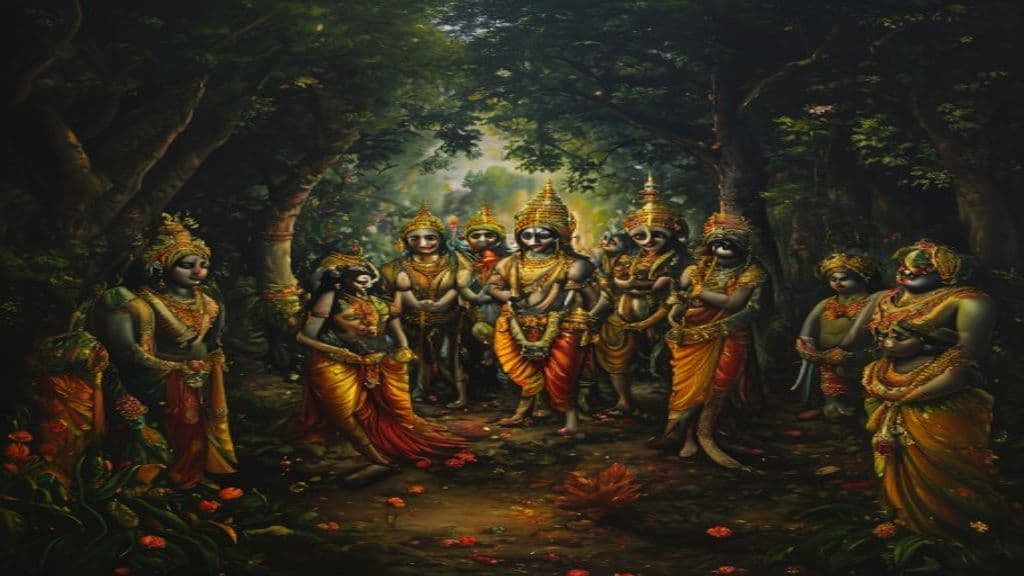
Gandharva
A class of non-human celestial or semi-celestial beings in Indic religions associated principally with music, song, dance, fertility, and an escort/guardian role for liminal arrivals (such as Soma or beings). In Hinduism they are minor deities and musicians of the devas; in Buddhist cosmology they are a low rank of devas and the term (gandhabba in Pāli/commentary) is also used doctrinally for a sentient intermediate state between death and rebirth.
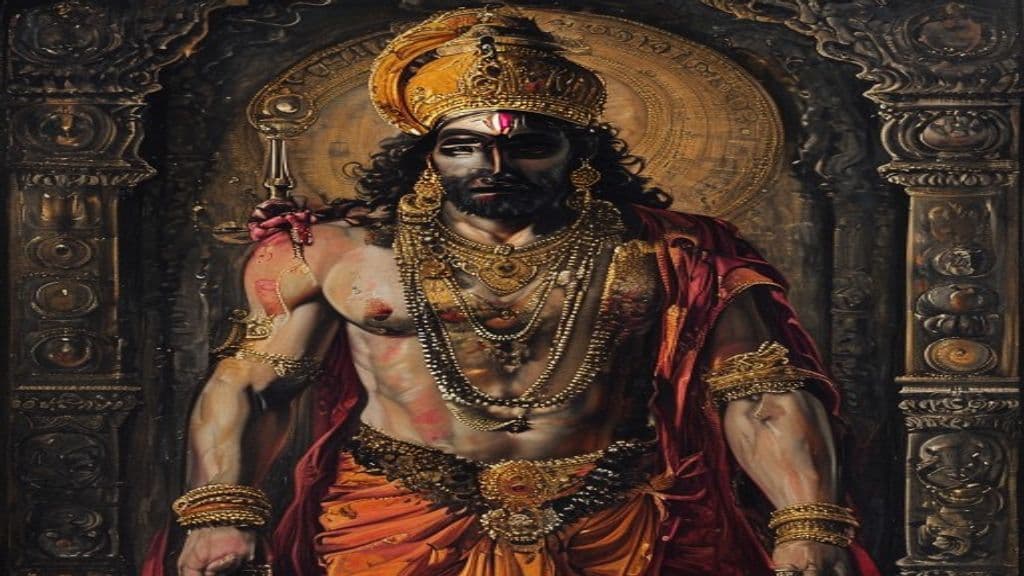
Rāma
Rāma is a major divine-hero in Hindu tradition, worshipped as the seventh avatar of Viṣṇu and the central protagonist of the Ramayana. He is portrayed both as the ideal man (maryāda puruṣottama) and, in Rama-centric sects, as the Supreme Being; his life-story (birth in Ayodhyā, 14-year exile, Sītā's abduction, and the defeat of Rāvaṇa) functions as a primary exemplar of dharma.

Rakshasa (Himalayan variants)
A Himalayan reception of the pan-Indian rakshasa motif: hostile or disruptive non‑human beings known from Sanskrit epic and Puranic literature, here noted where Himalayan sources and discussions intersect with the broader epic tradition. The supplied sources do not document distinct, well‑attested Himalayan folklore variants; the entry therefore presents primarily the epic/legendary profile as transmitted into Himalayan contexts in general references.
Jörð
Jörð (Old Norse: Jǫrð, anglicized Jörð) is the personification and theonymic incarnation of the Earth in Norse mythic-cosmology. Attested in the Poetic Edda, the Prose Edda, and Saxo's Gesta Danorum, she functions genealogically (notably as mother of Thor) and linguistically as the common noun for 'earth/land' used interchangeably with a named goddess-figure in skaldic poetry.
Jötunn (Jotun / Giant)
A jötunn (Old Norse jǫtunn; plural jötnar) is a class of powerful non-human beings in Norse/Germanic myth that exist alongside gods, dwarfs, elves, and humans. They commonly dwell across boundaries (e.g., Jötunheimr) and appear ambivalently as adversaries, kin, spouses, and participants in cosmological narratives.
Jātaka stories (Buddhist mythology)
The Jātaka stories are a collection of Buddhist tales that recount the past lives of the Buddha Gautama, highlighting his virtues and spiritual development. (Note: 1. Power tier should be changed to "Greater" since it's a deity-level being but not cosmic. 2. Origin story needs clarification that these stories are meant to convey moral teachings, not supernatural)
Jūratė (Jūratė and Kastytis)
Jūratė is a Lithuanian legendary sea‑woman variously described in sources as a sea‑goddess, mermaid, or undine who dwells beneath the Baltic in an amber palace. In the best‑known tale she falls in love with a mortal fisherman, Kastytis; a thunder god (Perkūnas) destroys her amber castle in anger, and the shattered amber or 'tears' are said to wash up on Baltic shores.
KAI Zilant
The Zilant is a legendary winged serpentine creature in Tatar mythology, described as something between a dragon and a wyvern. It appears in foundation legends of the city of Kazan and has served as the city's official emblem since 1730.
Kaal Bhairav
Kaal Bhairav (Kāla Bhairava, Kalabhairava) is a fierce Shaivite manifestation of Shiva associated with Time (kāla), death, guardianship, and punitive justice. Worshipped in Hindu and some Vajrayāna Buddhist tantric contexts, he functions as a guardian, enforcer and protector who is propitiated by devotees through mantras, puja and yantra practice.
Kabumpo, the Elegant Elephant of Pumperdink
Kabumpo is a fictional anthropomorphic elephant from the Oz book series (first appearing in Kabumpo in Oz, 1922) who functions as a courtly dignitary and occasional adventuring companion in the kingdom of Pumperdink and the wider Oz cosmology. Portrayed as wise, vain, and sarcastic but fundamentally good-hearted, he appears in multiple works by Ruth Plumly Thompson and later Oz continuations.
Kabunian
Kabunian is a named spiritual figure referenced in the highland cultural vocabulary of northern Luzon (Igorot/Bontoc area). The supplied sources show Kabunian appears in contemporary theological discussions about indigenous contextualization of Christianity and in modern cultural/arts contexts, but the provided materials do not record traditional myths, rituals, iconography, or specific powers.
Kachcha Kalwa
North Indian spirit of those who died 'raw' — violently, accidentally, or before their destined time. Unable to rest, the Kachcha Kalwa attaches to survivors and causes a trail of accidents, illness, and misfortune until properly appeased through rites at the site of death.
Kadam Rao (literary attestation)
The name 'Kadam Rao' appears as part of the title of a 15th-century Deccani Urdu masnavi, Kadam Rao Padam Rao, composed by Fakhruddin Nizami of Bidar. The supplied sources do not document Kadam Rao as a supernatural being in Bengali folk tradition; instead the attestation is literary and historical (Source 1).
Kadlu
Kadlu is one of three sister-figures in an Inuit account who together produce storm phenomena; Kadlu specifically makes thunder by actions such as jumping on hollow ice, singing, or rubbing dried seal skins. The sisters are described as living in a large house supported by whalebone ribs.
Kadru
Kadru is a mythic woman in Hindu sacred narrative, daughter (or descendant) of Daksha and one of the wives of the sage Kaśyapa, best known as the ancestress of the nāgas (a thousand serpent-sons such as Śeṣa, Vaśuki, and Takṣaka). Her stories focus on genealogical role, a famous wager and trick against her co-wife Vinata, and interactions with sages that produce curses and restorations by ascetic penance.
Community Record
- [1]Valmiki Ramayana - Aranya Kanda - Sarga 71 (prose summary). Valmiki, Aranya Kanda, Sarga 71 (prose rendering)literary
- [2]Valmiki Ramayana - Aranya Kanda - Sarga 72 (prose summary). Valmiki, Aranya Kanda, Sarga 72 (prose rendering)literary
- [3]Kabandha — Wikipedia. Kabandha entry, Wikipedia (summary of epic descriptions and variants)wiki
- [4]Mahabharata (Ramopakhyana summaries mentioning Kabandha). Summarized Mahabharata description as collated in secondary summaries (chest-eye, thunderous voice, etc.)literary
- [5]Mythology / Folklore encyclopedia entry: Kabandha. Encyclopedic summary of Kabandha in Indian folklore and epic traditionfolk
- [6]Variant retellings and editions (Adhyatma Ramayana, Kamban, later retellings) — archival material. Adhunik Galpo Sankalan and related archival retellings noted in research corpusother