Attested in Hellenistic and later mythographic collections, Leucophrye is presented as the daughter of Mandrolytus from a city in Asia Minor. Parthenius and later lexical summaries record that while her father's town was besieged she fell in love with the attacking commander (named Leucippus in at least one summary) and betrayed the town to the besiegers. The tale is presented as a variant of a broader Greek narrative motif exemplified by the Scylla (daughter of Nisus) story and compared in compendia and scholarship to similar figures such as Pisidice and Comaetho; some shared narrative geography connects related episodes to islands later called Tenedos or Leucophrye in overlapping traditions.
No physical description of Leucophrye is preserved in the available sources. Parthenius and lexicographic summaries focus solely on her actions—her falling in love with the assailant and the betrayal of her city—and do not supply bodily or costume details, so any attempt to describe appearance would be speculative beyond the attested texts.
Sources attribute no supernatural powers or special abilities to Leucophrye; she is a mortal, mythological human whose significance lies in motivated human behavior. The attested behaviors are that she fell in love with an attacking commander during a siege and, because of that passion, betrayed her father's city to the enemy. Her role functions as a moral and narrative exemplar illustrating conflict between erotic passion and familial or civic duty.
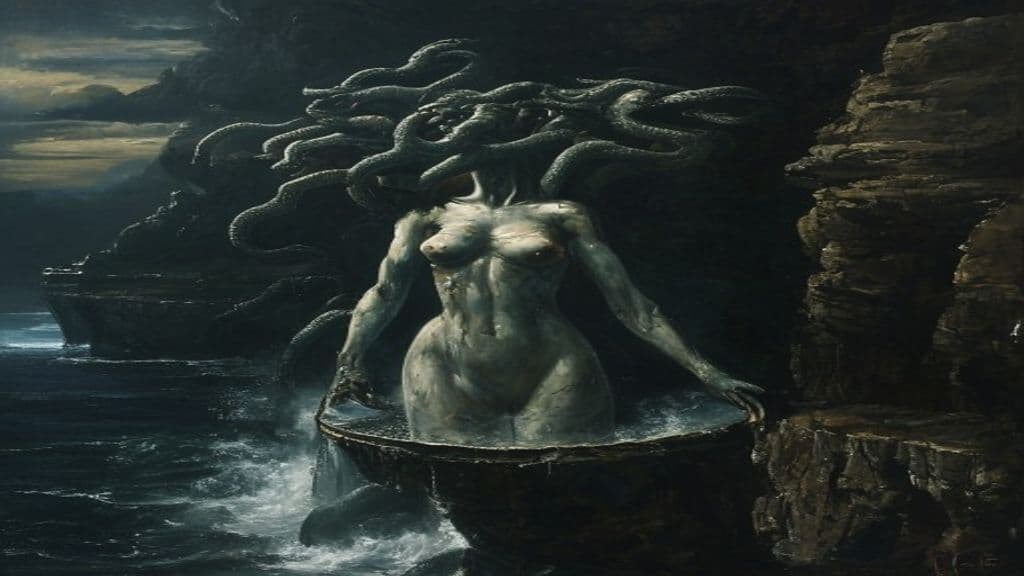
Scylla
A six-headed sea monster lurking in a narrow strait, snatching sailors from passing ships — the original origin of the phrase 'between Scylla and Charybdis.'
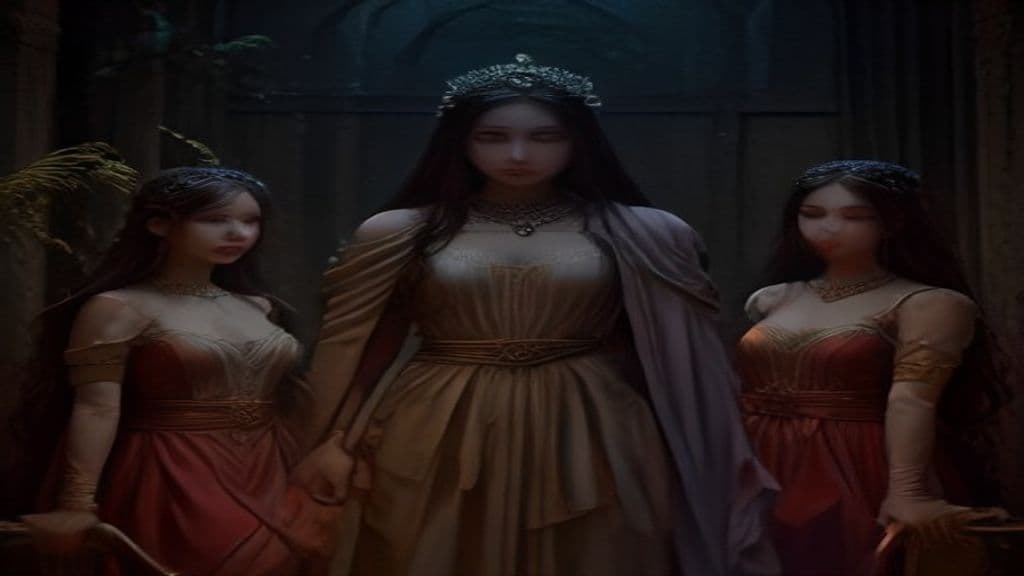
Pisidice
Pisidice (Ancient Greek Πεισιδίκη, Peisidíkē) is a personal name borne by multiple mortal women in ancient Greek myth. The bearers of the name appear as princesses, queens, daughters, and wives in distinct genealogical and heroic narratives (Aeolian, Pelian, Pylian, Methymnaean, Boeotian), rather than as a single supernatural entity.
Comaetho
Comaetho (Ancient Greek: Κομαιθώ, Komaithṓ, 'bright-haired') is a personal name borne by several distinct figures in Greek myth — a Taphian princess whose plucking of a golden protective hair undid her father's invincibility, a Patraean priestess whose sexual transgression in Artemis' temple led to divine demand for sacrifice, and a spring-nymph associated with the river-god Cydnus. The name and narratives function within Greek mythic genealogy and moral/etiological storytelling rather than denoting a recurring supernatural class.
Tenes
Tenes (Ancient Greek: Τέννης) is an eponymous heroic founder and cult-hero of the island Tenedos in Greek tradition. His myth explains a local sanctuary, ritual taboos (notably exclusion of aulos-players and prohibition on uttering Achilles' name), a founding-law involving a man with an axe, and the place-name Tenea in post-Trojan War tradition.
*Péh₂usōn (reconstructed)
Péh₂usōn is a hypothetical Proto‑Indo‑European pastoral guardian reconstructed by comparative scholars from parallels in Greek and Vedic traditions. Proposed as a Graeco‑Aryan ancestor‑figure, the reconstruction describes a protector of flocks, roads, and travellers rather than an attested historical cultic personality.
3-D Man
3-D Man is a Marvel Comics superhero identity associated with a 1950s-era origin in which the body of Chuck Chandler can materialize in three-dimensional existence when activated by his brother Hal via a pair of glasses. The mantle was later assumed by Delroy Garrett (formerly Triathlon) in modern continuity.
5 Ronin
5 Ronin is a 2011 Marvel Comics five-issue limited series that reimagines five Marvel superhero archetypes as rōnin (masterless samurai) in a fictionalized post‑Sekigahara feudal Japan. The work places Wolverine, Hulk, Punisher, Psylocke, and Deadpool analogues into period roles to explore displacement, revenge, and identity in an era of political upheaval.
A Elbereth Gilthoniel
An Elvish hymn in Sindarin addressed to Elbereth (Varda) from J. R. R. Tolkien's legendarium. Presented in The Lord of the Rings and later musical and dramatic adaptations, the hymn functions as devotional poetic language that evokes Elvish reverence for the star-kindler rather than an independent supernatural agent.
A.R.G.U.S.
A.R.G.U.S. is a fictional clandestine United States government agency in the DC Comics universe that investigates, contains, and manages superhuman, meta-human, and supernatural incidents and assets. Introduced in The New 52 continuity, it functions as an institutional actor providing intelligence, logistical support, covert task forces (notably Task Force X / the Suicide Squad), and a dedicated magic division across comics and media adaptations.
Aba (disambiguation / name-form)
Aba is a polyvalent name-form attested across many unrelated contexts (place names, personal names, animal names, and brief mythological listings). The provided sources do not support a single, coherent supernatural entity called "Aba" and offer no descriptive or ritual material for such a being.
Abarbarea
Abarbarea is a name attested in classical Greek and Roman sources for freshwater nymphs (naiads). The name appears for at least two individual mythic figures — a naiad wife of Bucolion and a naiad counted among ancestors of the Tyrians — and Hesychius records plural forms that may indicate the name was also used as a class-name (Abarbareai / Abarbalaiai).
Abas
Abas (Ancient Greek: Ἄβας, gen.: Ἄβαντος) is not a single mythic being but a recurring personal name borne by multiple mortals and minor mythic figures in Greek epic and genealogical traditions — kings, founders, seers, warriors, attendants, a centaur, and a youth transformed by a goddess. The name is glossed in the sources as 'guileless' or 'good-hearted' and appears across Argive, Theban, Trojan, Euboean, and other local cycles.
Abderus
Abderus (Ancient Greek: Ἄβδηρος, romanized Ábdēros) is a mortal heroic figure in Greek myth closely associated with Heracles, remembered as the youth left in charge of the Mares of Diomedes who was killed by them. He functions as an eponymous local/divine-hero ancestor for the city of Abdera and received funerary commemoration and athletic agones at his tomb.
Abin Sur
Abin Sur is a fictional extraterrestrial Green Lantern from the planet Ungara in DC Comics. A former history professor turned Green Lantern of Space Sector 2814, he discovered and investigated a prophecy tied to the "Blackest Night," died wounded on Earth and chose Hal Jordan as his ring-successor, and was later reanimated as a Black Lantern in the Blackest Night storyline.
Abomination of Desolation
An apocalyptic prophetic phrase originating in the Book of Daniel designating a profaning thing or act that renders the Jerusalem Temple cult desolate; later reused in the Synoptic Gospels as an eschatological sign prompting urgent flight. The term denotes ritual/cultic impurity (Hebrew shiqquts) and is variously interpreted as pagan offerings or altar, a foreign cult statue, or (in some New Testament readings) an acting agent.
Absolute Green Lantern (tradition)
A modern comic-book reinterpretation in DC's Absolute Universe in which a giant green lantern-shaped vessel appears above Evergreen, Nevada, generates an impenetrable green dome, judges townspeople and sends the judged into the Lantern to await further adjudication in OA (Omega‑Alpha). The story reframes Green Lantern mythos as cosmic/religious horror with an "Enlightenment Spectrum" of flames (Qard, Rao, Sur, Aur) stewarded by Oans such as Abin Sur.
Community Record
- [1]Leucophryne. Wikipedia, entry 'Leucophryne'wiki
- [2]Leucophrye (dictionary entry). Maicar / Greek Mythology Link, 'Leucophrye to Meander'literary
- [3]Parthenius, Love Romances (summary). Parthenius (summary in Theoi Classical Texts Library)literary
- [4]Scylla (daughter of Nisus). Wikipedia, 'Scylla (daughter of Nisus)' — comparative note referencing similar stories including Leucophryewiki
- [5]Women Who Betray Their Fathers. Alonso D. Toledo, 'Women Who Betray Their Fathers' — comparative commentary linking Leucophrye to the Scylla motifother
- [6]Tenes. Wikipedia, 'Tenes' — noted for overlapping geographic/narrative networks (Tenedos/Leucophrye)wiki