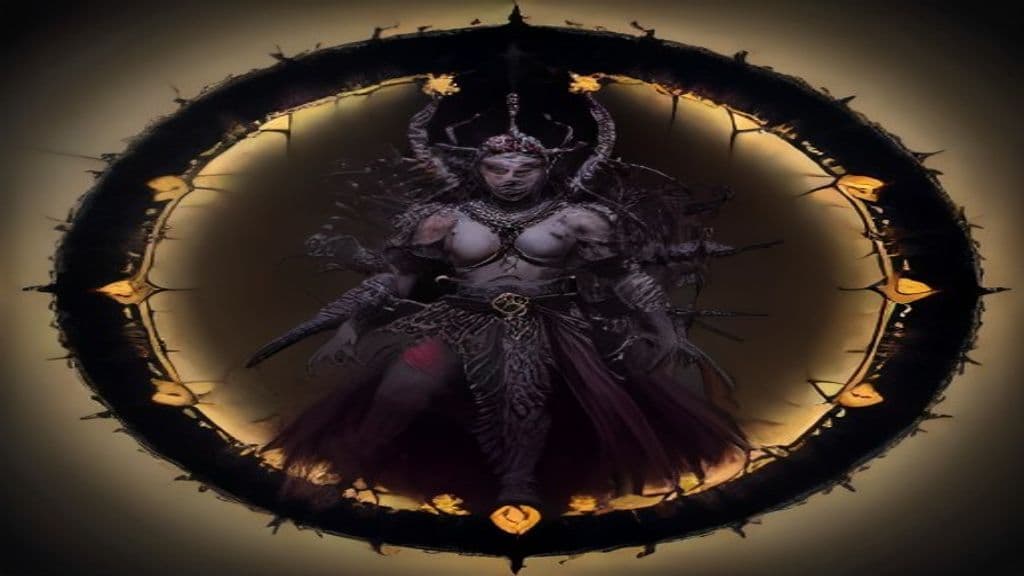
According to the Ramayana tradition as summarized in the cited sources, Narantaka and Devantaka are sons of the rakshasa-king Rāvaṇa by Dhanyamalinī (Rāvaṇa’s second wife). They are listed among Rāvaṇa’s progeny and act as combatants in the great war recounted in the Yuddha Kanda of the Valmiki Rāmāyaṇa alongside other lieutenants such as Atikāya. Their names function as descriptive epithets indicating roles in opposition to men and gods respectively.
The provided sources do not record physical descriptions for either Narantaka or Devantaka. No details about stature, coloration, armor, or specific weapons beyond their participation in battle are given in the cited material.
The sources identify them primarily as martial combatants in the Rāmāyaṇa war; their names literally mean 'destroyer of men' and 'destroyer of gods,' but the cited texts do not attribute specific supernatural powers beyond their role as warriors. The only recorded feats are their deaths in single combat: Narantaka is killed by Aṅgada, and Devantaka is slain by Hanuṃan's mace.
Weaknesses
- conditionKilled in single combat by heroic allies (recorded vulnerability)
Wards
- otherNo wards recorded in the cited sources
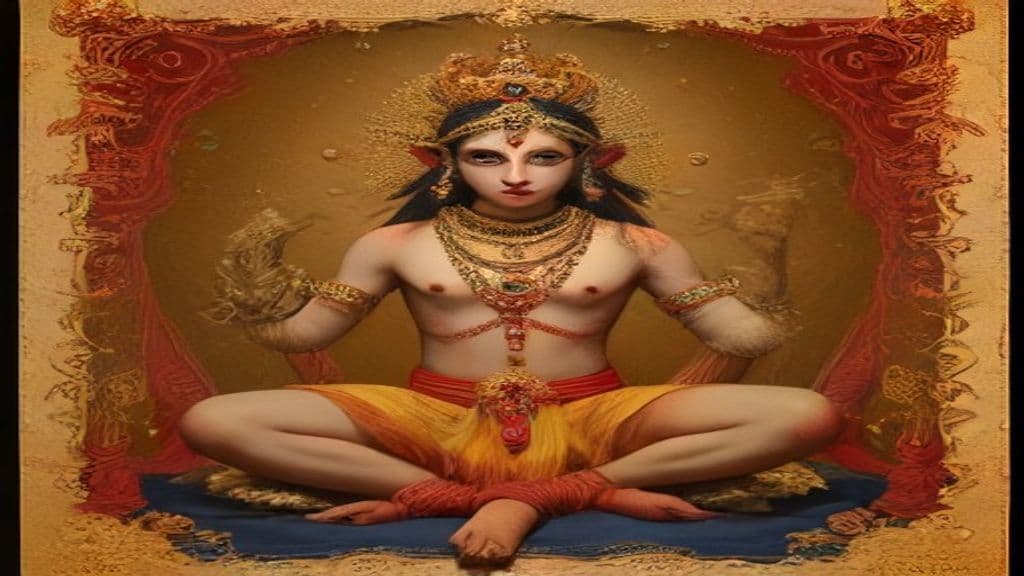
Angada
Angada (Sanskrit: Aṅgada) is a legendary vanara prince in the Rāmāyaṇa tradition who serves as a warrior, envoy, and later king of Kiśkindhā. He is presented as the son of Vāli and Tārā, nephew and lieutenant of Sugrīva, a commander in the expedition to Laṅkā, and a dramatic figure in later literary and performative adaptations.
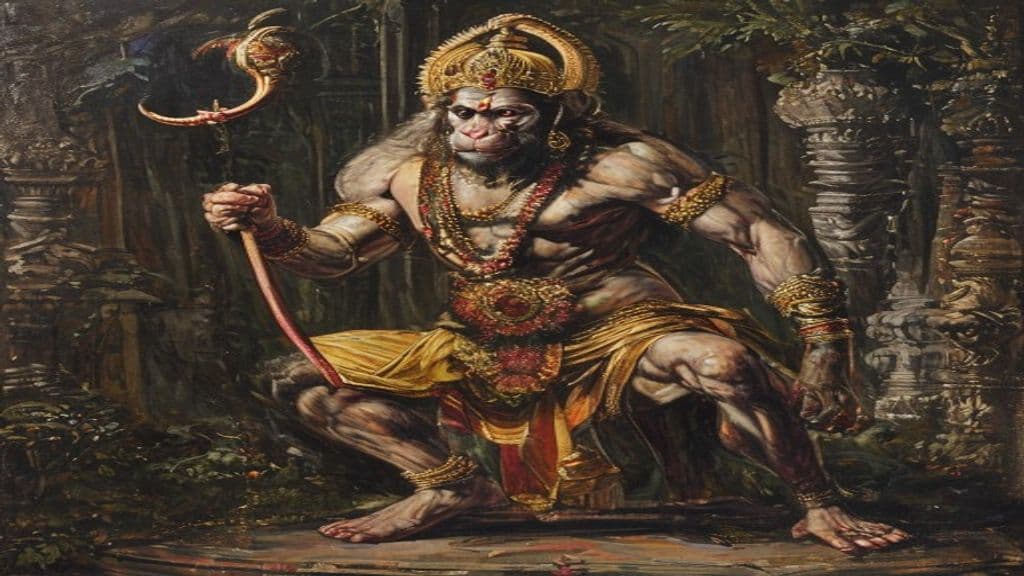
Hanuman
Hanuman is a divine vanara (monkey‑like being) in Hindu literature, foremost companion and devoted servant (Rama-dūta) of Lord Rama in the Ramayana. Revered in later Bhakti traditions, he is worshipped as a protector and exemplar of devotion, strength, and service.

Atikāya
Atikāya is a colossal rakṣasa prince in the Ramayana (Yuddha Kāṇḍa), son of Rāvaṇa and Dhanyamalinī, who fights in the Lanka war and is slain by Lakṣmaṇa after being struck with a Brahmāstra. Later retellings attribute to him an episode in which he catches Śiva's trident and is taught archery.

Dhanyamalini
Dhanyamalini (also Dhanyamala, Dhanyamali, Dhanyamālinī) is named in Ramayana tradition as one of Rāvaṇa's wives — frequently listed among his many junior wives — and is cited in some recensions as the mother of notable sons such as Atikāya and, in other versions, Narantaka, Devantaka, and Trishira. The extant sources provided record her relational and genealogical role within Rāvaṇa's household but do not attribute independent deeds or supernatural functions to her.

Rakshasa (Himalayan variants)
A Himalayan reception of the pan-Indian rakshasa motif: hostile or disruptive non‑human beings known from Sanskrit epic and Puranic literature, here noted where Himalayan sources and discussions intersect with the broader epic tradition. The supplied sources do not document distinct, well‑attested Himalayan folklore variants; the entry therefore presents primarily the epic/legendary profile as transmitted into Himalayan contexts in general references.
Nanna
Nanna is the Sumerian moon-god of ancient Mesopotamia, later known in Akkadian as Sîn (Su'en, Sîn). A principal heavenly deity, Nanna occupies a place in the high divine genealogy and is associated with the lunar sphere, calendrical and celestial functions within Sumerian and broader Mesopotamian religion.
Nanna Tala
Nanna Tala is a sacred ancestral woman-figure associated with a perennial spring in the Nafusa (Western) Mountains of Libya. Treated as a holy woman and local ancestor, her burial-mound and the spring above it serve as a locus of pilgrimage, offerings, healing practice, and communal ritual that also registers moral or ritual correctness.
Nanook
Nanook is the Inuit name applied to the polar bear and, in Inuit religious descriptions, the spiritual master associated with bears who regulates human–bear relations, deciding whether hunters deserve success and punishing violations of hunting taboos.
Nanshe
Nanshe is a Sumerian/Mesopotamian goddess associated with marshes and the sea, the fishes and water‑birds of those biomes, and with divination (notably dream interpretation), social justice, and civic welfare. Her primary cult center was the city Nina (Tell Zurghul); she appears across a long Mesopotamian chronology from the Uruk period into the first millennium BCE.
Napakivi (Finnish)
A traditional Finnish name for a standing stone in the middle of a field. (Note: 1. Power tier should be Primordial (Natural feature fits within this category, as it's an unaltered aspect of the environment). 2. Add sensory cues: The unique shape or positioning of the stone may pr)
Naraka Yaksha (hellish Yaksha)
The term 'Naraka Yaksha' is not attested in the provided source; it would, hypothetically, denote a yaksha-like being associated with an infernal loka. The supplied material only discusses the general loka concept and does not document any specific entity called Naraka Yaksha.
Nariphon
In Thai Buddhist mythology, the Nariphon is a tree that bears fruit in the shape of young female creatures. (Note: - Power tier: Lower than Primordial (consider Greater or Ancient) - Abilities: The draft implies interaction between Nariphon and Gandharvas, but this is only a suggestion, not a concrete ability. - S)
Nasnas
A half-human djinn creature of Arab folklore — possessing only half a face, one arm, one leg, and half a torso — descended from the union of a shaitan and a human, moving by leaping and highly dangerous to encounter.
Nastes
No folkloric or mythological evidence for an entity called 'Nastes' is present in the supplied sources; the token appears only as the title of contemporary electronic/industrial music tracks by the artist Subjected.
Nasu (Zoroastrianism)
In Zoroastrian cosmology, Nasu is a daeva associated with corpse matter and decay at a cosmic level. (Note: 1. Power tier should be Primordial (supported) but description needs clarification. 2. Clarify which abilities are described in the sources to ensure consistency. 3. Sensory cues and wards seem consis)
Nat
A nat (နတ်; nat) is a spirit-being venerated in Myanmar alongside Buddhism, encompassing deified humans and nature spirits. Nats form an institutionalized pantheon (notably the canonical 37 Great Nats) and function as village, household, lineage, and landscape guardians whose worship is expres sed through shrines, festivals, and mediumship.
Nathiya
Ghost of a young bride who died before her first Diwali as a wife — still wearing her wedding nose ring (nath), she haunts the marital home she never truly inhabited, causing illness in subsequent brides and making the household unwelcoming to new marriages.
Community Record
- [1]Narantaka-Devantaka — Wikipedia. Wikipedia contributors, 'Narantaka-Devantaka,' Wikipedia, The Free Encyclopedia, https://en.wikipedia.org/wiki/Narantaka-Devantakawiki
- [2]Wikidata: Narantaka-Devantaka. Wikidata entry Q6965380, http://www.wikidata.org/entity/Q6965380wiki