
The supplied sources do not record a distinct birth or origin myth for Dhanyamalini. She is attested within the Ramayana narrative corpus as one of the wives of Rāvaṇa and is thereby placed in the domestic and kinship network of the Rakshasa king. Modern summaries and structured-data records characterize her as among Rāvaṇa's many junior wives and, in some recensions, as the mother of specific sons; beyond these familial attributions the consulted materials do not supply a separate origin account.
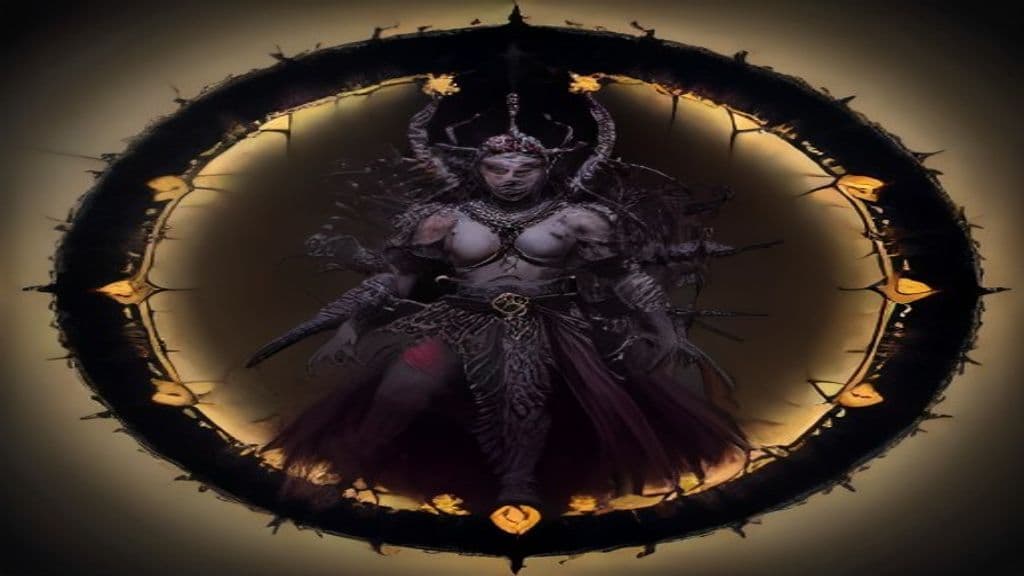
The provided texts and summaries do not give a physical description of Dhanyamalini. Her appearances in the narrative are situational (for example, being enumerated among Rāvaṇa's consorts who return to his household in Sundara Kanda Sarga 22), but no passages in the cited sources describe her features, dress, or bearing.
The available sources identify Dhanyamalini primarily by relationship and parentage rather than by individual actions or supernatural powers. She is noted as the mother of Atikāya (explicitly) and, in some versions, of Narantaka, Devantaka, and Trishira; those sons are represented elsewhere in the epic cycle as martial figures, but the sources provided do not attribute their abilities to Dhanyamalini herself or describe her performing notable deeds or wielding distinct powers.

Atikāya
Atikāya is a colossal rakṣasa prince in the Ramayana (Yuddha Kāṇḍa), son of Rāvaṇa and Dhanyamalinī, who fights in the Lanka war and is slain by Lakṣmaṇa after being struck with a Brahmāstra. Later retellings attribute to him an episode in which he catches Śiva's trident and is taught archery.
Narantaka and Devantaka
Narantaka (narāntaka, 'destroyer of men') and Devantaka (devāntaka, 'destroyer of gods') are named asuras, sons of the rakshasa-king Rāvaṇa, who fight on Rāvaṇa's side in the Yuddha Kanda of the Valmiki Rāmāyaṇa. Their roles in the surviving sources are martial: Narantaka is slain by Aṅgada and Devantaka is killed by Hanuṃan’s mace in the epic war.

Mandodari
Mandodari is the principal queen-consort of Rāvaṇa in the Rāmāyaṇa tradition: a beautiful, pious, and morally clear-sighted royal woman of mixed supernatural parentage who functions as a counselor, protector, and ritual exemplar (one of the Pancha-kanyā). Her story appears in multiple regional retellings with variant origin accounts.

Rakshasa (Himalayan variants)
A Himalayan reception of the pan-Indian rakshasa motif: hostile or disruptive non‑human beings known from Sanskrit epic and Puranic literature, here noted where Himalayan sources and discussions intersect with the broader epic tradition. The supplied sources do not document distinct, well‑attested Himalayan folklore variants; the entry therefore presents primarily the epic/legendary profile as transmitted into Himalayan contexts in general references.
Dewi Sri
Dewi Sri (also Shridevi, Nyai Pohaci Sanghyang Asri in Sundanese contexts) is the indigenous rice-and-fertility goddess of parts of the Indonesian archipelago (Java, Bali, Lombok and surrounding islands). She is a living cultic presence in village ritual life believed to preside over rice, household and communal prosperity, and the prevention of famine; in Hindu-influenced contexts she is often equated or syncretized with the Sanskritic goddess Sri/Lakshmi.
Dexamene
Dexamene (Greek: Δεξαμένη) is one of the fifty Nereids, the sea-nymph daughters of the sea-god Nereus and the Oceanid Doris in Greek myth. She is named in genealogical lists of the Nereids but has no individually attested myths or distinct cult practices in the cited sources.
Dexamenus
Dexamenus (Ancient Greek Δεξάμενος) is a name applied to multiple mytho-historical mortal figures in Greek tradition—chiefly local kings or eponymous ancestors associated with Olenus and Ambracia—best known from tales in which Heracles rescues a daughter from the centaur Eurytion. The name literally means 'hospitable' or 'receiver' and functions as a host-figure and genealogical anchor in regional heroic narratives.
Dhadu Monara
In Sri Lankan folklore, Dhadu Monara is a legendary pre-historic aircraft associated with King Ravana's reign. The Department of Archaeology has rejected the story as fiction due to lack of evidence. (Note: 1. Power tier should be Ancient, not Primordial, as it's described as a mode of transportation used by King Ravana, implying deity-level abilities. 2. The Department of Archaeology has rejected the st)
Dhampir
A figure from Balkan folk belief described as the offspring of a vampire and a human. Dhampirs occupy an intermediate social and ontological position — generally living among humans while inheriting certain capacities or markers associated with vampire-kind, and in many traditions are associated with the role of specialist vampire-hunters.
Dhanvantari
Dhanvantari is the divine physician in Hindu tradition, identified as an avatar of Viṣṇu who emerges from the Samudra Manthana bearing the pot of amṛta and is credited in Purāṇic and later accounts with promulgating and systematizing Āyurveda. He appears both as a cosmic being born from the churning of the Ocean of Milk and in later Purāṇic narratives as a terrestrial king/teacher who transmits medical knowledge.
Dharmanātha
Dharmanātha is the fifteenth Tirthankara of Jainism's present age (Avasarpini). Sources state he attained siddhahood (liberation by destroying all karma) and is portrayed in tradition as a supreme spiritual teacher who establishes the ford (tīrtha) across saṃsāra.
Dharmapāla
In Buddhist traditions, a dharmapāla is a protective deity or guardian whose role is to defend the Dharma (the Buddha's teaching) and to avert obstacles to spiritual practice. Appearing across Mahāyāna and Vajrayāna contexts (notably Tibetan, Chinese, and Japanese), dharmapālas range from local worldly guardians to wrathful enlightened emanations invoked in tantric ritual.
Dharmathakur
Dharmathakur (also Dharmaraj or Dharma) is a locally venerated village deity of the Rarh region of West Bengal associated in local practice with death, justice, and fertility. His cult centers on communal worship (notably the Dharmer gajan), non‑figurative stone images and terracotta horse votives, and shows layered syncretism between popular agrarian forms and later Brahminical textualization.
Dhuʾl-Khalasa
Dhuʾl-Khalasa (al-Khalasa) is attested in early Islamic literature as a pre-Islamic southern Arabian cult-centre and/or idol—described variously as a deity, the shrine/house associated with that deity, or the name of its worshippers. Islamic-era sources portray it as a regional “Southern Kaʿba” used for communal ritual and divination and record its demolition on the Prophet’s order shortly after the Islamic conquest.
Dhū Samawī
Dhū Samawī (Dhū Samuī, Dhu Samawi) is a pre-Islamic South Arabian deity attested in the Kingdom of Saba context and worshipped as a sky or heavenly god. He is described as 'He of the Heavenly' or 'The Heavenly One' and was called Malik al-Dhū Samāwī ('Lord of the Heavens'). His cult is attested especially in the city of Najran and in inscriptions that record cultic offerings, confession, penance, and fines.
Dhūmāvatī
Dhūmāvatī (Dhumavati) is one of the ten Mahavidyas in Tantric Shakta traditions, a fearsome aspect of the Great Goddess associated with widowhood, inauspiciousness, cremation grounds, and desolation. She is represented as an old crone figure and figures in Tantric iconographic and devotional material as the embodiment of loss and marginality.
Community Record
- [1]Dhanyamalini — Wikipedia. Wikipedia, 'Dhanyamalini' (accessed via supplied source list)wiki
- [2]Dhanyamālinī — Wikidata. Wikidata entry labeling Dhanyamālinī as 'second wife of Rāvaṇa' (as supplied)other
- [3]Valmiki Ramayana — Sundara Kanda — Sarga 22 (prose). Valmiki, Sundara Kanda, Sarga 22 (prose) — situates Rāvaṇa returning to his house with his consortsliterary
- [4]Valmiki Ramayana — Sundara Kanda — Sarga 22 (prose alternate link). Valmiki Sundara Kanda Sarga 22 (prose) (alternate supplied link)literary
- [5]Narantaka-Devantaka — Wikipedia. Wikipedia entry on Narantaka and Devantaka (used to contextualize sons attributed to Dhanyamalini in some versions)wiki
- [6]Hinduism StackExchange — 'Are Dhanyamalini and Mandodari one and the same?'. Community Q&A discussing variant readings and identity questions among Rāvaṇa's consortsother
- [7]Hinduism StackExchange — 'Does Hanuma actually know Ravana's wife Mandodari by her name when he sees her the first time?'. Community Q&A addressing naming and recognition of Rāvaṇa's wives in differing recensionsother