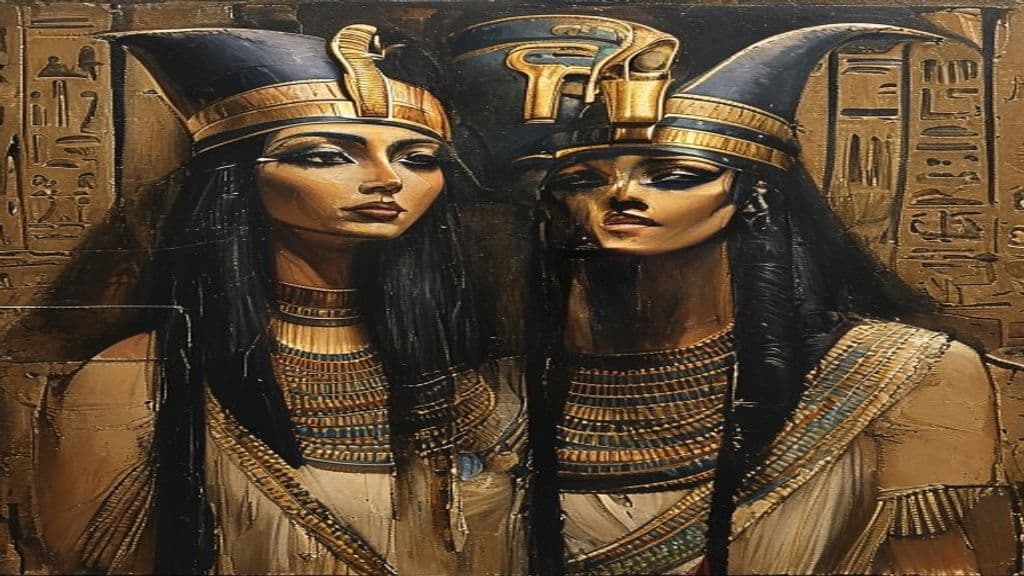
The Two Ladies were considered protectors of unified Egypt, indicating their role as Ancient level guardians or defenders.
Atef Crown
Egyptian feathered white crown associated with Osiris, symbolizing his status and power. (Note: * Power tier should be Ancient, not Greater, since it's associated with a deity. * Abilities statement is accurate based on source material, but can be rephrased for clarity: "As an inanimate object, )
Egyptian Supernatural Beings
In Egyptian mythology, various supernatural entities inhabit different realms, including gods, goddesses, demons (uncertain), and spirits. They are considered Primordial beings, with cosmic-level powers. (Note: 1. Remove the claim that demons are considered Primordial beings (Source 1 does not mention this). 2. Update the power tier to Ancient, as Egyptian gods have cosmic-level powers but the text describes)
Nebu
An ancient Egyptian hieroglyph representing gold with phonetic value nb, associated with royalty and divine authority. (Note: 1. Power tier: Change Primordial to Ancient (since Nebu is a hieroglyph associated with royalty and divine authority, but not described as cosmic). 2. Abilities/Origin story: Add that Nebu has no know)
Thinis (Egyptian tradition)
A significant cultural and administrative center in ancient Egyptian history, mentioned as the capital city of pre-unification Upper Egypt. (Note: - Power tier should be Primordial, not Greater, since it's a significant cultural and administrative center and its decline is tied to pharaonic unification. - Abilities should be stated as "No record)
Tutu
Tutu is attested as a theonym in multiple ancient Near Eastern contexts. Wikipedia lists Tutu as an Egyptian god 'during the Late Period' and separately as a Mesopotamian god described as a 'creation god'. The sources available for this entry are disambiguation-level and provide no further doctrinal, ritual, or iconographic detail.
Tvashtr
Tvashtr (also Tvashta, Tvashṭṛ, Tvastr) is the Vedic artisan or fashioner-deity attested in early Vedic hymns and Brāhmaṇa narratives. He functions as the divine craftsman who fashions implements, weapons and sometimes beings for the gods, and in later tradition his role is closely associated or assimilated with the craftsman deity Vishvakarma.
Twelve Olympians
A cultic grouping of the principal deities of the ancient Greek pantheon, traditionally reckoned as twelve gods residing on Mount Olympus and honoured in communal cult. Membership varies by locality and source; the formula of a dōdekátheon (twelve-gods) appears in cult and poetic evidence from the late sixth century BC onward.
Twin Sisters of Cain and Abel
In Jewish tradition, the Twin Sisters of Cain and Abel are twin daughters born to Adam and Eve at the same time as Cain and Abel, serving a narrative function in explaining the origins of humanity. (Note: 1. Remove power tier "Primordial" as it is not supported by source material; instead, specify that their existence serves a narrative function in explaining the origins of humanity. 2. Clarify appeara)
Tyche
Tyche (Greek Τύχη, Túkhē) is the personified deity of luck, fortune, and the collective prosperity or destiny of a polis. Originating in Classical Greek religion, she becomes especially prominent in the Hellenistic period as an explanatory and civic principle for unpredictable events and continues to appear in Roman iconography (often parallel to Fortuna).
Tydeus
Tydeus (Ancient Greek: Τυδεύς) is an Aetolian heroic figure of archaic Greek myth, counted among the Seven against Thebes and known as the father of Diomedes (Tydides). He appears in narratives of exile, single combat, and the Theban campaign; in some traditions his extreme violence — notably a reported episode of consuming the brains of his killer — leads the goddess Athena to withdraw a promised immortality.
Tyet
Egyptian symbol associated with the goddess Isis, representing her powers and attributes. (Note: - Power tier: Primordial is not supported by source material (no evidence suggests Tyet has primordial powers or abilities). - Abilities: Add that Tyet is often associated with Isis' protective and nu)
Typhon
The last great monster of Greek mythology — a vast, fire-breathing giant whose shoulders sprouted a hundred serpent heads, nearly toppling Zeus from Olympus.
Community Record
- [1]Wikipediawiki