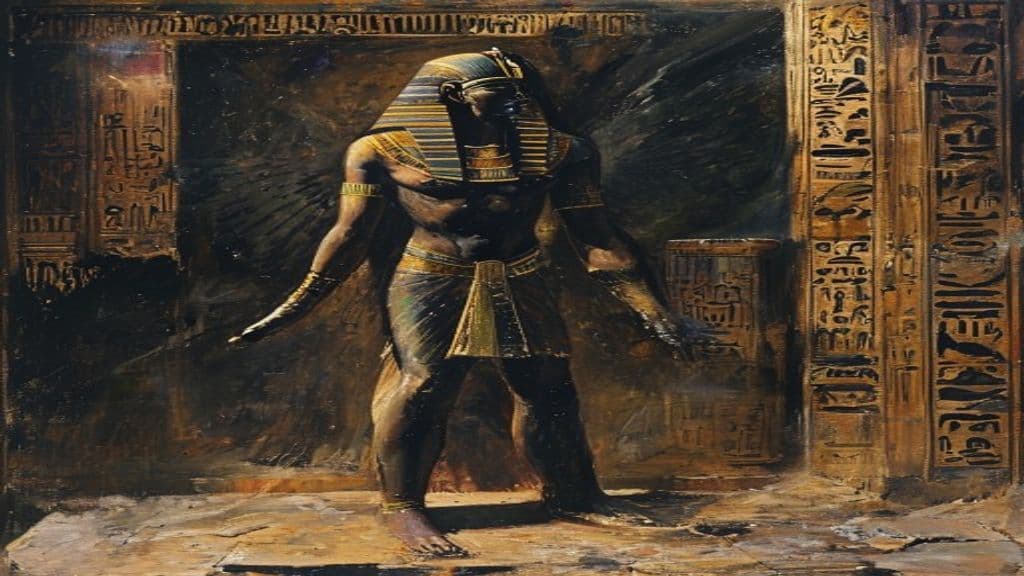
Thinis is mentioned as the capital city of pre-unification Upper Egypt in ancient Egyptian texts, serving as a significant cultural and administrative center.
The location of Thinis is unknown, but its historical significance and importance in ancient Egyptian history are well-documented. It was a major regional administrative center during the First Intermediate Period and Old and New Kingdoms.
No recorded abilities
Weaknesses
- conditionloss of regional administrative center status
Wards
None recorded.
Atef Crown
Egyptian feathered white crown associated with Osiris, symbolizing his status and power. (Note: * Power tier should be Ancient, not Greater, since it's associated with a deity. * Abilities statement is accurate based on source material, but can be rephrased for clarity: "As an inanimate object, )
Egyptian Supernatural Beings
In Egyptian mythology, various supernatural entities inhabit different realms, including gods, goddesses, demons (uncertain), and spirits. They are considered Primordial beings, with cosmic-level powers. (Note: 1. Remove the claim that demons are considered Primordial beings (Source 1 does not mention this). 2. Update the power tier to Ancient, as Egyptian gods have cosmic-level powers but the text describes)
Nebu
An ancient Egyptian hieroglyph representing gold with phonetic value nb, associated with royalty and divine authority. (Note: 1. Power tier: Change Primordial to Ancient (since Nebu is a hieroglyph associated with royalty and divine authority, but not described as cosmic). 2. Abilities/Origin story: Add that Nebu has no know)
Two Ladies (Egyptian)
In ancient Egyptian tradition, the Two Ladies refer to the goddesses Wadjet and Nekhbet as national symbols of unified Egypt. (Note: - Power tier should be Ancient (not Greater), since the article describes them as "protectors" which aligns with deity-level powers. - Abilities should include specific references to their roles as pa)
Thessalus
Thessalus is an ancient Greek personal name applied to multiple mythic and historical men who function as eponyms, local founders, or notable professionals (actor, physician). The name (Ancient Greek Θεσσαλός, 'Thessalian man') appears across genealogical traditions tying figures to Thessaly, in classical theatrical records, and in histories of medicine referring to the Methodic school.
Thestius
Thestius (Ancient Greek: Θέστιος) is a mythic, mortal king of Pleuron in Aetolia appearing in Greek genealogical and local‑hero traditions. He functions primarily as a dynastic ancestor and regional ruler whose family and political actions connect several better‑known heroic cycles, and some variants link him etiologically to a river‑name and a tragic domestic death.
Thetis
Thetis is a figure from ancient Greek myth: a sea-nymph (one of the fifty Nereids) and a semi-divine water-goddess. She is mother of Achilles, a shapeshifter and protector who intervenes for gods and heroes, and a liminal figure tied to older sea-divinities and questions of mortality and divine succession.
Thingol (Elu Thingol / Elwë Singollo)
Thingol is the King of Doriath and leader of the Sindar (the Grey Elves) in J.R.R. Tolkien's First‑Age legendarium. An original chieftain who awoke at Cuiviénen, he became High‑king/Lord of Beleriand, married the Maia Melian, and whose political choices and dynastic actions figure centrally in the tragic history of Doriath.
Thirty-two forms of Gaṇeśa
A canonical set of thirty-two named iconographic and devotional forms of the Hindu god Gaṇeśa, attested in Gaṇeśa‑centered scriptures and later compendia; each form has prescribed visual attributes and associated meditation verses used in worship and temple imagery.
Thoas (multiple figures in Greek myth)
Thoas (Greek: Θόας) is a recurring personal name attached to several distinct mortal/heroic figures in ancient Greek myth and legend — variously kings of Lemnos, the Taurians, Aetolia, and Corinth, and an offspring of Jason — appearing across genealogical and epic cycles rather than representing a single supernatural species.
Thoe
Thoe (Greek: Θόη, Thoê) is a personal name borne by multiple female figures in ancient Greek mythographic name-lists. The name appears as an Oceanid, a Nereid, and as an Amazon; these are distinct bearers rather than a single coherently defined supernatural class.
Thomas le Mousquetaire
The available sources do not attest Thomas le Mousquetaire as a folkloric or supernatural being. The term mousquetaire (musketeer) is documented as a literary/military archetype in Alexandre Dumas's The Three Musketeers and as an adapted helper/props-provider labelled "le Mousquetaire" in French-language episodes of La Maison de Mickey; no source supplied identifies a distinct supernatural entity named Thomas.
Community Record
- [1]Wikipedia: Thinis. online encyclopediawiki