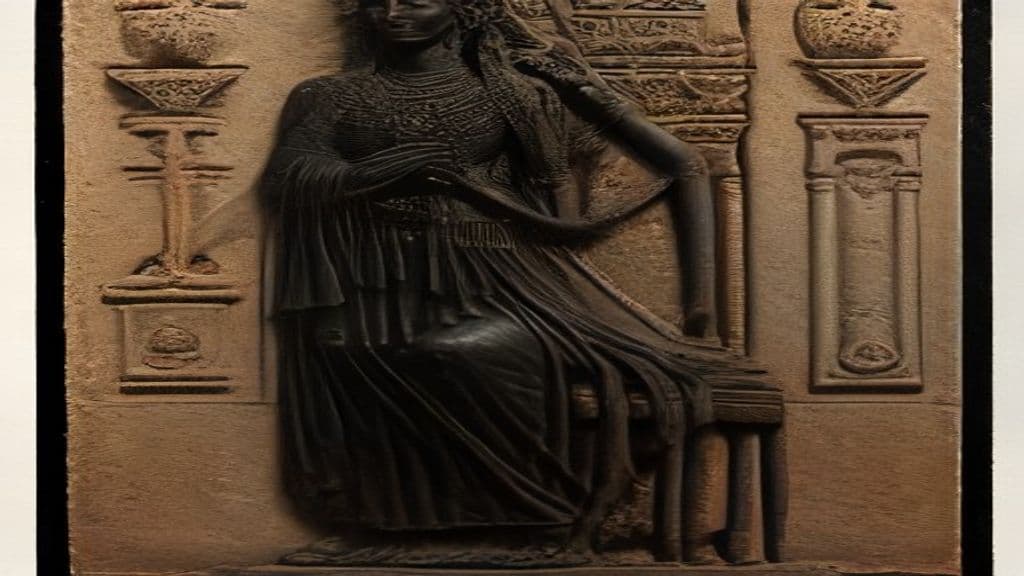
No distinct cosmogonic origin tale for Ninmug is preserved in the supplied sources. She is attested in Early Dynastic god lists, in ritual and literary corpora (for example in birth-creation helper lists alongside Ninmah), and in administrative and cultic records showing an established local cult (temple at Adab, month named for her at Adab). The sources therefore present her as an established artisan/birth-assistant deity within the Mesopotamian divine roster rather than as the subject of a personal creation myth.
Textual sources describe Ninmug with attributes associated with craftsmanship; literary passages can depict her in relation to tools of metalworking and sculpture. Later summaries list items such as a chisel, burin and obsidian knife in rhetorical descriptions, but the supplied materials do not preserve a fixed iconographic program or detailed anthropomorphic description for her.
Ninmug's principal function is as a divine artisan — described by the Sumerian title tibira kalamma, commonly rendered "metalworker/sculptor of the land" — with authority over sculpting and technical crafting, especially in contexts related to cult statuary and consecration. She is also named among the divine helpers invoked in birth-creation sequences, functioning in a generative or midwifery role alongside deities such as Ninmah. Texts associate her with aspects of royal investiture (she appears in Enki and the World Order in association with the ordering of divine responsibilities) and she can act as an intercessory figure (an Old Babylonian letter invokes her on the grounds that "Ishum will listen to what you say"), indicating petitionary cultic use. Familial links in some sources include a husband, Ishum (and in some contexts Hendursaga by equation), and in some texts she is addressed as mother of the minor god Lumma.
Ishum
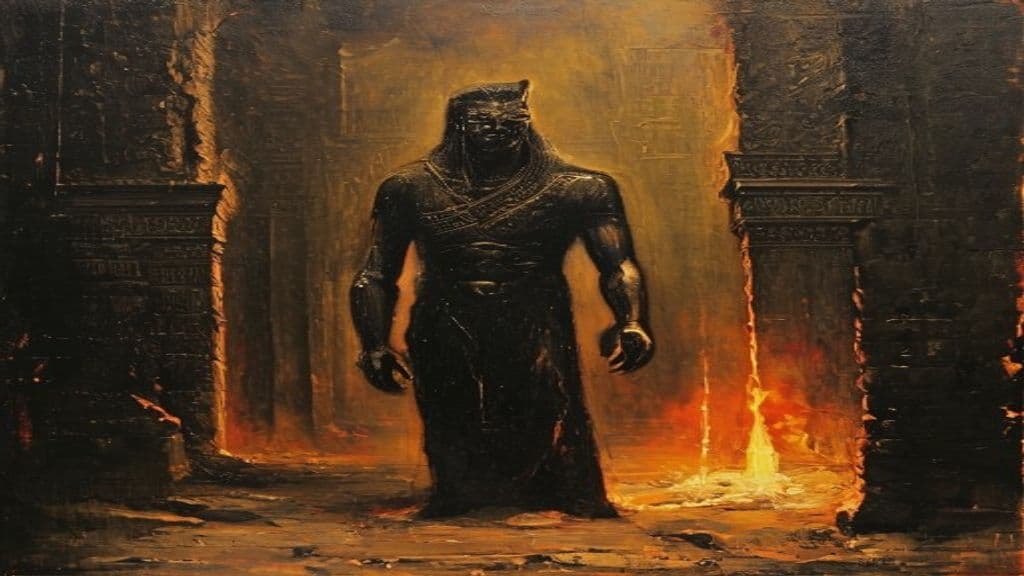
Ishum (Akkadian Išum) is a Mesopotamian deity of Akkadian origin who functions primarily as a nocturnal, ambulatory guardian associated with streets and the protection of houses from without; in later periods he is integrated into the underworld retinue as an attendant (sukkal) of Nergal/Erra and appears in literary texts such as the Erra epic.

Ninmah
Ninmah (also attested in scholarship as Ninḫursaĝ / Ninhursag / Ninursag / Ninḫarsag) is a principal Sumerian mother and mountain goddess. She is a major deity in the early Sumerian-Akkadian pantheon associated with fertility, birth, the shaping of humans, and the ordering of fate; she appears in foundational myths such as “Enki and Ninmah” and “Enki and the World Order.”

Hendursaga
Hendursaga (Sumerian Dḫendur-saŋ) is a Mesopotamian deity described in hymnic and god-list sources as a divine night watchman who patrols city streets, bears an insignia (staff or torch), and protects nocturnal travelers from hostile supernatural beings. He is attested in connection with the state of Lagash and is equated with the Akkadian Išum in later bilingual contexts.
Adapa
Adapa is a mythic figure from ancient Mesopotamian (Sumerian and Akkadian) literature: a mortal fisherman and temple sage of Ea at Eridu endowed with exceptional wisdom. He appears in a fragmentary tale in which he breaks the wings of the south wind and is summoned to the divine court; his name was later invoked in exorcistic and ritual contexts as an authoritative identity.
Aga of Kish
Aga of Kish (Aga, Agga, Akka) is an Early Dynastic Mesopotamian king recorded in the Sumerian King List, the Tummal Inscription, epigraphic objects, and the Sumerian poem "Gilgamesh and Aga." He functions in texts as a historical/legendary political actor who attempted hegemonic demands on Uruk and was ultimately captured and released by Gilgamesh.
Alulim
Alulim is the legendary antediluvian 'first king' of Eridu in Mesopotamian tradition, presented in king lists and mythic compositions as the initial ruler appointed by the gods. He functions etiologically to explain the origin of kingship and, in late ritual texts, is invoked in agricultural incantations associated with driving off field pests.
Alû (Alu)
A named lemma attested in modern reference lists as 'ALU / Alu', but for which the supplied research corpus contains no substantive primary- or secondary-source information about nature, appearance, powers, or rituals in Mesopotamian tradition.
Amurru (Martu)
Amurru, Sumerian Martu, is a Mesopotamian deity who functions as the divine personification of the Amorites. Originating in Mesopotamian textual practice, he is associated with the steppe and mountains, depicted with a crooked staff, portrayed in hymnography as warlike and lightning-armed, and from the Old Babylonian period acquires a prominent exorcistic cultic role.
Ancestors of Enlil (Enki-Ninki deities)
A sequence of Sumerian divine pairs (en-/nin- names) conceived as the primordial ancestors culminating in Enlil; chiefly attested in god lists and invoked as authoritative primordial names in ritual, especially in incantations and exorcisms.
Anshar
Anshar is a Mesopotamian primordial deity whose name (Cuneiform AN.ŠÁR) literally means "whole sky" or "the whole heaven." He functions as an abstract ancestral figure in theogonic genealogies (not actively worshiped as a regular cult deity) and appears in literary contexts—most notably the Enūma Eliš—and in god lists where he legitimizes later supreme gods.
Anu
Anu (Sumerian An; Akkadian Anu/Anum) is the divine personification of the sky in ancient Mesopotamian religion, traditionally ranked at the top of god‑lists as the source of heavenly authority (anûtu/anuti) and the fount of legitimate rule for gods and kings. Though supreme in genealogies and astronomical schema, many periods portray him as a relatively passive or figurehead deity whose active cultic role is limited until a late Seleucid reinvention in Uruk.
Anunnaki
A variable collective of major deities in ancient Sumerian, Akkadian, Assyrian and Babylonian religious literature, described as offspring or descendants linked to the sky god An (Anu) and an earth/mother figure (Ki/Ninhursag). Texts portray them as participants in the divine assembly, decreers of human fate, and in some traditions a group of seven underworld judges; their number, membership, and functions vary across sources.
Anzû (Imdugud)
Anzû, also called dZû or Imdugud, is a large storm-associated bird-figure in Sumerian/Akkadian/Babylonian myth. Portrayed as a hybrid (commonly a massive bird with a lion's head or as a half-human storm-bird), Anzû is credited in mythic narratives with seizing the Tablet of Destinies and thereby challenging the authority of chief gods such as Enlil.
Apkallu (Abgal)
Apkallu (Akkadian; Sumerian: Abgal) are polyvalent Mesopotamian wisdom figures attested as mythic/semi-divine sages (notably a group of seven), as professional human experts (ummânu), and as apotropaic images used in household and cultic ritual. They are closely associated with the god Ea (Nudimmud) as transmitters of secret knowledge and are represented in diverse iconography including fish-man and bird-headed types.
Ara
Ara (Sumerian: A) is a minor Mesopotamian goddess attested as a servant or attendant of the god Enki. Earlier scholarship sometimes conflated her theonym with the attendant deity Isimud, but modern treatments distinguish Ara as a separate divine household figure.
Community Record
- [1]Ninmug — Wikipedia. Wikipedia entry 'Ninmug' (summary of name, functions, cult centers, associations)wiki
- [2]Wikidata: Ninmug. Wikidata label and entity data for Ninmugwiki
- [3]Lumma — Wikipedia. Wikipedia entry 'Lumma' (for information on Lumma as related minor god)wiki
- [4]Sumerian Narrative Texts / Birth of Humanity (collection). Collection of Sumerian birth-creation lines showing Ninmug listed among helper deitiesother
- [5]Genesis as ANE ripoff: Part4 — Sumerian narrative texts (online reproduction). Online reproduction/collection of Sumerian narrative texts (used for lines where Ninmug appears among helpers)other