
Within Hawaiian narrative frameworks represented in the cited materials, Pele is presented as a primary volcanic deity who figures in the genealogies and pantheon of Hawaiian gods and goddesses. The sources identify her as the creator of the Hawaiian Islands and place her among a family of deities who personify natural forces; specific episodic origin narratives are recorded in fuller myth collections (for example Emerson's Pele and Hiiaka) referenced by the sources but are not reproduced in the provided excerpts.
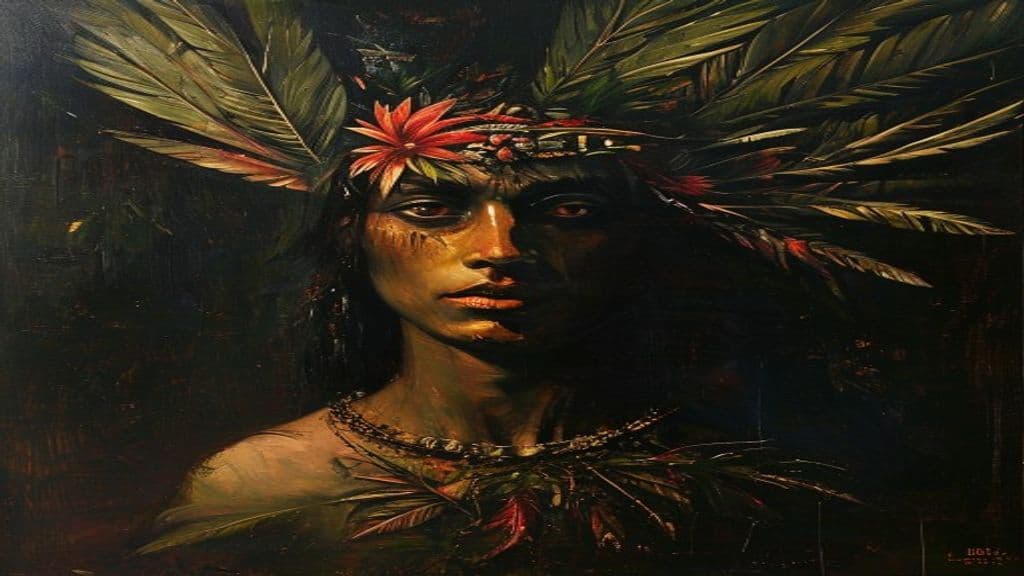
The provided source excerpts do not supply a consistent canonical physical description. While fuller narrative texts (not quoted in the supplied snippets) contain stories centering on Pele, the materials given here do not provide reliable, uniform details about her height, clothing, or fixed bodily form, so no singular physical description can be stated from these excerpts.
The sources characterize Pele as the goddess of fire, lightning, wind, and volcanoes and as the creator of the Hawaiian Islands; within Hawaiian mythic frames these attributes explain volcanic eruptions and the shaping of the islands. She appears in narratives interacting with other deities (for example, her sister Hiiaka) and functions as an agent whose actions are invoked to account for dramatic geological phenomena in Hawaiian storytelling.
Weaknesses
None recorded.
Wards
- otherHonorific address (e.g., "Madame Pele", "Tūtū Pele")

Hiʻiaka
In Hawaiian religion, Hiʻiaka is a minor goddess and daughter of Haumea and Kāne. She is associated with the natural world and has sacred connections. (Note: * Power tier should be Minor Spirit (correct) * Origin story needs to be more specific, as the source only mentions parentage but not her role in ancient Hawaiian cosmology * Appearance and Abilities )
Laka
A 'popular hero' in Hawaiian mythology, associated with heroic qualities. (Note: * Power tier should be revised to Greater or Ancient since it's referred to as a "popular hero" and is associated with heroic qualities, suggesting a higher power level. * Appearance should state that)

Kanaloa
Hawaiian god associated with marine life and possibly tied to fertility or creation. (Note: * Power tier should be Greater (powerful regional), not Primordial (cosmic). * No information on appearance or abilities/behaviors is available, so these sections should be removed. * The association )

Rongo
Major god in Māori mythology associated with cultivated plants, particularly kūmara. (Note: - Power tier should be Ancient (deity-level) instead of Primordial. - Abilities could use further clarification or expansion based on the source material. - Sensory cues are missing entirely and need )
Akua
Akua is the Hawaiian common noun for a god, deity, or divine being; in the provided sources it functions as a lexical category applied to indigenous Hawaiian deities and as the translation-term for the Christian God in Hawaiian-language liturgy and scripture.
Hiʻiaka
In Hawaiian religion, Hiʻiaka is a minor goddess and daughter of Haumea and Kāne. She is associated with the natural world and has sacred connections. (Note: * Power tier should be Minor Spirit (correct) * Origin story needs to be more specific, as the source only mentions parentage but not her role in ancient Hawaiian cosmology * Appearance and Abilities )
Peko
Peko is a Baltic‑Finnic agrarian spirit and cult figure associated with barley, brewing, and field fertility, particularly attested in Seto, Estonian, and Finnish traditions. He appears in cult practice as a guardian of granaries and crops, a focus of seasonal feasts and offerings, and is invoked in rituals for rain, abundance, and certain soil‑related cures.
Pelagon
Pelagon is a personal name attested in ancient Greek mythic and genealogical sources for several distinct mortal or semi-divine figures (kings, warriors, hunters, companions). The supplied sources present multiple individuals called Pelagon rather than a single coherent supernatural entity; later modern uses of the name are homonymous and do not indicate a unified mythic being.
Pelasgians
In Greek tradition, the Pelasgians were a collective term for indigenous people inhabiting Greece before the emergence of the Greeks. (Note: 1. Power tier should be Primordial is incorrect; given that there's no information about their abilities or behaviors, they should not have a power tier assigned. 2. Appearance should state "No physic)
Pelasgos
Pelasgos is an eponymous ancestral figure (and ethnic label Pelasgians/Pelasgoi) from Greek mythohistory used to account for the antiquity and origins of certain peoples and cults in Greece. He appears across regionally variable traditions as a foundational progenitor rather than a supernatural monster or spirit.
Pelasgus
Pelasgus (Πελασγός) is a mythic ancestral and eponymous founder figure in ancient Greek tradition credited in various local accounts with founding cities, teaching agriculture, receiving Demeter, and giving his name to the Pelasgians and regions such as Pelasgiotis. He appears across competing regional genealogies (Argive, Arcadian, Thessalian) rather than as a standardized supernatural being.
Pele's Curse
A supernatural concept that manifests as an implied threat of bad luck associated with taking native Hawaiian materials away from Hawaii. (Note: 1. Power tier: Greater (the curse can have significant consequences for those who disregard it) 2. Abilities: specify that the bad luck is said to manifest as accidents, mishaps, or other unfortunate )
Pelesit
A Malay familiar spirit traditionally conceived as a small insect (generally a cricket or sometimes a grasshopper) kept by a human owner—usually a woman—and used as an instrument of magical harm. The pelesit chirps and may enter a victim's mouth tail-first; its chirping can call a more dangerous spirit (the polong).
Peleus
Peleus (Ancient Greek Πηλεύς) is a mortal heroic king of the Greek heroic age—son of Aeacus and an oread, husband of the sea-nymph Thetis, and father of Achilles—figuring as a founder-ancestor and culted hero in later local practice. He is portrayed in epic narrative as a warrior-king, Argonaut, and participant in the web of marriages and purifications that link human rulership to divine beings.
Peliades (Daughters of Pelias)
In Greek myth, the Peliades (Greek: Πελιάδες) are the daughters of King Pelias who, deceived by Medea's staged 'rejuvenation' demonstration, dismembered their father believing he would be restored to youth. The story survives in fragmentary literary references, summaries of Euripides' lost play Peliades, and later mythographic accounts.
Pelias
Pelias (Πελίας) is a mortal king of Iolcus in Greek myth who usurped power in Thessaly, sent Jason to fetch the Golden Fleece, and was ultimately killed through Medea's deception when his daughters dismembered him in an attempted false rejuvenation.
Community Record
- [1]Pele, the Hawaiian goddess | USC Digital Folklore Archives. USC Digital Folklore Archives, "Pele, the Hawaiian goddess" (metadata summary)folk
- [2]Pele, Hawaiian Lava Queen | USC Digital Folklore Archives. USC Digital Folklore Archives, "Pele, Hawaiian Lava Queen" (metadata summary)folk
- [3]Pele and Hiiaka: A Myth From Hawaii. Nathaniel Bright Emerson, Pele and Hiiaka: A Myth From Hawaii (narrative collection cited in provided materials)literary
- [4]List of figures in the Hawaiian religion. Wikipedia, "List of figures in the Hawaiian religion" (lists Pele among Hawaiian deities)wiki
- [5]Pele (Hawaiian) summary (two pronunciations cited). Summary material indicating Pele is goddess of fire, lightning, wind, and volcanoes and creator of the Hawaiian Islands; notes honorifics "Madame Pele" and "Tūtū Pele" (excerpted in provided notes)wiki