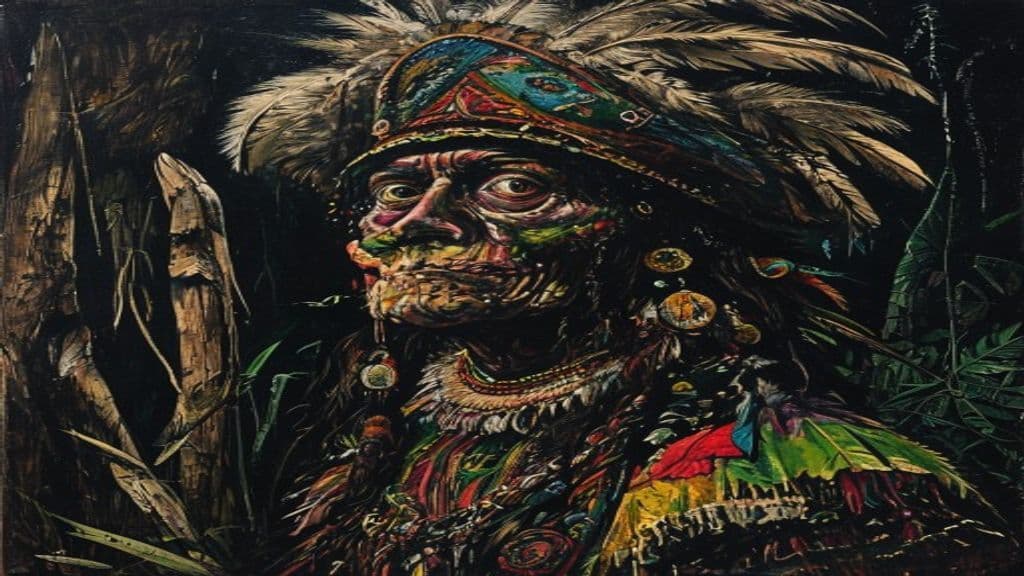
Accounts situate the pishtaco in colonial and postcolonial contexts: scholars and popular accounts link the motif to practices and rumors about Spanish conquistadors and later outsiders who used Indigenous corpses' fat for wound treatment and other purposes. Over time the attacker’s social guise changes with historical circumstance (Conquest soldiers, eighteenth-century priests labeled nakaq, hacendados, and modern professionals), making the figure an idiom for extractive violence rather than a single origin tale.
Descriptions vary regionally and historically. Many accounts associate the pishtaco with an outsider racial/occupational profile (white man or mestizo; in some eras Spanish soldiers, priests, hacendados, men on horseback, automobile drivers, or modern professionals such as doctors). Folklore commonly links the figure with a long knife in some tellings, but sources present knife use as one motif among several rather than a universal trait. Some narratives portray the attacker as indistinguishable from ordinary outsiders until the act, while other variants emphasize supernatural or anonymous marauder aspects.
Folkloric accounts attribute to the pishtaco the extraction of human fat from victims for uses variously described as medicinal ointments, soap, grease for firearms or machinery, cosmetics, or other commercial applications. Modes reported in sources include violent physical methods (beheading, disembowelment, dismemberment) in some narratives and stealthier or 'magical' methods in others (stunning with 'magic powder', invisible extraction leaving no visible wounds and producing wasting illness days later, or extraction through the anus in certain accounts). Occasional secondary motifs include rumors of draining 'body fluids' and isolated cannibalistic allegations (e.g., sale/preparation of human flesh products), which sources treat as episodic elements of the broader legend.
Weaknesses
- otherNo explicit folkloric 'weakness' provided in sources; protective practices are attested instead
Wards
- substancewayruru (brilliant red and black beans used as amulets)
- substancechewing chancaca (unrefined sugar) — reported protective practice
- substanceeating earth — reported protective practice
- symbolclove of garlic pierced by a needle (shown as a protective display in some accounts)
Apu
In Andean (Inca-era and continuing) belief, an apu is the spirit of a mountain or a solitary rock, conceived as a localized, often anthropomorphic guardian presence associated with a particular peak or notable stone in Peru, Ecuador, and Bolivia.
Aymara people (tradition)
Aymara cultural and ritual traditions of the high Andean Altiplano centering on long-term place-based continuity (Lake Titicaca, Tiwanaku), ancestor mortuary practices (chullpas), oral and musical repertoires, and distinctive linguistic cosmologies that shape how the community apprehends time, space, and relations with powerful places. The supplied sources do not record a single named supernatural entity; this entry documents the ethnographic and cosmological context relevant to Aymara beliefs about ancestors, sacred places, and ritual practice.
Huanca
Huanca refers to two related Andean referents in the supplied sources: (A) an ethnonym for a Quechua people of the Junín region of central Peru, and (B) huanca/wanka, a sacred elongated vertical standing stone (monolith) in Andean ritual practice that is worshipped and given offerings and is believed to represent chiefs and ancestors.
Supay
Supay is an ambivalent subterranean spirit and regent of the Incan underworld (Uku Pacha / Hurin Pacha). In Quechua and Aymara tradition he embodies aspects of shadow, death, and chaos, functioning both as lord of the dead and as the archetype or progenitor of many dangerous local spirits; Spanish colonial sources later equated him with the Christian Devil.
Ukhu Pacha
Ukhu Pacha is the under- or inner-world layer in Andean (Quechua/Inca) tripartite cosmology. As a pacha it functions as a position in an integrated space–time ordering rather than as a single personal spirit or deity.
Pishacha
Flesh-eating spirits of Hindu mythology that haunt cremation grounds and are associated with disease, madness, and possession. The lowest class of demon in the Vedic hierarchy.
Pishacha-graha
The possessing variety of pishacha described in classical Ayurvedic and tantric texts — a grasping spirit (graha) that seizes the body of a victim, producing symptoms of madness and compulsion.
Pishachini
Pishachini is attested in the provided sources both as the central antagonist in a contemporary Hindi television drama (a formerly human woman cursed after death into a malign supernatural female being) and as an indexed term in a corpus of tantric/vedic sadhana listings (Pankaj Oudhia archival entries) where Pishach‑related sadhana and herbal ingredients are named. The materials do not provide a classical canonical account, so description remains provisional across a fictional and an indexical ritual register.
Pishdadian Dynasty
Mythological rulers in Zoroastrian belief, Persian mythology, and Iranian national history. (Note: - Power tier: Primordial (not Ancient), as they are described as "primordial kings" controlling the world. - Abilities: Remove mention of specific abilities related to governance and leadership, as th)
Pisidice
Pisidice (Ancient Greek Πεισιδίκη, Peisidíkē) is a personal name borne by multiple mortal women in ancient Greek myth. The bearers of the name appear as princesses, queens, daughters, and wives in distinct genealogical and heroic narratives (Aeolian, Pelian, Pylian, Methymnaean, Boeotian), rather than as a single supernatural entity.
Pisinoë
Pisinoë (also Peisinoe, Peisithoe) is attested in Greek mythographic sources as one of the Sirens, named among the daughters of the river-god Achelous and either the Muse Melpomene or Sterope. Surviving references are genealogical; no independent narratives, descriptions, rituals, or specific powers unique to her are preserved in the supplied sources.
Pitys
Pitys is an Oread (mountain) nymph from Greek myth who, pursued by the god Pan in classical accounts, was transformed into a mountain pine. Her story functions etiologically to explain the origin of a pine tree associated with rustic landscape and Pan.
Community Record
- [1]Pishtaco. Wikipedia article 'Pishtaco' (entries on nomenclature, legend, protection and cure, and related observations).wiki
- [2]Pishtaco (Wikidata Q607347). Wikidata entry Q607347 (classification as 'andean mythological figure').other
- [3]Pishtaco 👻 (Archive record). Archive record 'Leyenda andina del Perú' (additional attestation cited in research notes).other