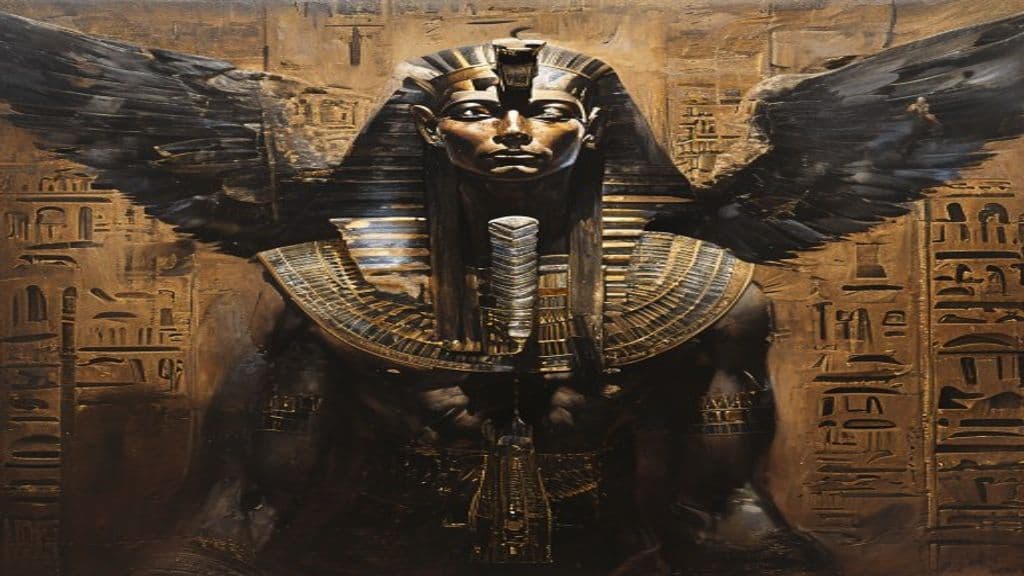
As a royal title, the Prenomen doesn't have any supernatural abilities or behaviors. Its role is closely tied to the pharaoh's identity and power.
Poutini
Poutini is a taniwha (water spirit) in Ngāi Tahu oral tradition associated with the West Coast (Te Tai o Poutini) of New Zealand's South Island. In the cited sources Poutini is described primarily as a guardian or kaitiaki of the people and of valued resources such as pounamu (greenstone).
Povitrulya
Povitrulya (Ukrainian: Повітруля) is a female wind-associated figure from Ukrainian lower mythology, described as an airy, winged maiden from the Carpathians who aids lovers and appears in folk tale motifs where her wings can be taken or burned to bind her to the human world.
Power animal
A contemporary New Age / Neoshamanic category for animal-form spirit-allies adopted in modern Western shamanic-style practices and also a phrase circulating in popular culture; not a single traditional indigenous entity and lacking a unified cosmology in the provided sources.
Prahasta
Prahasta (Sanskrit: प्रहस्त, IAST: prahasta, lit. "he who has extended hands") is a powerful rakshasa warrior in the Ramayana tradition, presented there as Ravana's chief commander who leads Lanka's armies in campaigns against gods, asuras, and the invading forces of Rama. Variants across traditions differ on his precise kinship to Ravana and on ethical portrayal, with some later retellings depicting him as a virtuous figure who counsels restraint.
Prajapati
Prajapati (Sanskrit: प्रजापति) is a Vedic-Brahmana creator figure whose name means "lord of creatures." In Vedic and Brahmana texts he functions as a primordial creative principle and progenitor; in later Puranic layers the term becomes a flexible title applied to multiple creator‑figures (including Brahma and others).
Praxithea
Praxithea (Ancient Greek Πραξιθέα) is a personal name borne by multiple women in classical Greek narrative traditions: several distinct figures include a freshwater nymph (Naiad), an Athenian queen or royal matron in different genealogical accounts, a daughter who with her sisters was linked to a civic-sacrificial legend at Athens, and a named witness who cries out during Demeter’s attempt to make Demophon immortal. The name thus indexes liminal roles between natural/divine landscapes and Athenian civic and household myth.
Preta (Bhūt)
A bhoota (bhūt) is a supernatural being in Indian popular culture and some ancient texts, typically understood as the restless or perturbed spirit of a deceased person that has not properly moved on after death. Their existence is linked to failures in funerary practice, violent death, or unresolved matters in life.
Preta (Hungry Ghost)
A post-mortem supernatural being associated with extreme, unremitting hunger and thirst. In Hindu usage the Sanskrit term can mean a deceased person, while Buddhist traditions develop the category into a distinct realm of hungry spirits whose condition illustrates karmic consequences for demeritorious action.
Preto / Preta (Bhuta) — Rajasthani folk tradition (absence of sourced evidence)
Requested research on a Rajasthani entity called "Preto/Preta (Bhuta)" cannot be supported by the supplied sources. The provided materials consist of a Portuguese disambiguation for 'Preto', a Wikidata entry for Pretoria, and three municipal/archival documents from Ribeirão Preto; none contain information on Rajasthani folklore, Bhuta, or preta spirits.
Priam
Priam is the legendary king of Troy in Greek and Roman epic tradition, an aged sovereign and father figure whose grief, supplication, and death are central episodes in the narratives of the Trojan War. He is portrayed as a mortal ruler embedded in a cosmos of gods and fate rather than as a supernatural being.
Pricolici
A Romanian folkloric revenant that combines lupine characteristics with vampiric, post-mortem hostility; typically represented as a wolf- or dog-like attacker associated with violent deaths, werewolves, and other harmful undead in rural tradition.
Prince Charming
A European-derived fairy-tale stock character archetype: an idealized princely rescuer who appears at the narrative moment of resolution to liberate a heroine (by kiss, recognition, marriage, or quest-completion) and thereby complete the tale's social or romantic reward.
Community Record
- [1]