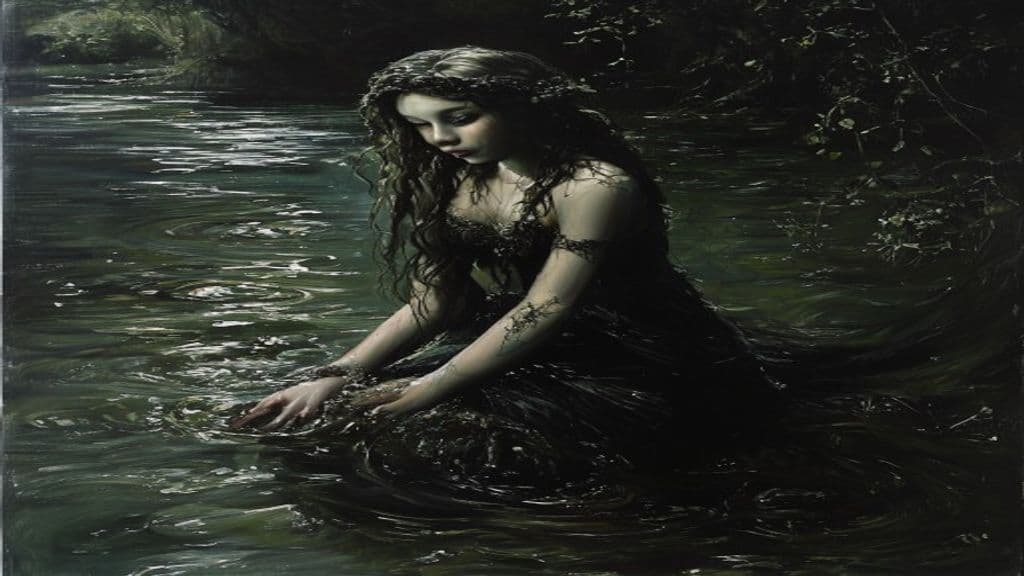
The Rhinemaidens were created by Richard Wagner for his opera cycle Der Ring des Nibelungen, drawing from earlier legends such as the Nibelungenlied.
No physical description is provided in sources. They are referred to as 'nixies sisters', implying an aquatic or water-dwelling nature.
The Rhinemaidens' abilities and behaviors are not specified in the provided sources, but they are said to act together as a single entity, luring men to their deaths with enchanting singing.
Weaknesses
- unknownNone specified
Wards
- unknownNone specified
Alberich
In Germanic heroic legend, Alberich is a dwarf associated with elven qualities and power. (Note: 1. Power tier: Reduce to Ancient as Alberich's abilities are not described beyond being a dwarf with elven qualities. 2. Origin story: Clarify that Alberich is mentioned in multiple Germanic texts, bu)
Altgermanische Religionsgeschichte
A historical survey of Germanic religious history, providing an overview of the pantheon of gods and goddesses. (Note: - Power tier is not applicable to historical surveys - The article should reflect that it's a historical survey, not an entity with abilities or appearance - Consider adding information on the signifi)
Anglo-Saxon Deities
A list of deities from the Anglo-Saxon pantheon, likely derived from Old English and other Germanic languages. (Note: 1. Power tier: Primordial seems too high given the sparse written record and limited information on abilities. 2. Appearance: Delete statement as no physical descriptions are provided in available sou)
Black Dog (folklore)
A class of supernatural canine apparition in British vernacular folklore, often associated with liminal places and regarded as an omen-bearing or guardian hound. Local named forms (Black Shuck, Barghest, Gurt Dog, Gallytrot) show a range from malign, death-portending hellhounds to benevolent guide-figures.
Black cat
A domestic cat with black fur that functions both as an ordinary companion animal and as a versatile folkloric symbol. In many traditions it is an omen of good or bad fortune, is associated with witches and seafaring luck, and has been repurposed in modern political and cultural symbolism.
Changeling
A changeling is a human-like substitute left by nonhuman beings (fairies, trolls, demons, etc.) after they abduct a human—most often an infant. Found throughout much of European folklore, the changeling functions as an uncanny domestic replacement whose presence explains sickness, developmental difference, or sudden loss.
Devil
A cross-cultural mythic personification of evil and hostile forces, used in religious, literary, and popular contexts to explain temptation, moral corruption, disease, death, and misfortune. Its exact cosmological status varies by tradition, ranging from an independent principle of evil to a created being that became evil or a symbolic embodiment of human wickedness.
Eotenas
Eotenas (Old English eotenas) are a race-class of other-than-human beings attested in Anglo-Saxon poetic contexts, notably Beowulf, where they appear among a catalogue of hostile or monstrous stocks. Philological traditions link the term to Old Norse jötnar/ettins (often rendered "giants" in modern summaries), but primary Old English lines give little concrete physical description.
Fairies
Fairies are a category of anthropomorphic spirit-beings from European folklore, described as possessing magical or preternatural qualities and appearing across a range of traditional stories and modern cultural expressions. The motif spans cautionary folk beliefs (often concerning protection from their spite) and contemporary festival, musical, and literary uses.
Fox spirit
A widespread class of mythical beings associated with foxes (often represented by red-fox imagery in many traditions) characterized by cunning, shapeshifting, trickery, and ambiguous moral roles; prominently attested in East Asian folklore and present in modern literature and media as romantic, vengeful, or matchmaking figures.
Imp
An imp is a small supernatural being in European folklore, typically characterized as a mischievous, lesser spirit or attendant rather than a major deity. Traditionally associated with pranks and household or local disturbance, the concept shifted over time toward associations with familiars and infernal attendants in Christianized contexts.
King in the Mountain
A widespread folklore motif of a ruler or hero who lies hidden or sleeping inside a mountain and is expected to return in a future time of need. Treated by folklorists as a comparative motif or tale type (e.g., the 'Kyffhäuser type') rather than a single named supernatural being.
Community Record
- [1]Wikipedia. Accessed on [date]wiki