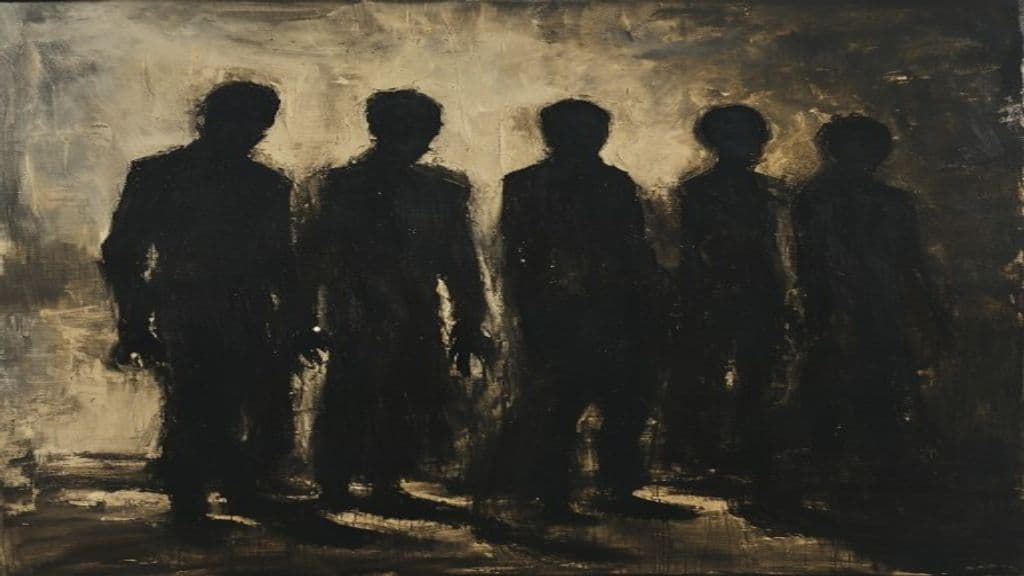
The supplied sources do not provide a traditional mythic origin story for shadow people. Instead, the concept appears in contemporary paranormal and supernatural discourse as a popular subject: described in modern media (encyclopedic entries, podcasts, and television/podcast listings) rather than traced to a single historic religion or indigenous cosmology. One practitioner in a recorded conversation frames shadow people within her personal, modern occult experience—reporting lifelong encounters and discussing them alongside spirit guides—but no culturally specific origin narrative or historic lineage is supplied in the provided material.
According to the sourced descriptions, shadow people are beings resembling animate human shadows. The available material gives no further fixed traditional details such as height, facial features, clothing, eyes, or a precise movement style: the characterization in the sources is limited to their shadow-like visual form as perceived in contemporary reports and discussions.
The sources do not document a consistent set of supernatural powers or behaviors. In contemporary paranormal discourse shadow people are 'sometimes interpreted as the presence of a spirit,' and at least one practitioner discusses them alongside spirit guides, implying they are experienced as unseen presences that can be perceived and potentially communed with. Beyond these generalizations about being read as spirits and debated as 'good or evil' in modern discussions, the supplied material does not record specific actions (such as possession, speech, or physical interaction) or defined capabilities.
Seventh son of a seventh son
A folkloric birth-status applied to a male who is the seventh consecutive male child in an unbroken male line whose father was also a seventh son; across several European-derived and Latin American traditions this status is associated variously with exceptional healing or with dangerous supernatural transformations. The figure functions as a social/biological category that explains extraordinary capacities or misfortunes rather than a single mythic individual or species.
Sexual vampire (Daoist sexual vampirism)
A conceptual category and set of practices in Chinese Daoist sexual-alchemical literature describing the absorption of another person's qi and jing through sexual techniques; also a literary motif comparing seductress spirits to practitioners who 'feed' on vital substances. It functions as both an esoteric technique aimed at longevity and a mythic trope of sexual predation in stories of fox spirits and reanimated corpses.
Shachihoko
A Japanese mythic sea-creature and roof-ornament (shibi) combining a predator head (dragon or tiger) with a carp body. In Japanese architectural and folkloric contexts it functions as an apotropaic roof guardian believed to store water and control rain, used primarily to protect wooden buildings from fire and as a status emblem.
Shaddād
A legendary king in Arabian folklore, described as tyrannical. (Note: 1. The power tier should be Greater (deity-level abilities are implied by association with a lost city and connection to Qur'anic lore). 2. Add appearance description from source material, mentioning )
Shade
A shade is the shadowy spirit or ghost of a dead person in classical and ancient Near Eastern literary and religious cosmologies, understood as the diminished, insubstantial residuum of a person who dwells in the underworld (Hades, Sheol/tsalmavet) rather than among the living.
Shadow (concept)
A polyvalent term used across optics, psychology, computing/administration, and popular paranormal conversation. In the supplied sources it is primarily an optical phenomenon and a psychological archetype; other uses are metaphorical or technical rather than descriptions of a single, traditional supernatural being.
Shadow person
A contemporary popular‑paranormal motif describing animate human‑shaped silhouettes or ‘black mass’ figures, often reported in contexts of sleep paralysis, low light, or substance‑induced delirium. Accounts range from experiential memorates and forum testimony to skeptical clinical explanations that treat sightings as hallucinations.
Shahbaz (Persian bird deity)
A divine being in Persian mythology associated with protection and guidance, resembling a large eagle. (Note: * Power tier: Greater (Shahbaz is described as a "god" in the source material, indicating deity-level powers) * Sensory cues: Add description of sensory cues associated with Shahbaz, such as its prese)
Shahnameh (Persian epic poem)
A long epic poem that tells of the mythical and historical past of Iran, containing descriptions and stories about various mythological creatures. (Note: - Power tier: Ancient (not Primordial), as it is a work of human authorship that conveys cultural narratives. - Summary: A long epic poem that tells of the mainly mythical but to some extent historica)
Shahrasb (Shahnameh)
A pious and reliable advisor in the Shahnameh tradition, guiding King Tahmuras towards moral guidance and acquiring Khvarenah. (Note: - Power tier: Primordial or Ancient would be more plausible given Shahrasb's role as a moral guide for a mythical king. - Appearance: Add "Not described in source material" to indicate that the inform)
Shai
Shai (also Sai, Shay; Greek Psais) is the Egyptian deification of fate, especially the ordained allotment of a person's lifespan. Present from an individual's birth and accompanying them until final judgment before Osiris, Shai functions as a theological principle integrated with birth goddesses, royal titulary, and, in the Hellenistic period, Greco-Egyptian syncretism.
Shaitan
A class of corrupted djinn who follow Iblis and dedicate themselves to leading humans astray — distinct from Iblis himself, the Shayatin are a species of evil djinn who whisper doubts and temptations into the minds of the living.
Community Record
- [1]Shadow person. "A shadow person is a popular subject in circles of the paranormal and supernatural detailing beings resembling animate human shadows, sometimes interpreted as the presence of a spirit."wiki
- [2]Shadow People (Wikidata entry). Wikidata entry linking contemporary media references (e.g., TV/podcast episodes) that discuss shadow people.other
- [3]They are Assigned to us Before we are Brought Earthside: Spirit guides and shadow people (podcast listing). "What are shadow people? Good or evil? And who are our spirit guides? We chat with Joelle Velez, a bruja in New Jersey who has been seeing shadow people her entire life as well as communing with her spirit guides."other
- [4]Superheroes & Acts of Kindness with Mark Grashow (S2 | E89) (podcast listing referencing shadow people). Episode listing included in the provided source set referencing modern media treatment of shadow-like phenomena.other
- [5]02-22-2023 Liberty RoundTable with Sam Bushman (archive listing referencing shadow people). Episode listing from the supplied sources indicating contemporary discussions of shadow people in modern media contexts.other