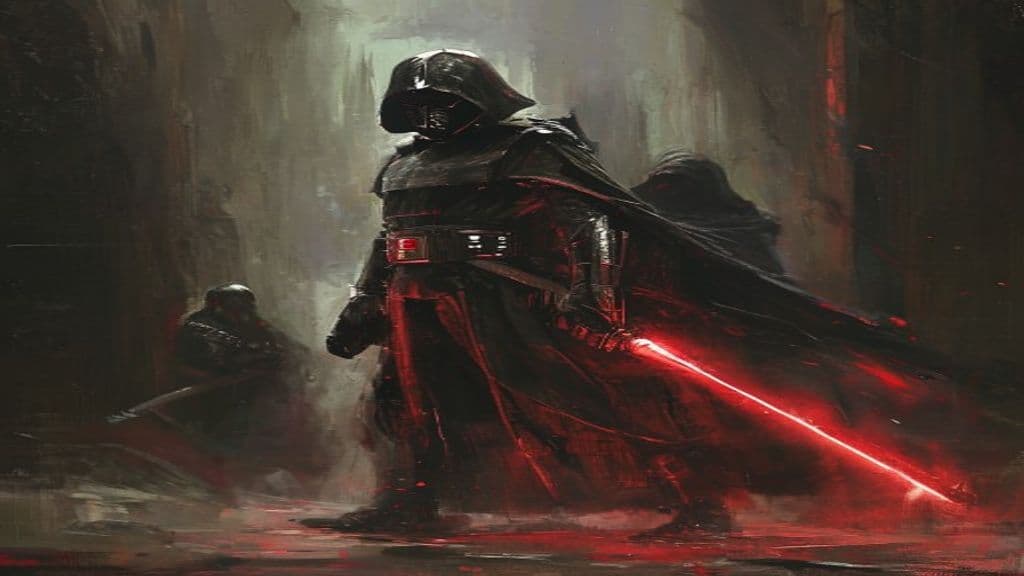
Within the franchise narrative summarized in the sources, the Sith are depicted as an ancient cult or order of warriors and Force-users who institutionalized devotion to the dark side of the Force. Historically within the narrative they grew to be a galaxy-spanning political-religious current; after coming close to extinction following the Battle of Ruusan roughly one thousand years before the Galactic Civil War, they survived covertly as a line of two Dark Lords organized as a master and an apprentice, later resurfacing as the ideological progenitors of major political regimes such as the Confederacy of Independent Systems, the Galactic Empire, the Imperial Remnant, and the First Order.
Sources do not present a single physical type for members of the order; Sith are a cross-species order of Force-sensitive individuals rather than a single race. A consistent visual association is their use of lightsabers as the traditional weapon, with Sith lightsabers typically depicted with red blades. The red color is explained in the cited material as the result of an unnatural corruption of kyber crystals by the dark side — a process described as causing kyber crystals to 'bleed' and produce red blades.
Sith are Force-sensitive and employ the dark side of the Force as their means and ideology. Ethically they embrace aggressive emotions — rage, hatred, and the pursuit of personal power — and use Force abilities toward domination, political seizure, terrorism, and mass murder as means to destroy the Jedi and rule the galaxy. Institutionally they practice a master–apprentice model characterized by perpetual treachery and betrayal; sources describe the fate of Sith Lords as often being death at the hands of their own apprentices. Specific named Force techniques are not enumerated in the provided excerpts, but their behavior and tools (lightsaber combat, kyber crystal 'bleeding') are emphasized.
Weaknesses
- conditionOpposition by Jedi and light-side institutions
- conditionInternal treachery and betrayal (institutional self-destruction through apprentices supplanting masters)
- conditionHistorical near-extinction (vulnerability to decisive military defeat, e.g., Battle of Ruusan)
Wards
- otherNo canonical universal wards described in the provided sources; opposition is organized institutional resistance by Jedi/light-side factions
Siren Head
Siren Head is a modern, internet-originated fictional cryptid created as an artwork by Canadian horror artist Trevor Henderson in 2018 and spread through social media, creepypasta lists, fan art, games, and mods. It functions as a transmedia horror icon—an image-first monster used in short narratives and interactive media rather than a traditional folk spirit.
Sirens
In Greek myth, Sirens are female-associated supernatural beings whose enchanting music lures sailors to ruin; they appear in epic voyages (notably the Odyssey) as maritime hazards and are depicted in early art as hybrid bird-women. Their role is chiefly as temptresses whose song causes the downfall or shipwreck of those who hear it.
Sirenuca
A Cantabrian water-associated female figure, the Sirenuca (literally 'Little Mermaid') is portrayed in regional tradition as a transformed young woman who became a water nymph after repeatedly climbing dangerous coastal cliffs to sing with the waves.
Sirona
Sirona is attested in modern scholarship as the name of a Celtic goddess known from sculptural and temple-related material; surviving references and images associate her with local cultic presence in parts of continental Europe. The supplied sources document visual attestations (museum/sculpture images and a woodcut) and modern reuses of the name but do not give detailed mythic narratives, functions, or ritual formulas.
Sirsir
Sirsir (also Ninsirsir) is a Mesopotamian deity associated with sailors and boats, attested from Early Dynastic god lists through later Babylonian compendia. He is named as the boatman/captain of Enki in literary tradition and appears among the names of Marduk in the Enuma Elish, while iconographic identification with a serpent‑tailed “boat god” motif is a debated scholarly proposal.
Sisyphus
Sisyphus is a legendary mortal king of Ephyra (Corinth) in classical Greek myth, famed for his exceptional craftiness and for twice cheating death; as punishment he is condemned in the underworld to an eternal, futile labor of rolling a great boulder up a hill only to have it roll back down.
Sitri
Sitri is attested in the supplied materials as a named entry associated with goetic lists derived from the Ars Goetia. The provided sources record the name but contain no descriptive, functional, or ritual information about Sitri itself.
Situa Festival
The Situa was a festival in the Inca Empire, held in Cusco to promote health and ritual purification. (Note: 1. Add a specific origin story or mythological reference to the "Origin Story" section. 2. Power tier: Given that it's an important festival and its rites are described by chroniclers, it's unlikely t)
Six‑Eared Macaque
A supernatural primate antagonist from the Ming‑dynasty novel Journey to the West who impersonates Sun Wukong. Described in the text as one of four special "spiritual primates," he demonstrates near‑omniscience and perfect mimicry of the Monkey King until revealed and subdued by the Buddha.
Siyah Div (Black Div)
Siyah Div (Persian: سیاه دیو), rendered in English as 'Black Div', is a named Div‑figure attested in Persian epic tradition (the Shahnameh). In the available sources he is identified in the manuscript/illustration cycle of the Shah Tahmasp Shahnameh and remembered by the epithet 'Slayer of Siamak.'
Sjtuf
Sjtuf is a Roermond processional giant — a 6‑metre-high anthropomorphic effigy (also called Christoffel) used in Dutch/Flemish giants' processions. It functions as a civic and religious pageant figure personifying Saint Christopher and is documented in archival descriptions and a Wikidata entry as a constructed parade giant rather than an autonomous supernatural being.
Sjörå
A female humanoid water spirit of Swedish folklore classed among the rå (place-keepers). Bound to a particular lake, pool, or freshwater site, the sjörå protects the waters and its fish, rewards respectful users with good catches and safety, and may seduce or drown those who are disrespectful.
Community Record
- [1]Sith - Wikipedia. Wikipedia contributors. 'Sith.' Wikipedia, The Free Encyclopedia.wiki
- [2]Sith - Wikidata. Wikidata entry Q51771.other
- [3]Full of Sith (podcast archive listings). Archive.org: Special Release: The Trailer Council (Full of Sith podcast listing).other
- [4]Full of Sith episode archive. Archive.org: Episode CCXXXII: Boba Fett and Daniel Logan (Full of Sith podcast listing).other
- [5]Full of Sith episode archive. Archive.org: Episode XVIII: Tricia Barr and the Fangirl Blog of Doom (Full of Sith podcast listing).other