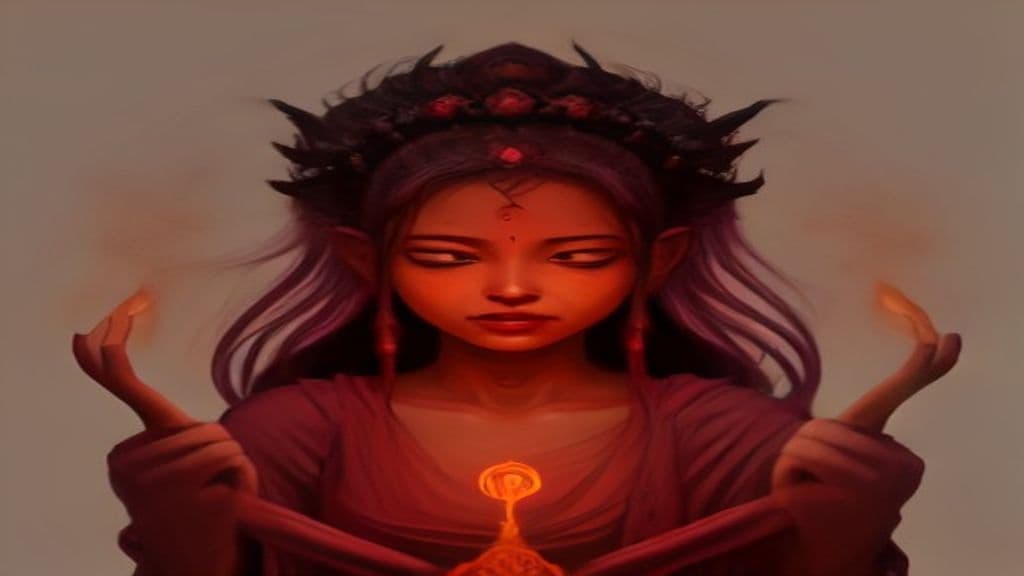
The supplied sources do not contain a narrative origin story for Ucchuṣma. The available entries identify Ucchuṣma only by classificatory terms (Vidyārāja) and refer to ritual manuscript material; no mythic birth or origin account is provided in the excerpts cited.
The provided sources do not supply descriptive iconographic details. One archive catalog title refers to a 'wrathful ucchusma,' indicating a wrathful form in ritual material, but no specifics (such as number of heads, hands, implements, posture, or colors) are given in the cited excerpts.
The cited materials classify Ucchuṣma as a Vidyārāja and note the existence of ritual texts for a wrathful form, which establishes Ucchuṣma's role within ritual and liturgical contexts. The sources do not enumerate specific powers, abilities, or behavioral patterns; they do not provide explicit statements that Ucchuṣma performs particular acts such as purification, protection, or exorcism within the supplied excerpts.
Acala
Acala (Sanskrit: अचल, 'The Immovable') is a wrathful protective deity (dharmapala) in Vajrayāna and East Asian esoteric Buddhism, classed among the Wisdom Kings (Vidyārāja). He functions as a ritual focus for visualization and mantra practice intended to remove obstacles and bind or destroy hostile forces.
Akshobhya
Akshobhya is a transcendent buddha of Mahāyāna and Vajrayāna Buddhism, one of the Five Wisdom (Dhyāni) Buddhas. He personifies 'mirror knowledge' (ādarśa-jñāna), is conventionally placed in the East, and is lord of the eastern Pure Land Abhirati; in esoteric texts he is associated with the eastern Vajra division and invoked in mantra/mandala ritual contexts.
Amitābha
Amitābha is a central celestial Buddha of Mahayana Buddhism who presides over the western Pure Land called Sukhāvatī. Devotional practices invoking his 'measureless' light and life (nianfo/nembutsu) are presented in Pure Land traditions as a path by which beings may be reborn in his buddhafield and quickly attain Buddhahood.
Anantacāritra
Anantacāritra (Sanskrit: अनन्तचारित्र) is a bodhisattva figure in the Lotus Sūtra, identified as one of the four great perfected bodhisattvas who attend Gautama Buddha. The name is glossed as "Boundless Practice" and, in Tiantai commentary, is read as representing eternity.
Arhat
An arhat (Sanskrit: arhat; Pāli: arahant) is in Buddhist traditions a human practitioner who has gained insight into the true nature of existence, attained nirvāṇa, and been liberated from the cycle of rebirth. The status and valuation of arhatship vary by school: some traditions equate it with full liberation, while others treat it as distinct from or inferior to the bodhisattva/buddha ideal.
Avalokiteśvara
A central Mahāyāna and Vajrayāna bodhisattva who embodies great compassion (mahākaruṇā), Avalokiteśvara hears the cries of sentient beings and manifests in many forms to relieve suffering. Venerated across South, Central, and East Asia, the figure functions devotionally (mantra and sutra recitation) and iconographically in multiple gendered and regional guises.
Bhaisajyaguru
Bhaisajyaguru (Bhaiṣajya‑guru; Medicine Buddha) is a Mahāyāna buddha associated with healing, medicine, and a pure land called Vaiḍūryanirbhāsa (Pure Lapis Lazuli). He functions as a therapeutic savior whose remedies operate through the "medicine of his teachings," vows, devotional practice, and radiance associated with lapis‑lazuli light.
Bhaiṣajyarāja (Medicine King Bodhisattva)
Bhaiṣajyarāja (Sanskrit: Bhaiṣajyarāja; Chinese: 藥王 Yào Wáng) is a Mahāyāna bodhisattva associated with healing, medicine, and supreme self‑offering. He appears in the Lotus Sūtra and in visualization/contemplation sutras and is often connected ritually and iconographically with the Medicine Buddha (Bhaiṣajyaguru) and with the paired bodhisattva Bhaiṣajyasamudgata.
Bhaiṣajyasamudgata
A Mahāyāna bodhisattva associated with the therapeutic activity of the Buddha and invoked in visualization (Guan) sūtras. He is named alongside the Medicine King (Bhaiṣajyarāja) and is the co-subject of a dedicated contemplation sūtra used in meditative-healing practice.
Cintāmaṇicakra (Nyoirin Kannon / Ruyi-lun Guanyin)
Cintāmaṇicakra is a bodhisattva-manifestation of Avalokiteśvara (Guanyin), identified with the wish-fulfilling jewel (cintāmaṇi) and wheel (cakra). In Mahāyāna sources the figure functions as one of six Avalokiteśvara forms tied to deliverance across the six realms (especially the deva realm) and is invoked through a dhāraṇī for karmic purification, protection, and fulfillment of aspirations.
Dakinī
A dakini is a feminine spiritual figure attested in Hindu and Buddhist literature and in Himalayan Vajrayāna cultural contexts; sources in this set characterize the dakini as a type or class of goddess and as a figure embedded in tantric and Himalayan religious landscapes. Specific iconography, powers, and ritual formulas are not documented in the supplied sources.
Dharmapāla
In Buddhist traditions, a dharmapāla is a protective deity or guardian whose role is to defend the Dharma (the Buddha's teaching) and to avert obstacles to spiritual practice. Appearing across Mahāyāna and Vajrayāna contexts (notably Tibetan, Chinese, and Japanese), dharmapālas range from local worldly guardians to wrathful enlightened emanations invoked in tantric ritual.
Community Record
- [1]Ucchusma — Wikipedia. Wikipedia, 'Ucchusma', accessed via provided research notes.wiki
- [2]Ucchusma — Wikidata Q667619. Wikidata entry classifying Ucchusma as a Vidyārāja in Mahayana and Vajrayana Buddhism, accessed via provided research notes.other
- [3]rdo rje rnam 'joms khro bo rme brtsegs pa'i mnol bsangs sogs (Ritual texts of wrathful ucchusma and some other daily ritual texts) — Archive.org (W3CN18559). Archive catalog title: 'Ritual texts of wrathful ucchusma and some other daily ritual texts Electronic reproduction' (transliterated Tibetan title provided in research notes).other