
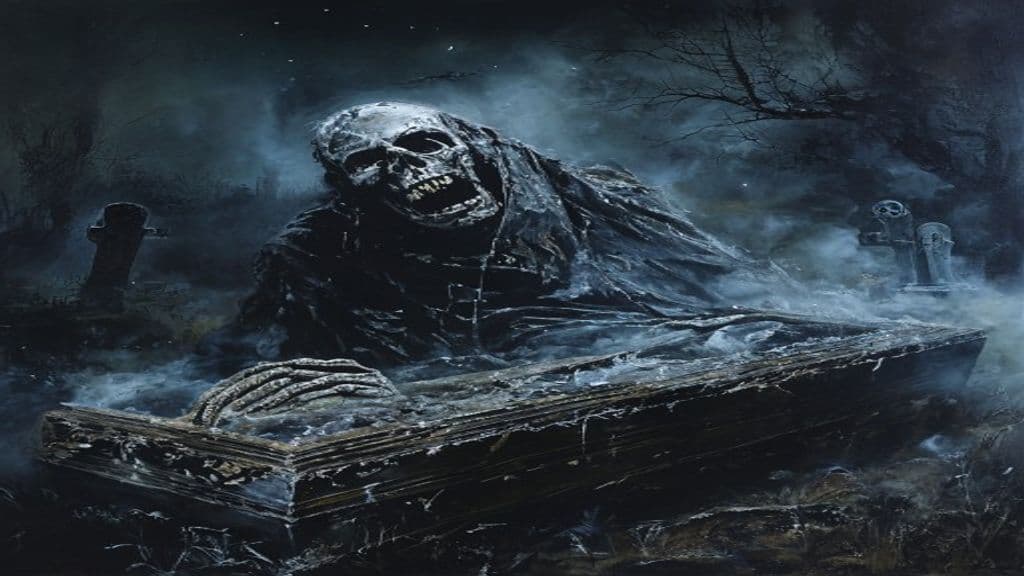
The term Wiedergänger is German for 're-walker' or 'one who walks again' and denotes the dead who return to the world of the living. Scandinavian cognates (Danish genganger, Norwegian gjenganger, Swedish gengångare, Icelandic afturganga) derive from Old Norse aptrgangr ('re-walker') and cover a similar conceptual field of revenant returns. Sources treat Wiedergänger not as a single uniform entity but as a category of post-mortem problematic presences whose apparent causes include vengeance for injustices suffered in life or a soul that is not released due to the deceased's former conduct.
Descriptions vary by region and by subtype rather than presenting a single canonical form. In German tradition the revenant may appear as a corporeal corpse rising from the grave; specialized forms include the nachzehrer (often depicted as remaining in the grave with an open mouth/eye while gnawing burial shrouds) and the aufhocker (an undead that physically springs onto night walkers). West German material also records headless-rider motifs as a local form of physical revenant. In the Nordic/Icelandic corpus the cognate category includes the draugr, a supernatural corporeal revenant encountered in sagas. Archaeological finds (e.g., a Schelluinen skeleton interpreted by excavators) show burial treatments—face down, heavy stones, unusual orientation—made in some contexts out of fear of physical reanimation; such finds are interpreted as evidence of concern about corporeal return.
Wiedergänger broadly are credited with returning from death to disturb, harm, or frighten the living. Specific behaviors are recorded for regional subtypes: the nachzehrer was said to 'suck the vitality' of the living by means of an open mouth or eye and by gnawing burial shrouds, sometimes without leaving the grave; the aufhocker physically leaps upon night ramblers, growing ever heavier until the victim collapses from exhaustion or dies (legends add the aufhocker can take forms such as a werewolf in some Rhineland tales); draugr in the Icelandic sagas are corporeal revenants whose encounter often portends imminent death. Motivations offered in sources include vengeance for wrongs or a soul not being ready to pass on.
Weaknesses
- ritualburial immobilization (face-down and heavy stones)
- ritualbanishment by prayer or spell
Wards
- ritualfunerary inversion and immobilization (burying face down, placing heavy stones / slate over the body; unusual orientation)
- mantraprayer or spell to banish an Aufhocker (unspecified formula)
Nachzehrer
A German revenant who gnaws its own shroud in the grave while draining the life-force of surviving family members, causing them to waste away one by one.

Aufhocker
The Aufhocker is a German folkloric shapeshifting 'pressure' or 'perching' spirit that leaps upon the backs or shoulders of solitary travelers, weighing them down with each step until victims become exhausted, incapacitated, or—in some variants—killed. It is associated with liminal places (bridges, crossroads, hollow paths, cemeteries) and exists in multiple narrative roles including punitive agent, nightmare embodiment, and theriomorphic attacker.
Nachzehrer
A German revenant who gnaws its own shroud in the grave while draining the life-force of surviving family members, causing them to waste away one by one.

Draugr
In Nordic folklore the draugr (plural draugar; anglicized draug) is an archaic term for a malevolent revenant — a dead person who returns and remains active in the world of the living. Accounts emphasize variability: traits, behaviours, and descriptions change between stories and across regions, especially in early medieval Icelandic sagas and surviving Norwegian folklore.
Dvalinn
Dvalinn is an Old Norse mythic name attested in the Poetic Edda and several sagas applied to at least two distinct figures: a named dwarf among the dwarf-kind (craftsman, rune‑figure, leader in some lists) and one of the four harts/stags that feed among the branches of the world‑tree Yggdrasill. The corpus does not reconcile these uses of the same name into a single coherent biography.
White Dragon Horse
A dragon prince from the West Sea who, after punishment and Guanyin's intervention, is transformed into and serves as Tang Sanzang's steed in the 16th‑century Chinese novel Journey to the West; by the pilgrimage's end he is ordained as a bodhisattva and resumes dragon status in a temple role.
White Hare of Inaba
A mythic talking hare from the Izumo/Inaba cycle of Japanese myths recorded in the Kojiki and later local traditions. In tales it tricks sea-creatures to cross water, is punished and later aided by the god Ōnamuchi (Ōkuninushi), and in some variants guides Amaterasu to a temporary palace site before revealing a divine identity.
White House Ghost (Abraham Lincoln)
The White House Ghost refers to reports that the spirit or apparition of U.S. President Abraham Lincoln has haunted the White House and other Lincoln-associated residences since his 1865 assassination. The phenomenon functions both as a reported localized haunting tied to Lincoln and as a recurring metaphor in American political and cultural writing.
White Lady
The White Lady is presented in the supplied source material as a type of female ghost, typically depicted wearing a white dress or similar garment. The available materials are minimal and provide only a brief definitional statement without cultural context, regional variants, or narrative detail.
Wicked fairy (Sleeping Beauty)
A folkloristic antagonist figure in the Sleeping Beauty tale-cycle, commonly called the Wicked fairy and appearing in adaptations under names such as Carabosse and Maleficent. The figure functions as the malign actor who precipitates the heroine’s central misfortune in the narrative tradition.
Wicker Man
The Wicker Man is a large wicker statue used in ancient Celtic ritual sacrifice by the druids, symbolizing human and animal sacrifice. (Note: - Remove "Primordial" power tier as it implies a level of cosmic or universal power that is not supported by source material. - Add Origin story based on source 1 (Julius Caesar's Commentary on the Ga)
Wight
A Germanic-language term historically meaning 'being' or 'creature' that, across Old English and Old Norse usage, covers ordinary created beings as well as a range of supernatural local spirits (e.g., land- and household- vættir). In later medieval and modern contexts the term's range shifted and in modern fantasy it has been narrowed by authors to denote specific undead creatures.
Wiglaf
Wiglaf is a human thane in the Old English epic Beowulf who exemplifies the comitatus ideal: he aids the dying Beowulf against the dragon, retrieves the treasure, and is charged with leadership and funerary duties as the poem's climax resolves.
Wild Hunt
A fearsome spectral cavalcade of the dead sweeping through the winter sky — those who see it risk being carried off or killed, and its passage foretells war, plague, or catastrophe.
Will-o'-the-Wisp
A wandering light seen over marshy ground at night, leading travellers astray into bogs and fens. Possibly a spirit, possibly the soul of the unbaptised dead, possibly the devil himself.
Will-o'-the-wisp
An atmospheric 'ghost light' — a small, mobile, lamp-like light seen at night over marshes, bogs, wet ground, or graveyards. In many cultures the phenomenon is interpreted as a supernatural being or manifestation (wandering nature-spirit, soul of the dead, transformed witch, or treasure-indicator); modern science offers chemiluminescent explanations for some occurrences.
Community Record
- [1]Wiedergänger — Wikipedia. Wiedergänger. Wikipedia entry summarising German and Nordic revenant traditions, including Nachzehrer, Aufhocker, draugr, and archaeological reports (Schelluinen).wiki
- [2]Hoaxilla #43 - 'Gefährliche Tote' (podcast listing). Episode description summarising popular motifs: 'They come at night to feed on the living...' (archive listing).other
- [3]Karin Lehmann, Wiedergänger - Seventeen gallery (exhibition text). Exhibition text noting literal translation and contemporary cultural resonance of the term Wiedergänger.other
- [4]Wikidata: Wiedergänger. Wikidata entry linked to the Wiedergänger concept.other