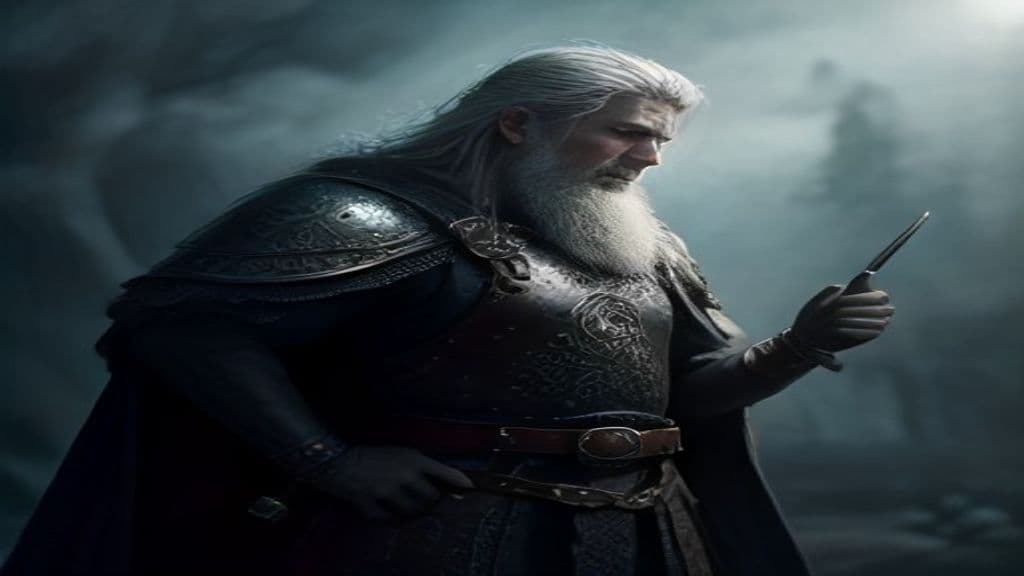
Wiglaf appears within the narrative world of the Old English poem Beowulf as a member of the Wægmunding lineage and a kinsman associated with Scylfing/Swede affiliations. The poem identifies him by name and kinship ties (son of Weohstan is noted in broader scholarship though the provided notes limit claims to his Wægmunding affiliation). He is presented as a young thane bound by kin‑duty and comitatus obligations who in the poem's final dragon episode is singled out by Beowulf to receive armor and rings and to be charged with building Beowulf's funeral mound and looking after the people, thereby functioning as Beowulf's designated heir and memorial custodian within the narrative.
The poem supplies only sparse descriptive detail: Wiglaf is introduced as a praise‑worthy shield‑warrior and described with epithets that mark his kinsmanship (mæg ælfheres) and association with Scylfing identity. No sustained physical portrait (height, hair, facial features) is given in the supplied material. In the dragon fight his hand is badly burned and his shield is consumed by fire.
Wiglaf displays courage, martial skill, and fidelity to comitatus norms. In the dragon fight he either alone or after a moment of remorse returns to aid Beowulf, strikes the dragon in its open wound, and tears at its throat so it can no longer breathe fire; his hand is grievously burned in the action. He rebukes fleeing thanes, takes responsibility for leadership after Beowulf's death, gathers treasure from the dragon's lair, participates in disposal of the dragon's corpse, and is entrusted with Beowulf's rings, helm, and mail‑shirt. Scholarly readings diverge on whether he briefly fled with the other thanes before returning or never fled (uncertain in sources).
Eanmund
Eanmund is a semi-legendary Swedish prince of the Scylfing dynasty attested in the Old English epic Beowulf. Portrayed as a mortal claimant to the Swedish throne whose exile and death precipitate inter-kingdom conflict and later vengeance by his brother Eadgils, he functions as a genealogical and political figure within the Scandinavian heroic cycle rather than a supernatural being.
Eoten (ēoten)
Eoten (Old English ēoten) is the Old English term glossed as 'giant' and cognate with Old Norse jötunn. In Anglo‑Saxon and Norse literary traditions the word is used within a wider family of large non‑human beings (jötnar, þurs, risi, troll) that often occupy liminal or primeval roles in myth and saga.
Finn (Frisian)
Finn is a named legendary Frisian king of the heroic age attested in Old English poetry (Widsith, the Finnesburg Fragment) and in the episode preserved within Beowulf. He appears in narratives of inter-ethnic warfare, hospitality, and the uneasy settlements that follow slaughter, sometimes portrayed as ruling honorably over surviving enemy retainers and in other variants as slain in the conflict.
Freawaru
Freawaru is a legendary human royal woman in Old English and Scandinavian traditions, presented in Beowulf as the daughter of King Hroðgar and Queen Wealhþeow and married to Ingeld as a freoðuwebbe (peace-weaver) intended to settle a blood-feud. Scandinavian prose (Gesta Danorum) preserves a cognate episode in which an old warrior (Starkad) incites renewed vengeance, reversing the marriage's peacemaking purpose.
Hengest
Hengest is a legendary early leader in Anglo‑Saxon tradition, presented in poetry and chronicles as a warrior‑chief and the putative founder or first king of Kent. He appears in Old English heroic material (the Finn/Hengest episodes of Beowulf tradition) and in later historiographical narratives (Anglo‑Saxon Chronicle, Vortigern story) as a culture‑hero and dynastic ancestor.
Sigmund
Sigmund is a legendary human hero of the Völsung (Wælsing) lineage in Germanic/Norse and Anglo‑Saxon literary tradition. Presented as son of Völsung and Hljod and father of later heroes, his life links kin‑vengeance, an Odin‑placed sword, cursed wolf‑skins, and the hereditary destiny that prepares for the later dragon‑slayer of the cycle.
Wicker Man
The Wicker Man is a large wicker statue used in ancient Celtic ritual sacrifice by the druids, symbolizing human and animal sacrifice. (Note: - Remove "Primordial" power tier as it implies a level of cosmic or universal power that is not supported by source material. - Add Origin story based on source 1 (Julius Caesar's Commentary on the Ga)
Wiedergänger
A Wiedergänger is a revenant — literally a 're-walker' — a deceased person or corpse believed in Germanic and Nordic traditions to return in bodily form or otherwise to affect the living. The concept functions as an umbrella for varied local revenant types (e.g., nachzehrer, aufhocker) and has cognates in Scandinavian genganger/gengångare and the Icelandic draugr traditions.
Wight
A Germanic-language term historically meaning 'being' or 'creature' that, across Old English and Old Norse usage, covers ordinary created beings as well as a range of supernatural local spirits (e.g., land- and household- vættir). In later medieval and modern contexts the term's range shifted and in modern fantasy it has been narrowed by authors to denote specific undead creatures.
Wild Hunt
A fearsome spectral cavalcade of the dead sweeping through the winter sky — those who see it risk being carried off or killed, and its passage foretells war, plague, or catastrophe.
Will-o'-the-Wisp
A wandering light seen over marshy ground at night, leading travellers astray into bogs and fens. Possibly a spirit, possibly the soul of the unbaptised dead, possibly the devil himself.
Will-o'-the-wisp
An atmospheric 'ghost light' — a small, mobile, lamp-like light seen at night over marshes, bogs, wet ground, or graveyards. In many cultures the phenomenon is interpreted as a supernatural being or manifestation (wandering nature-spirit, soul of the dead, transformed witch, or treasure-indicator); modern science offers chemiluminescent explanations for some occurrences.
Community Record
- [1]Wiglaf — Wikipedia. Wikipedia entry 'Wiglaf'.wiki
- [2]Wiglaf — Wikidata. Wikidata item for Wiglaf.other
- [3]Beowulf (poem excerpts and commentary provided in research notes). Quoted poem lines and scholarly commentary as supplied in research notes (appearance at line 2602, dragon fight actions, funeral mound charge, name etymology).literary