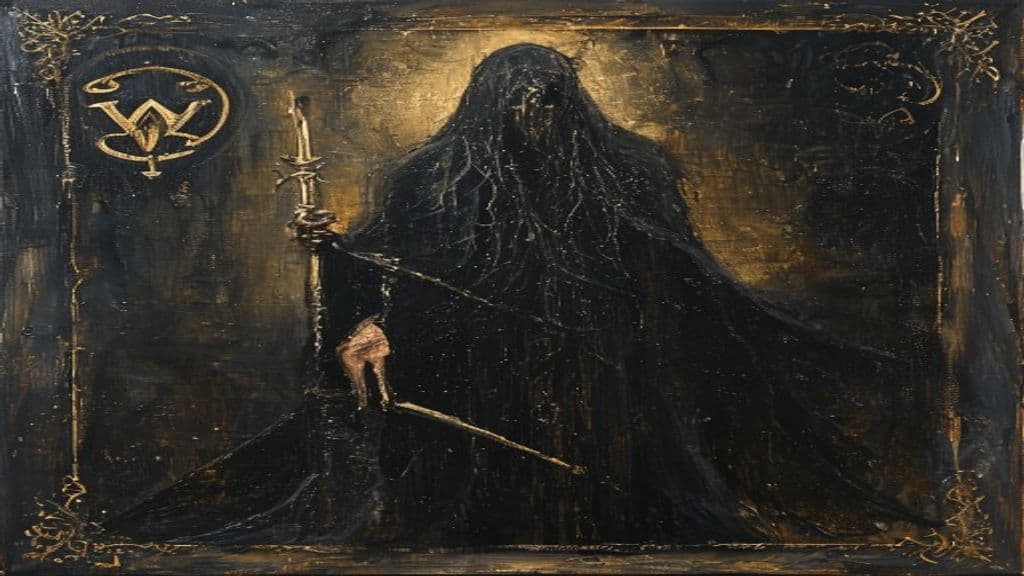
Wyrd is an abstract concept with no physical description.
Wyrd governs individual lives and their destinies, implying a sense of inevitability regarding the course of life events.
Wosret
Wosret (also Waset or Wosyet) is an ancient Egyptian city-goddess of Thebes whose name means "the powerful female one." She is a minor Theban deity attested primarily through royal titulary (e.g., Senwosret/Senusret) and occasional iconography that links her to the Was sceptre and martial accoutrements. Sources describe her as an early consort of Amun and later associated or conflated with Mut, though the relationship is ambiguous in the surviving record.
Wrathful Deities
In Mahayana and especially Vajrayana Buddhism, wrathful deities are fierce or wrathful forms (Tibetan: trowo; Sanskrit: krodha) of enlightened Buddhas, Bodhisattvas, or Devas. They function as protectors and transformative meditational yidams whose terrifying imagery is a skillful means (upaya) to remove obstacles, protect the Dharma, and transform afflictive emotions into wisdom.
Wu Fu (Wufu, Five Blessings)
Wu Fu (Wufu, "five blessings") is a Chinese cultural concept and auspicious motif representing a bundle of five desirable fortunes. It appears widely in decorative arts, rebuses, and charms as an emblem intended to signify or attract good luck rather than as an independent sentient spirit.
Wu Gang
A supernatural being in traditional Chinese folklore associated with endless labor and punishment, similar to Sisyphus. (Note: 1. Power tier should be Ancient (deity-level) as Wu Gang's punishment involves being confined to the Moon. 2. No information about sensory cues is provided in the source material. 3. No information ab)
Wufu (五福) — The Five Blessings
Wufu (五福), literally "Five Blessings," is a Chinese cultural concept grouping five auspicious life goods (such as longevity, wealth, offspring, virtue, and peace). It functions as a moral‑cosmological template expressed in textual enumerations, visual rebuses, household displays, and New Year greetings rather than as a personified supernatural being.
Wunambal
Wunambal (also Unambal, Wunambal Gaambera, Uunguu) is an Aboriginal Australian people, language, and name for country in the northern Kimberley of Western Australia. The term in the available sources refers to the ethnonym, language, and landholders rather than a discrete supernatural being; their cosmology forms part of the wider Wanjina Wunggurr cultural bloc in which creator spirits such as the Wanjina and Wunggurr (including Wandjina imagery) are central.
Wælcyrge (wælcyrie / wlcyrge)
An Old Norse-origin conception of a battle-associated female supernatural figure known in Old Norse as valkyrja and attested in Old English as wælcyrge/wælcyrie. In Norse sources these figures choose the slain on the battlefield and convey the chosen to Valhalla, while Old English attestations sometimes portray a more witch-like or maleficent war-maiden addressed in charms and manuscripts.
Wākea
Wākea is the Hawaiian Sky father and primordial ancestral progenitor who, with Papahānaumoku, forms the founding parent‑couple of the Hawaiian cosmos and chiefly genealogies. He is credited in some accounts with cosmogenic acts (creating islands, heavens, rain, and celestial bodies), is ancestor of the aliʻi, and is associated with moral adjudication of departed souls.
Wōden
Wōden (reconstructed Proto‑Germanic Wōðanaz) is the chief figure of Germanic paganism attested across Norse mythological sources and historical records of Northern Europe; scholarship reconstructs his name as linked to frenzy or possession and to poetic inspiration. Surviving information about him comes largely from medieval Norse literature and later historical commentaries of the Germanic world.
Xanthe
Xanthe (Greek: Ξανθή, Xanthē) is primarily a Greek-derived personal name meaning "blond-haired" attested across mythological, toponymic, astronomical, and modern personal-name usages. In the supplied sources it appears as the name borne by multiple distinct figures in Greek myth (an Oceanid, an Amazon, and as an alternate name applied to Epione) and as a modern given name and place/asteroid name, rather than as a single unified supernatural entity with its own cult or powers.
Xanthus (Ξάνθος)
Xanthus (Ancient Greek: Ξάνθος) is a recurring proper name in Greek myth and geography applied to multiple distinct beings and places: a river-personification (the divine name for the Scamander at Troy), one of Achilles' pair of immortal horses, several mortal figures (e.g., a Theban king), and the Lycian city and river Xanthus/Xanthos. The name literally means "yellow" or "blond" and functions as a descriptive epithet transferred across persons, animals, and places.
Xezbeth
Xezbeth (alt. Shezbeth; Arabic: al‑Kadhāb, "The Liar") is attested in Western demonological reference works and modern creative uses as a named demon associated with lies, invented tales, and the propagation of false legends.
Community Record
- [1]Wikipediawiki