Classical sources treat Acheron not as an individualized deity but as one of the infernal rivers structuring the geography of Hades; in mythic topography it functions as a liminal watercourse at the entrance to the realm of the dead. Some genealogical variants appear in mythic catalogues (the Suda records Acheron in differing conceptual roles, and certain authors attribute parentage of minor chthonic figures such as Ascalaphus to it), but the primary ancient attestation is as a named underworld river used by poets and geographers to situate passages to the afterlife rather than as a personal origin myth.
Literary descriptions variably present Acheron as a river, lake, or marshy watercourse associated with the Underworld; classical poets and playwrights sometimes depict it alongside other infernal waters (Styx, Cocytus, Phlegethon). In the physical landscape, the name designates a real 52 km river in Epirus (source near Zotiko, flowing to the Ionian Sea at Ammoudia near Parga) whose environs contain the ruins of a site identified as a Necromanteion; ancient colonists and later writers mapped mythic features of the underworld onto such real locales (for example, equivalences with Lake Avernus in Italy are attested in colonial and literary usages). Later authors (e.g., Dante) adapt Acheron as the border of Hell.
As a cosmological feature rather than an animistic being, Acheron's 'functions' are thematic and infrastructural: it serves as an entrance or boundary to the Underworld and a crossing-point for newly dead souls often ferried by Charon in many classical accounts; Roman and later poets sometimes vary this attribution, conflating or shifting ferryman or principal-river roles between Acheron and the Styx. In some traditions (notably an entry in the Byzantine Suda) Acheron is described as purgative or restorative — 'a place of healing' that cleanses sins — indicating that ancient conceptions ranged from punitive to curative. Classical sources (e.g., Virgil) also present Acheron in cosmological genealogies of infernal waters (Virgil describes it as principal in some contexts, with other rivers springing from or joining it). The river itself acts as a geographic organizer of afterlife space rather than an independent agent with volition.
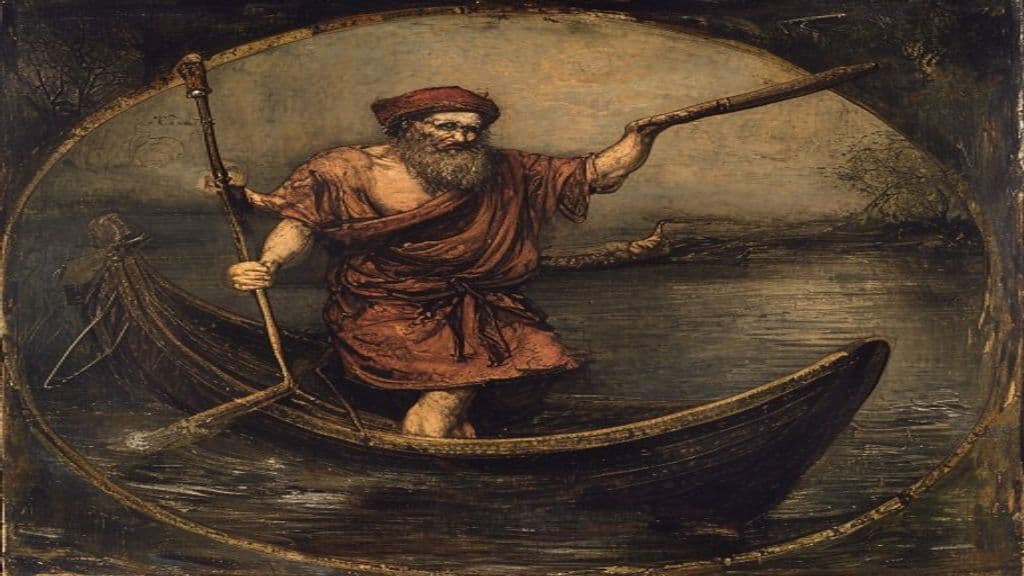
Charon
Charon (Χάρων) is the ferryman of the Greek underworld who conveys the souls of the dead across the boundary river (variously Acheron or Styx). He functions as an underworld attendant and psychopomp whose service typically requires funeral rites and payment (Charon's obol).

Styx
In Greek myth Styx is both a divine river-goddess and the underworld river she embodies; her waters form an ontological and ritual boundary of Hades and serve as the medium for the most solemn divine oaths, with specified punitive consequences for perjury.
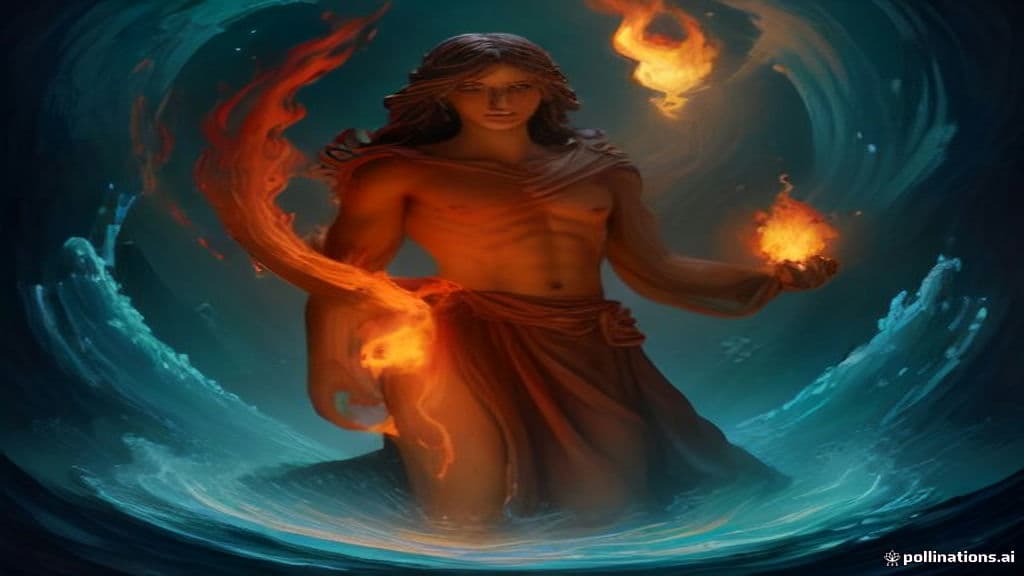
Phlegethon
A named river of the Greek underworld traditionally described as a flaming or fire-associated stream; later literary traditions (notably Virgil and Dante) reuse the name with varied imagery such as a river of boiling blood in Dante's Inferno.
*Péh₂usōn (reconstructed)
Péh₂usōn is a hypothetical Proto‑Indo‑European pastoral guardian reconstructed by comparative scholars from parallels in Greek and Vedic traditions. Proposed as a Graeco‑Aryan ancestor‑figure, the reconstruction describes a protector of flocks, roads, and travellers rather than an attested historical cultic personality.
3-D Man
3-D Man is a Marvel Comics superhero identity associated with a 1950s-era origin in which the body of Chuck Chandler can materialize in three-dimensional existence when activated by his brother Hal via a pair of glasses. The mantle was later assumed by Delroy Garrett (formerly Triathlon) in modern continuity.
5 Ronin
5 Ronin is a 2011 Marvel Comics five-issue limited series that reimagines five Marvel superhero archetypes as rōnin (masterless samurai) in a fictionalized post‑Sekigahara feudal Japan. The work places Wolverine, Hulk, Punisher, Psylocke, and Deadpool analogues into period roles to explore displacement, revenge, and identity in an era of political upheaval.
A Elbereth Gilthoniel
An Elvish hymn in Sindarin addressed to Elbereth (Varda) from J. R. R. Tolkien's legendarium. Presented in The Lord of the Rings and later musical and dramatic adaptations, the hymn functions as devotional poetic language that evokes Elvish reverence for the star-kindler rather than an independent supernatural agent.
A.R.G.U.S.
A.R.G.U.S. is a fictional clandestine United States government agency in the DC Comics universe that investigates, contains, and manages superhuman, meta-human, and supernatural incidents and assets. Introduced in The New 52 continuity, it functions as an institutional actor providing intelligence, logistical support, covert task forces (notably Task Force X / the Suicide Squad), and a dedicated magic division across comics and media adaptations.
Aba (disambiguation / name-form)
Aba is a polyvalent name-form attested across many unrelated contexts (place names, personal names, animal names, and brief mythological listings). The provided sources do not support a single, coherent supernatural entity called "Aba" and offer no descriptive or ritual material for such a being.
Abandinus
Abandinus is a locally attested Romano‑Celtic theonym known from a single inscribed bronze feather (votive object) dedicated at Godmanchester (the Roman fort Durovigutum) in Cambridgeshire. Scholars interpret him as a local god or male spirit tied to a specific place and possibly associated with a nearby spring or stream; this association is tentative and based on etymological readings of the name.
Abarbarea
Abarbarea is a name attested in classical Greek and Roman sources for freshwater nymphs (naiads). The name appears for at least two individual mythic figures — a naiad wife of Bucolion and a naiad counted among ancestors of the Tyrians — and Hesychius records plural forms that may indicate the name was also used as a class-name (Abarbareai / Abarbalaiai).
Abas
Abas (Ancient Greek: Ἄβας, gen.: Ἄβαντος) is not a single mythic being but a recurring personal name borne by multiple mortals and minor mythic figures in Greek epic and genealogical traditions — kings, founders, seers, warriors, attendants, a centaur, and a youth transformed by a goddess. The name is glossed in the sources as 'guileless' or 'good-hearted' and appears across Argive, Theban, Trojan, Euboean, and other local cycles.
Abderus
Abderus (Ancient Greek: Ἄβδηρος, romanized Ábdēros) is a mortal heroic figure in Greek myth closely associated with Heracles, remembered as the youth left in charge of the Mares of Diomedes who was killed by them. He functions as an eponymous local/divine-hero ancestor for the city of Abdera and received funerary commemoration and athletic agones at his tomb.
Abellio
Abellio is a theonym attested in Roman‑period inscriptions from the Comminges area of the Pyrenees and reported as worshipped in the Garonne Valley of ancient Gallia Aquitania. Surviving evidence is limited to a small number of inscriptions; scholars have variously hypothesized solar or arboreal associations and compared the name to forms of Apollo or to Celtic Belenus, but the deity's precise role in local cosmology remains uncertain.
Abin Sur
Abin Sur is a fictional extraterrestrial Green Lantern from the planet Ungara in DC Comics. A former history professor turned Green Lantern of Space Sector 2814, he discovered and investigated a prophecy tied to the "Blackest Night," died wounded on Earth and chose Hal Jordan as his ring-successor, and was later reanimated as a Black Lantern in the Blackest Night storyline.
Community Record
- [1]Acheron - Wikipedia. Wikipedia, 'Acheron' article (summary and classical references)wiki
- [2]Wikidata entry for Acheron (Q10399209). Wikidata item Q10399209 (name usages and disambiguation)other
- [3]Archive: The Walking Dead 1101 - Acheron Part 1. Archive.org item noting modern media use of the name 'Acheron'other
- [4]Archive: Ghost Acheron (Adam Hully). Archive.org item referencing modern creative uses of the nameother