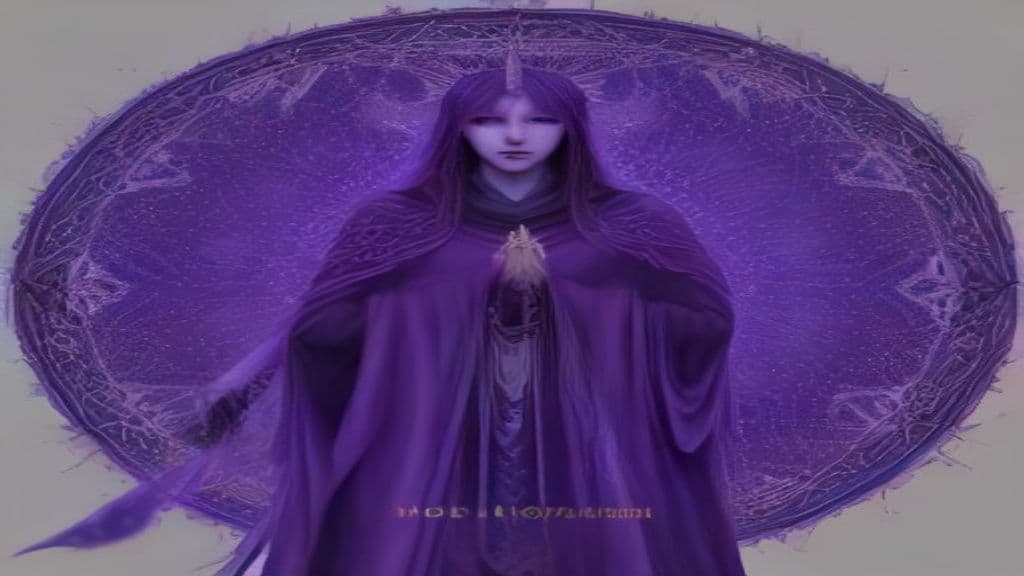
Amdusias has no narrative origin or mythic biography in the supplied materials; he appears as an entry in goetic grimoire listings (the Seventy-Two Spirits of the Ars Goetia / Lesser Key of Solomon) and is transmitted in modern commentaries and reproductions of those listings as a ritual entity available for evocation by ceremonial practitioners.
Primary goetic summaries record that Amdusias' 'true form' is that of a unicorn, while also noting that he can present as a human when evoked at the conjurer's request. The provided sources give no consistent further physical details (coloration, size, or other distinguishing marks) beyond the unicorn motif.
Goetic listings attribute to Amdusias command over twenty-nine legions and emphasize auditory/musical associations: his arrival is accompanied by the sound of trumpets and other musical instruments, and he is said to 'give concerts' or perform musically. He is also described as able to transform into human shape on request. Some excerpts mention an effect upon trees but the supplied lines are truncated and do not specify the precise nature of that effect.

Amaymon
Amaymon is a high-ranking infernal spirit—called a prince or king—named in Renaissance and later European grimoires as a cardinal or territorial ruler who exercises authority over other demons. Sources disagree whether he is king of the east (Pseudomonarchia Daemonum, Lesser Key of Solomon) or king of the south (Liber Officiorum Spirituum, Clavis Inferni, Book of Abramelin); he is credited with a deadly/poisonous breath, the capacity to deceive lax exorcists, and figures in ritual schemes that restrain or regulate spirits.
Flauros
Flauros (also attested as Haures / Hauras in variant spellings) is a named high-ranking spirit in Western grimoires, notably the Ars Goetia (Lesser Key of Solomon). Described as a 'Great Duke' who initially appears as a leopard and later assumes a human form with flaming eyes, he is invoked for truthful revelation about past, present, and future and for destructive aid against enemies, but must be constrained by ritual to prevent deception.
Focalor
Focalor is a named spirit from the Ars Goetia corpus, described in modern goetic compilations as a ducal-ranked spirit with authority over winds and seas who can drown men and sink ships; like other Goetic spirits he is represented as commandable by a conjurer.
Gamigin
Gamigin (also Samigina, Gamygin/Gamygyn) is a Goetic spirit attested in late-medieval to early-modern demonological grimoires (notably The Lesser Key of Solomon and Johann Weyer's Pseudomonarchia Daemonum). Described as a marquis who commands legions, he is reported to teach liberal arts and to compel certain souls (drowned and those in purgatory) into airy bodies to answer questions; in Thomas Rudd's tradition he is opposed by the Shemhamphorasch angel Ieuiah.
Paimon
Paimon is a high-ranking spirit from early-modern and medieval European grimoire traditions (notably the Ars Goetia and related compilations). He is depicted as a king who rules other spirits, teaches sciences and secret knowledge, and can be summoned and compelled by ceremonial operators within the ritual corpus.
Shax
Shax (also spelled Chax, Shan, Shass, Shaz, Scox) is a named spirit in ceremonial-grimoire listings, recorded with the rank of Marquis (and as Duke by some authors), said to command thirty legions and credited with removing sight, hearing, and understanding from targets and with stealing money.
Vassago
Vassago is a named spirit from European grimoire tradition (notably the Lesser Key of Solomon and the Book of the Office of Spirits / Sloane MS 3824). Presented as a princely Goetic spirit who can be summoned to reveal past and future events, locate lost things, and reveal treasures, he also appears in one manuscript as angelic in appearance.
Ambrosius Aurelianus
Ambrosius Aurelianus is presented in British late‑antique and medieval literary sources as a Romano‑British leader who rallied survivors against Anglo‑Saxon incursions in the 5th century. He is attested earliest in Gildas's De Excidio (6th century) as a Christian aristocratic war leader and is later expanded into prophetic and dynastic roles in the Historia Brittonum (9th century) and Geoffrey of Monmouth (12th century).
Ambush Bug
Ambush Bug is a fictional comic-book character published by DC Comics, created as a deliberately silly, self-referential figure who parodies superhero conventions and continuity. First appearing in DC Comics Presents #52 (Dec. 1982), he has been portrayed variably as an incompetent villain, a nuisance anti-hero, and a metafictional comic foil who frequently breaks the fourth wall.
Amduscias (Amdusias)
Amduscias (also spelled Amdusias) is a named entity appearing in lists of demons from the goetic tradition, most notably cited in modern compilations that draw from the Ars Goetia and related demonological works. The provided sources do not include a full primary grimoire entry for the name but show the term's reuse in contemporary music and gaming as an evocative cultural label.
Ame-no-Koyane-no-mikoto
Ame-no-Koyane-no-mikoto is a male Amatsukami (heavenly kami) in classical Shinto myth, presented as the ritual-official ancestor of the Nakatomi clan and linked genealogically to the Fujiwara. He functions as a divine ritual specialist—performing divination and liturgical speech in foundational myths (notably the Ama-no-Iwato episode) and as guardian of the sacred mirror—and is venerated at major shrines such as Kasuga Taisha and Hiraoka Shrine.
Ame-no-Minakanushi
Ame-no-Minakanushi (天之御中主) is a primordial kami named in Japan's classical creation texts as one of the very first deities to come into being in Takamanohara (High Heaven). Presented in the Kojiki and Nihon Shoki as a solitary, hidden first god, he functions primarily as a mythic point of cosmic origin rather than an actively intervening deity in surviving narratives.
Community Record
- [1]List of demons in the Ars Goetia (Wikipedia). Wikipedia: Amdusias entry in list of Ars Goetia spiritswiki
- [2]Amdusias - Thelemapedia. Thelemapedia: Amdusias entry (notes on unicorn form, legions, trumpet accompaniment, and human shape on evocation)other
- [3]Amdusias - Great Duke Demon of Hell - The Lesser Key of Solomon | Demonology - Solomon's Temple Investigation Marathon 449 (archive). Archive excerpt reproducing goetic listing for Amdusias (Sixty-seventh Spirit; appears as unicorn; legions; trumpet accompaniment; truncated note about trees)other
- [4]DUQUETTE + HYATT - Aleister Crowley's Illustrated Goetia (archive). DuQuette & Hyatt: modern commentary and practical manual reproducing Seventy-Two Spirits listings and general goetic ritual frameworks (source context for Amdusias entries)other
- [5]Amdusias (Anglic Seals Pages). Web summary reproducing goetic attributes for Amdusiasother