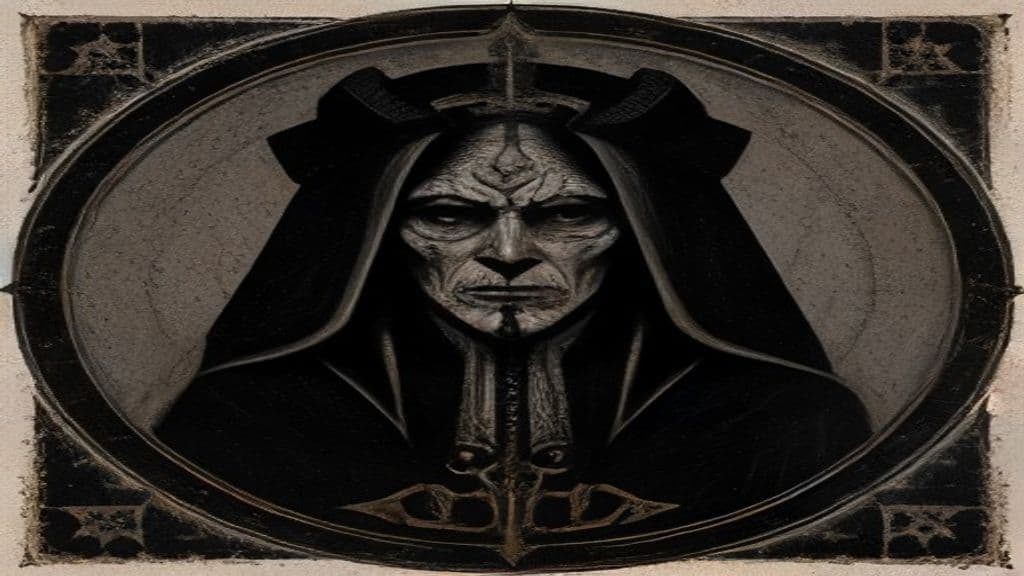
Focalor appears in the roster of spirits transmitted in the Ars Goetia tradition and is treated in modern goetic commentaries and compilations (e.g., the illustrated Goetia edition of DuQuette & Hyatt and online goetic encyclopedias). The tradition situates him among the seventy-two named intelligences cataloged in early modern and subsequently printed grimoires. Variant manuscript traditions and later commentators produce divergent details (notably in the number of legions he commands), but the consensus in the goetic corpus is that Focalor occupies a ducal office within that hierarchical taxonomy.
The supplied sources do not provide a consistent physical description of Focalor. Goetic transmission commonly varies in visual descriptions between manuscript traditions and later compilations; in the case of Focalor the available excerpts are silent on iconography or consistent iconographic traits, leaving no authoritative appearance attested in the provided material.
According to the cited goetic summaries, Focalor is ascribed power over wind and sea and is said to 'kill men, drown them, and sink warships.' He is described as a 'Great Duke' who commands legions of spirits (the number is reported variably as three legions in one account and as thirty legions in others). As with other entities in the Ars Goetia framework, his harmful natural operation is presented as subject to magical control: a conjurer who properly commands him can restrain him from harming people or things.
Weaknesses
- ritualcommand/evocation by a conjurer (Goetic binding)
Wards
- ritualConjuration and binding within the Ars Goetia framework (the sources note that if properly commanded by a magus he will not harm any man or thing)

Vepar
Vepar is a named spirit in the Western grimoire (Ars Goetia/Pseudomonarchia Daemonum) tradition presented as a ducal-ranked operative who governs waters and commands legions; sources attribute to her the power to roughen seas, guide armed ships, and cause putrefying sores that can kill. Descriptions in the supplied summaries emphasize her maritime domain and role within a ranked goetic hierarchy but do not provide detailed ritual protocols or a consistent corporeal iconography.
Djinn
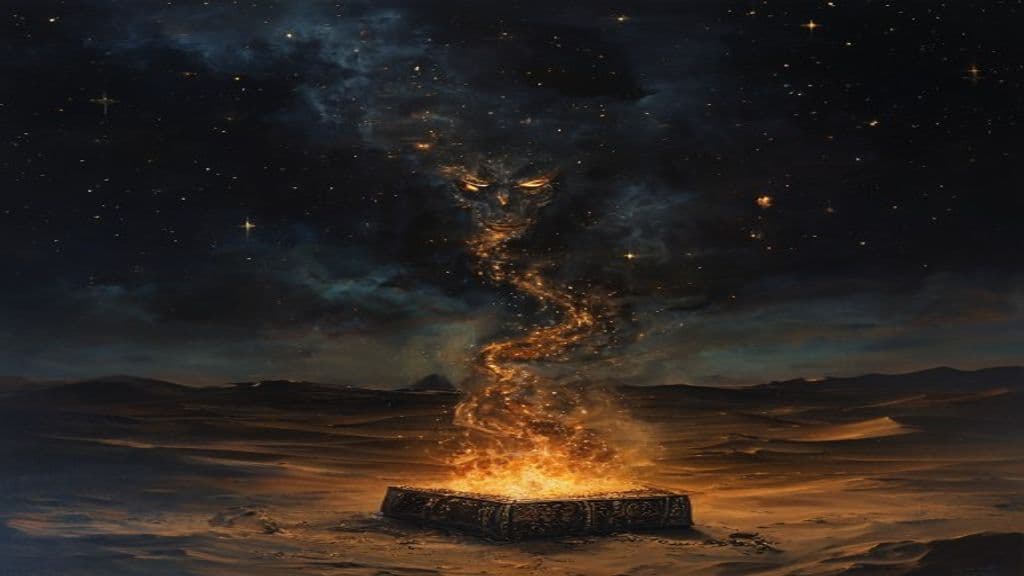
The class of supernatural beings created from smokeless fire in Islamic cosmology — a parallel civilization to humanity, capable of belief or unbelief, with their own prophets, society, and judgment before God.
Marid
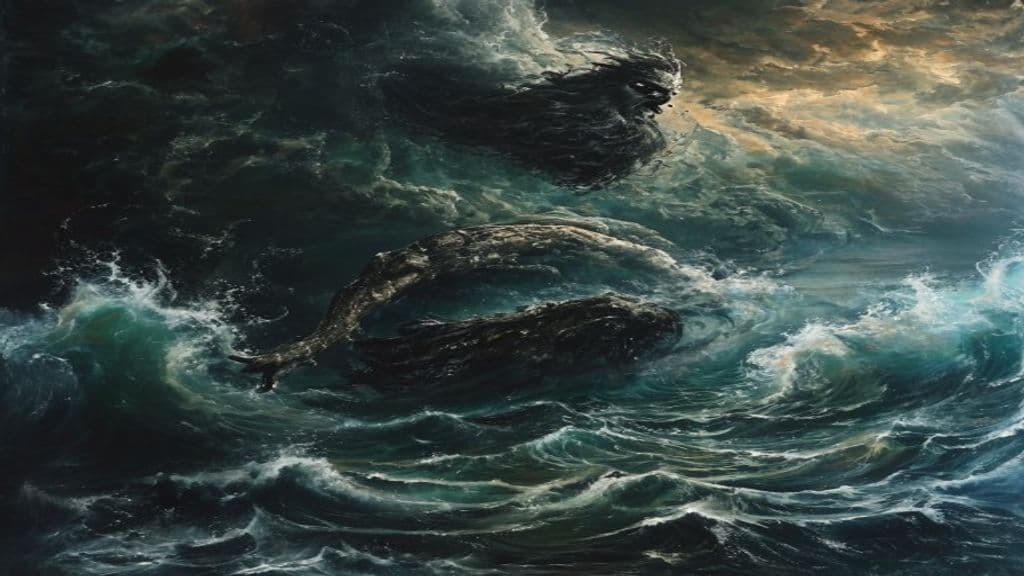
The most powerful class of jinn in Islamic tradition — beings of the sea, associated with the deep ocean, storms, and the granting of wishes at terrible cost. The classic genie of the Arabian Nights.

Jann
The weakest class of djinn in Islamic tradition, associated with desert winds and taking the form of snakes or whirlwinds, dwelling in empty wilderness and posing little threat to those who know the proper invocations.
Amaymon
Amaymon is a high-ranking infernal spirit—called a prince or king—named in Renaissance and later European grimoires as a cardinal or territorial ruler who exercises authority over other demons. Sources disagree whether he is king of the east (Pseudomonarchia Daemonum, Lesser Key of Solomon) or king of the south (Liber Officiorum Spirituum, Clavis Inferni, Book of Abramelin); he is credited with a deadly/poisonous breath, the capacity to deceive lax exorcists, and figures in ritual schemes that restrain or regulate spirits.
Amdusias
Amdusias is a named spirit listed in the goetic corpus (the Ars Goetia / Lesser Key of Solomon) described as the sixty-seventh spirit who commands twenty-nine legions; sources note his true form as a unicorn and that his arrival is accompanied by trumpets and musical sounds, and that he may assume human shape when evoked.
Flauros
Flauros (also attested as Haures / Hauras in variant spellings) is a named high-ranking spirit in Western grimoires, notably the Ars Goetia (Lesser Key of Solomon). Described as a 'Great Duke' who initially appears as a leopard and later assumes a human form with flaming eyes, he is invoked for truthful revelation about past, present, and future and for destructive aid against enemies, but must be constrained by ritual to prevent deception.
Gamigin
Gamigin (also Samigina, Gamygin/Gamygyn) is a Goetic spirit attested in late-medieval to early-modern demonological grimoires (notably The Lesser Key of Solomon and Johann Weyer's Pseudomonarchia Daemonum). Described as a marquis who commands legions, he is reported to teach liberal arts and to compel certain souls (drowned and those in purgatory) into airy bodies to answer questions; in Thomas Rudd's tradition he is opposed by the Shemhamphorasch angel Ieuiah.
Shax
Shax (also spelled Chax, Shan, Shass, Shaz, Scox) is a named spirit in ceremonial-grimoire listings, recorded with the rank of Marquis (and as Duke by some authors), said to command thirty legions and credited with removing sight, hearing, and understanding from targets and with stealing money.
Vassago
Vassago is a named spirit from European grimoire tradition (notably the Lesser Key of Solomon and the Book of the Office of Spirits / Sloane MS 3824). Presented as a princely Goetic spirit who can be summoned to reveal past and future events, locate lost things, and reveal treasures, he also appears in one manuscript as angelic in appearance.
Flying Crustacean
A cryptozoological report of a transparent, shrimp- or crayfish-shaped crustacean observed to leave the water and travel briefly through the air off Palawan, Philippines, in early 20th-century field notes by Dean C. Worcester. The phenomenon is also cataloged as a narrative motif in motif-indexing resources.
Flying Dutchman
A legendary phantom vessel in maritime folklore, said to be unable to make port and condemned to sail the oceans forever. Appearing to sailors as a full-rigged ship—sometimes ghostly-luminous, sometimes dark—its sighting functions as an omen of doom and is tied in many versions to a past crime or penance.
Flying Spaghetti Monster
The Flying Spaghetti Monster (FSM) is the satirical creator-deity of the Church of the Flying Spaghetti Monster (Pastafarianism), originated by Bobby Henderson in 2005 to parody and critique the introduction of intelligent design into public-school science. It functions as both a mock-religious deity in movement literature and a cultural/internet symbol used in public and media debates over religion and science education.
Fodbgen
Fodbgen (also Odbgen; modern Irish Foidhbhgen) is a legendary High King of Ireland from the Fir Bolg branch of the Dela. Medieval regnal lists record that he overthrew his cousin Rinnal, ruled for four years, and fell at Magh Muirthemne to Eochaid mac Erc; brief notices associate his reign with an etiological note about knots in trees and an unusual climatic formula.
Folklore, legends and myths in Dombey and Son
Literary influences from Greek folklore and mythology on the novel 'Dombey and Son' by Charles Dickens. (Note: 1. Summary: "Literary influences" is too vague; rephrase to specifically mention "Greek folklore and mythology". 2. Power tier: This entity doesn't exist in the source material; there's no indication )
Fomorians
A distinct supernatural race in early Irish myth who function as recurring antagonists to successive settler and divine groups in Ireland. They are frequently associated with hostile, chaotic forces of nature (sea, darkness, blight) and appear in origin‑war narratives as opponents of the Tuatha Dé Danann and earlier settler groups.
Community Record
- [1]List of demons in the Ars Goetia (Wikipedia). Wikipedia, 'List of demons in the Ars Goetia' (entry includes Focalor among the seventy-two spirits)wiki
- [2]Wikidata entry for Focalor. Wikidata item Q4491335 (Focalor)wiki
- [3]Focalor — Thelemapedia. Thelemapedia entry for Focalor (describes him as 'a powerful Great Duke', attributes over wind and sea, 'kills men, drowns them, and sinks warships', and notes he 'command[s] three legions' with variants)other
- [4]Aleister Crowley's Illustrated Goetia (DuQuette & Hyatt) — Table of Contents (archive). DuQuette & Hyatt, modern illustrated edition of the Goetia; Focalor appears among 'The Seventy-Two Spirits' in the table of contents (source indicates inclusion in that modern compilation and situates him within the broader ritual material though no Focalor-specific ritual text is quoted in the supplied excerpt).other
- [5]Delirium's Realm — Focalor. Online compendium entry referencing traditional attributions to Focalor (included in provided source list)other
- [6]Archive: Seal of Focalor (1993). Archive resource listed among supplied materials (seal image/resource associated with Focalor)other