In Greek mythographic genealogies cited in the surveyed sources, Anchinoe is named as a daughter of the river-god Nilus (Neilos). Some mythographers list her as the wife or consort of King Belus (Belos) of Egypt and the mother of Aegyptus (Aigyptos) and Danaus (Danao); a few accounts also attribute Cepheus and Phineus to her. These attributions appear in brief genealogical notices (e.g., Apollodorus as reported in modern compilations). Variant name-forms and separate local figures called Anchiroe or Anchinoe (for example a Thracian Anchiroe) probably represent distinct local nymphs or textual variants rather than a single unified origin story.
The sources identify Anchinoe only by classification as a Naiad (a freshwater nymph). No specific physical description, iconographic attributes, or independent depiction is recorded in the provided materials beyond that nymph-status.
No specific supernatural powers, feats, or characteristic behaviors are recorded for Anchinoe in the surveyed sources. Her attested role is genealogical and relational (daughter of Nilus, consort of Belus, mother of named offspring). Any assertion that she performed typical Naiad functions (for example, guardianship of a spring or river) is not documented in the provided materials and therefore remains speculative.

Naga
Divine serpent beings of Hindu, Buddhist, and Jain cosmology — powerful guardians of water, earth, and underground treasures. Revered as deities in South and Southeast Asia.

Naiad
A class of female nature-spirits in ancient Greek religion whose being is bound to particular bodies of fresh water (springs, wells, fountains, streams). Naiads are local, embodied presences venerated in community cults and invoked in rituals of purification, healing, and life-cycle events, yet they may also act harmfully toward humans.
Nilus
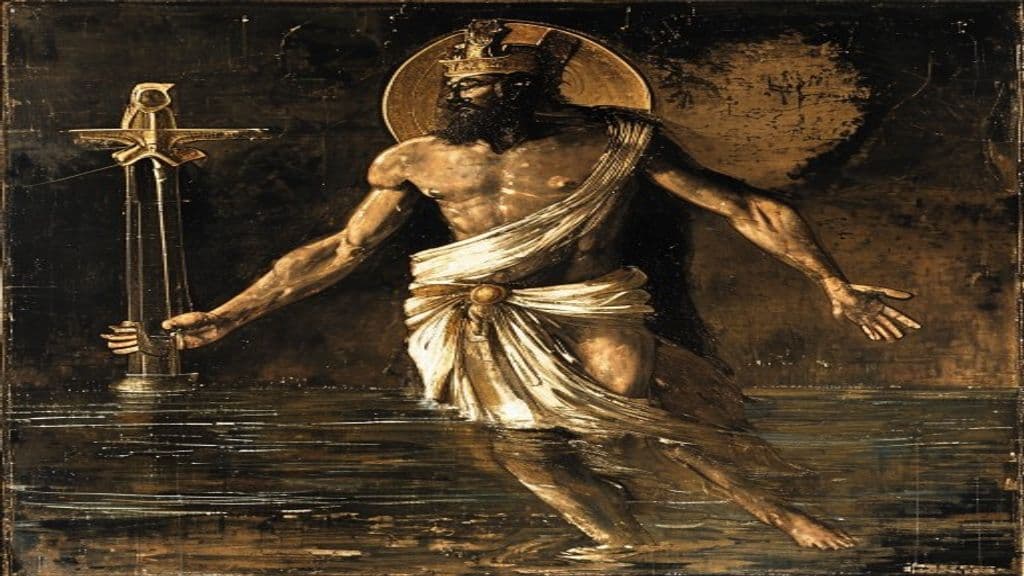
Nilus (Greek: Νεῖλος, Latin: Nilus) is the Greek personification of the Nile River attested in classical genealogies as a son of Oceanus and Tethys and historically referenced as a river-deity who received cultic honors in Egypt, notably at Niopolis. The name also functions separately as a Christian personal name borne by several saints and clerics; those human bearers are distinct from the river-personification.
*Péh₂usōn (reconstructed)
Péh₂usōn is a hypothetical Proto‑Indo‑European pastoral guardian reconstructed by comparative scholars from parallels in Greek and Vedic traditions. Proposed as a Graeco‑Aryan ancestor‑figure, the reconstruction describes a protector of flocks, roads, and travellers rather than an attested historical cultic personality.
Aani
Aani (ancient Egyptian jꜥnr) is the lexical term for the baboon in ancient Egyptian language and functions in religious contexts as an animal icon and theophoric epithet. Attested repeatedly in Egyptian texts and images, the baboon image is used to represent or denote aspects of gods such as Thoth, Hapy, Khonsu, and Osiris rather than implying the animal itself is an independent deity.
Aati
Aati (also rendered Ati) is one of the 42 judges of the dead in ancient Egyptian funerary literature, attested in the Book of the Dead tradition (notably the Papyrus of Nebsemy). Described as originating 'from Heliopolis', Aati's documented function is to question the deceased about a specific moral accusation during the Duat judgment; the funerary texts supply a formulaic denial the soul must recite.
Aba (disambiguation / name-form)
Aba is a polyvalent name-form attested across many unrelated contexts (place names, personal names, animal names, and brief mythological listings). The provided sources do not support a single, coherent supernatural entity called "Aba" and offer no descriptive or ritual material for such a being.
Abadiu of Antinoe
Abadiu of Antinoe was a fourth‑century bishop of Antinoe (Antinoopolis, in Roman Egypt) commemorated as a martyr and saint in the Coptic Orthodox Church, with a feast day on 26 December. Sources record that he was killed during a theological dispute with Arian opponents and reference him in collections of Egyptian martyrs.
Abarbarea
Abarbarea is a name attested in classical Greek and Roman sources for freshwater nymphs (naiads). The name appears for at least two individual mythic figures — a naiad wife of Bucolion and a naiad counted among ancestors of the Tyrians — and Hesychius records plural forms that may indicate the name was also used as a class-name (Abarbareai / Abarbalaiai).
Abas
Abas (Ancient Greek: Ἄβας, gen.: Ἄβαντος) is not a single mythic being but a recurring personal name borne by multiple mortals and minor mythic figures in Greek epic and genealogical traditions — kings, founders, seers, warriors, attendants, a centaur, and a youth transformed by a goddess. The name is glossed in the sources as 'guileless' or 'good-hearted' and appears across Argive, Theban, Trojan, Euboean, and other local cycles.
Abaset
Abaset is a localized ancient Egyptian goddess attested in tomb decoration at El‑Bawiti in the Bahariya Oasis during the 26th Dynasty. She is depicted anthropomorphically with a hedgehog motif incorporated into her headdress and appears on the walls of Qarat Qasr Salim, including twice in the Tomb of Bannentiu. No cult texts, myth narratives, or ritual prescriptions for her are recorded in the cited corpus.
Abderus
Abderus (Ancient Greek: Ἄβδηρος, romanized Ábdēros) is a mortal heroic figure in Greek myth closely associated with Heracles, remembered as the youth left in charge of the Mares of Diomedes who was killed by them. He functions as an eponymous local/divine-hero ancestor for the city of Abdera and received funerary commemoration and athletic agones at his tomb.
Abib and Apollo
Abib and Apollo are Christian ascetics and hagiographic saints of Akhmim (Upper Egypt) attested in Coptic sources and the Historia Monachorum. Remembered for extreme asceticism, monastic leadership, angelic encounters, and inclusion in the Coptic Synaxarion (feast day November 4).
Abomination of Desolation
An apocalyptic prophetic phrase originating in the Book of Daniel designating a profaning thing or act that renders the Jerusalem Temple cult desolate; later reused in the Synoptic Gospels as an eschatological sign prompting urgent flight. The term denotes ritual/cultic impurity (Hebrew shiqquts) and is variously interpreted as pagan offerings or altar, a foreign cult statue, or (in some New Testament readings) an acting agent.
Absyrtus
Absyrtus (Ancient Greek: Ἄψυρτος) is a Colchian prince in the Greek Argonautic cycle, son of King Aeëtes and brother or half-brother of Medea. He appears in variant traditions either as a companion taken by Medea during her flight with Jason and murdered/dismembered to delay pursuit, or as a pursuer sent by Aeëtes who is overtaken and slain by Jason; his death functions as a key narrative device in the escape from Colchis.
Community Record
- [1]Achiroe (Anchinoe) - Wikipedia. Wikipedia: Achiroewiki
- [2]ANCHINOE (Ankhinoe) - Egyptian Naiad Nymph of Greek Mythology. Theoi Project: Ankhinoefolk
- [3]Person: Anchinoe - UVic Myth Index. University of Victoria Mythology Index: Anchinoeacademic
- [4]Anchinoe in Greek Legends and Myths. Greek Legends and Myths: Anchinoefolk
- [5]Anchiroe of Thrace - Wikipedia (name-variant discussion). Wikipedia: Anchiroe of Thrace (notes on variant names)wiki
- [6]Wikidata entry for Anchiroe. Wikidata: Anchiroewiki