
Aniruddha is born into the Vrishni (Yadu) line as the son of Pradyumna and Rukmavatī and thus grandson of Kṛṣṇa and Rukmiṇī; he functions as a royal prince and warrior in the mytho-historical era surrounding Kṛṣṇa. In the Bhāgavata Purāṇa narrative he becomes the lover and husband of Uṣā (daughter of Bāṇāsura) through a dream-initiated episode that leads to his capture in Sonitapura, a subsequent rescue by Kṛṣṇa and the Yadu forces, and later fathers Vajra (and Mrigaketana by Rochana), through whom dynastic continuity is traced after the Yadu calamity. In Vaiṣṇava theological formulations he is also counted among the catur-vyūha (fourfold Vrishni emanations) and in some accounts is considered a jānā-avatāra or associated with Viṣṇu’s boar aspect (Varāha).
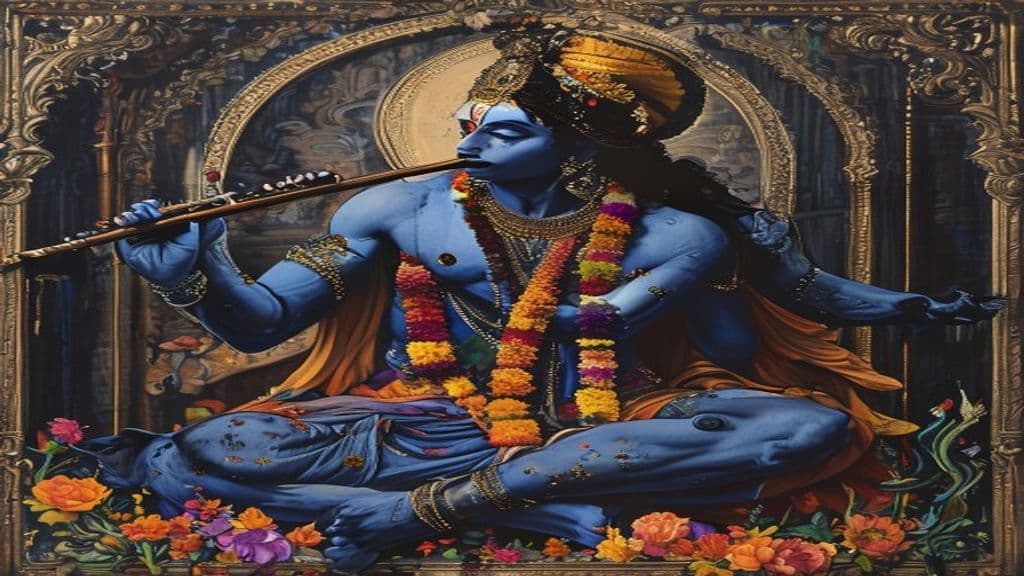
As narrated, Aniruddha appears as a Yadava prince and a mahārathi warrior; narrative sources focus on his princely/heroic role rather than detailed dress or bodily description. In Vaiṣṇava iconography and catur-vyūha/vaikuṇṭha-caturmūrti statuary he is given a theriomorphic aspect associated with the boar (Varāha)—in some caturvyūha images he appears as the boar member, and in Vaikuṇṭha caturmūrti imagery a boar head is represented projecting from the side of Viṣṇu’s head—indicating mixed human/divine/animal representation in temple and theological art.
Sources describe Aniruddha as a mahārathi (a great warrior) who fights in battles and performs the roles of prince, husband and dynastic progenitor. In the Uṣā episode supernatural and yogic powers affect him: Uṣā sees him in a dream, Chitralekha uses anima-like yogic power to render him small and bring him to Uṣā, and Varuṇa’s mystical ropes and other celestial interventions are used in the conflict that follows; these agents act upon him or against him rather than being described as his inherent powers. Theological descriptions that include him in the catur-vyūha and associate him with Varāha imply a ritual/iconographic role as an emanation within Vaiṣṇava cosmic schema.
Weaknesses
- conditionvulnerability to yogic/siddhic constriction (as in being shrunk via anima-like power and bound by mystical ropes)
Wards
None recorded.
Achyuta
Achyuta (Sanskrit: अच्युत, acyuta) is primarily an epithet/theonym in Vaishnava Hindu tradition applied to Vishnu and Krishna, signifying the divine quality of being 'not fallen' — immutable, infallible, and imperishable. It functions as a devotional name in scripture, liturgy, and Pancharatra lists of divine emanations rather than as an autonomous folkloric spirit.
Avatar (avatāra)
In classical Hindu theology, an avatāra is a divine 'descent' — the event or fact of a superhuman being or deity making a material appearance in the temporal world to accomplish a purpose (commonly to restore dharma). The term (Sanskrit अवतार, avatāra) emphasizes crossing down from the unconditioned into conditioned existence and is central to Vaishnava theology of Vishnu's incarnations while also appearing in other Indian religious contexts.
Dashavatara
Dashavatara (Sanskrit: daśāvatāra) names a canonical set of ten principal incarnations of the Hindu god Vishnu, each a full descent (avatara) taken to restore cosmic order (dharma) at moments of great disorder. The list and order of the ten vary by Purānic and sectarian traditions; the concept functions across mythology, temple cult, and devotional practice.
Devi
Devi (Sanskrit: Devī) is the general term for goddess in Indian religious thought, signifying the divine feminine or Shakti; in different texts and traditions she appears as individual goddesses (e.g., Parvati, Lakshmi, Saraswati) or as the supreme reality (notably in Shaktism and certain Upanishads). Sources treat Devi both as a class/category of female divinities and as a philosophical identification with ultimate reality.
Hindu deities
Hindu deities (Deva/Devi) are the diverse gods and goddesses recognized across Hindu traditions, ranging from Vedic forces of nature to later personalized major gods and goddesses. They function as patrons of rites, embodiments of moral and cosmic principles, and focal points for temple cults, festivals, and devotional traditions while often also being interpreted as aspects of a single Ultimate Reality (Brahman).
Krishna
Krishna (Sanskrit: Kṛṣṇa) is a major Hindu deity presented in the supplied sources both as the eighth avatāra of Vishnu and, in many traditions, as the Supreme Being (Svayam Bhagavān). He appears in a range of roles—child, cowherd, lover, charioteer, teacher and divine hero—and his life episodes (Krishna-līlā) are central to bhakti devotion, performance arts, and pilgrimage traditions.
Lakshmi
Lakshmi is a principal Hindu goddess who personifies śrī (auspiciousness) and is revered as the giver of fortune, wealth, prosperity, beauty, fertility, sovereignty, and abundance. She is the consort and shakti of Vishnu in Vaishnavism, part of the Tridevi with Parvati and Sarasvati, and is the focus of popular devotional and festival practices such as Lakshmi Puja during Deepavali and Navaratri.
Para Brahman
Para Brahman (Sanskrit: परब्रह्म, parabrahma) is a Hindu metaphysical designation for the Supreme Brahman — the highest, ultimate Reality described as beyond all descriptions and conceptualisations. Depending on school it denotes the attribute‑less absolute (nirguṇa) or the supreme personal God (saguṇa) identified with a sectarian deity.
Radha
Radha (Sanskrit: Rādhā; also Rādhikā) is a central goddess-figure in Vaishnavite devotional literature, portrayed as the chief gopi and beloved of Krishna and in many traditions as the supreme feminine principle (an aspect of Lakshmi or the hlādini-śakti). She is a paradigmatic emblem of devotional love (bhakti) whose prominence grows in medieval and early modern Bhakti poetry.
Satyabhāmā
Satyabhāmā is a goddess in the Krishna-centered Vaishnava tradition, presented as one of Krishna's chief/third consorts and as an incarnation of Bhūmi (the Earth) and an aspect of Lakshmi; she appears in scriptural episodes (notably the pārijāta episode in Śrīmad-Bhāgavatam) and in living devotional and performative contexts (temples, classical dance).
Anippe
Anippe (Ancient Greek: Ἀνίππης) is a river-nymph (naiad) in Greek mythology, described in mythographic sources as a daughter of the river-god Nilus and as the mother of the Egyptian king Busiris by the god Poseidon. She is attested primarily as a genealogical figure tying Egyptian place-figures into Greek divine genealogy.
Anit
The string "Anit" appears in the consulted sources as a modern personal name, acronym/technical term, and occasional orthographic variant; the dataset contains no coherent folkloric entity named "Anit." The only mythic figure in the corpus with a vaguely similar spelling is the Egyptian minor goddess Iunit (also spelled Iunet), 'She of Armant,' consort of Montu — an identification with "Anit" is uncertain in the sources.
Community Record
- [1]Aniruddha — Wikipedia. Wikipedia, 'Aniruddha' article (summary of traditional accounts, name gloss, Uṣā–Bāṇāsura episode, caturvyūha association)wiki
- [2]Bhāgavata Purāṇa — chapter 62 (SB 10.62) summary (Vedabase). Vedabase.io, 'Chapter Sixty-Two' (summary of the Bāṇāsura episode, Bāṇāsura as devotee of Śiva and the rescue narrative involving Kṛṣṇa and Aniruddha)literary
- [3]Aniruddha — Mythology/Encyclopedia entry. Mythology/folklore encyclopedia entry summarizing narrative elements (Uṣā dream-episode, lineage, marriages, offspring)folk