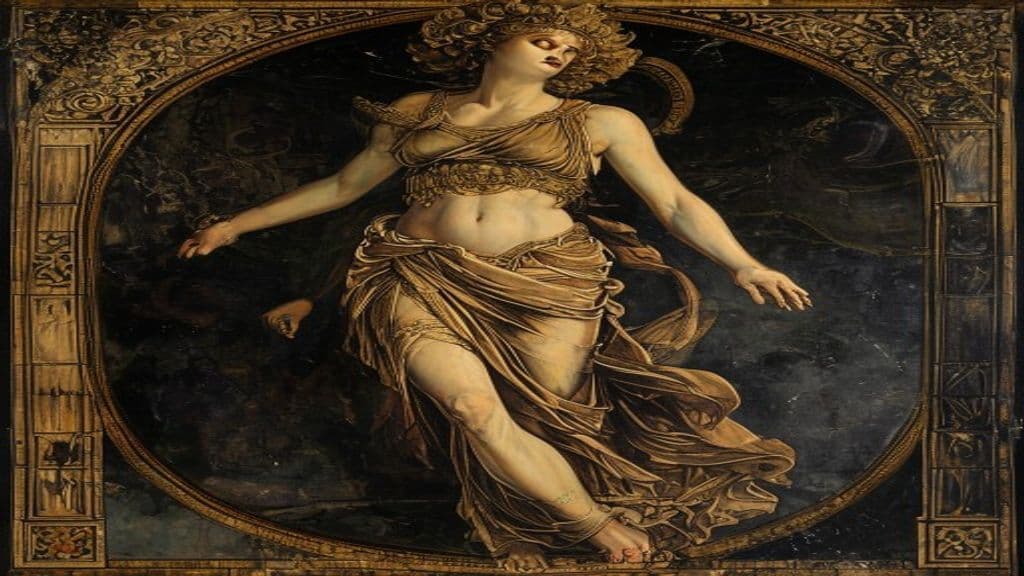
In the theogonic networks of Greek myth Apate is a primordial personification of deceit. The provided sources identify her as a daughter of Nyx (Night) and Erebus (Darkness), placing her among the older elemental personifications rather than the later Olympian order. The material also notes that variant theogonies exist in the tradition (minor/orphic variants are attested in broader scholarship), and that Roman mythographers equate her with Fraus and pair her with a masculine counterpart, Dolus.
Classical sources provide limited physical description. In Nonnus' Dionysiaca (as summarized in the provided material) Apate is characterized chiefly by a Kydonian girdle or cincture about her hips that is described poetically as containing the mechanisms of human guile — trickery, cajoling seduction, shifting guile, and perjury. This girdle functions as a symbolic/magical attribute in the mythic episode; no sustained anthropomorphic portrait (facial features, coloration, stature) is given in the supplied texts.
Attested powers are literary and symbolic: Apate embodies deception and, in Nonnus' account, provides a magical sash that effects deceitful outcomes — the girdle is described as able to instigate trickery, seduction, perjury, and to influence mortal and divine minds. She is an agent who can be petitioned by other gods (Hera seeks and receives her girdle) and in later philosophical reception (Proclus, Plotinus as cited in summaries) the concept of Apate is used to explain illusion and the role of deceptive appearance in desire and sensory cognition. The supplied sources do not record routine manifestations, possessions, or a catalogue of additional magical abilities beyond the mythic transfer of the girdle and the conceptual role in philosophical texts.
Alpheus
Alpheus (Ancient Greek: Ἀλφειός) is the personified river and river-god of the Alpheios in the Peloponnese. He is classed among the river-deities descended from Oceanus and Tethys and appears in myths linking the Arcadian/Elian river to the Sicilian well Arethusa, to Artemis, and to the labors of Heracles.
Coryphe
Coryphe (Ancient Greek: Κορυφή) is named in classical sources as one of the 3,000 Oceanids, the water-nymph daughters of the Titans Oceanus and Tethys. In some versions she is cited as mother by Zeus of a localized Arcadian figure called Coria who was worshipped as an inventress of chariots.
Cronus
A principal Titan in ancient Greek myth, Cronus (Κρόνος) is the youngest leader of the Titans who overthrew his father Uranus, ruled in the mythic Golden Age, devoured his newborn children to avert a prophecy, and was later overthrown by his son Zeus and confined to Tartarus. He is associated in some traditions with the harvest and is later equated with the Roman Saturn.
Harmonia
Harmonia is the ancient Greek goddess who personifies harmony, concord, and the principle of fitting or joining that underwrites civic and cosmic order. She appears in myth chiefly as the wife of Cadmus, mother of important Theban figures, and as the legendary source or eponym of a famed cursed heirloom (the Necklace or peplos) whose misfortunes affect later generations.
Pallas Athena
Pallas Athena (Athena or Athene) is an ancient Greek goddess associated with wisdom, strategic warfare, and handicraft; she functions as patron and protectress of cities—most notably Athens—and appears throughout art and myth from antiquity into later cultural traditions.
Satyr
In ancient Greek tradition a satyr (σάτυρος, sátyros) is a male nature spirit of woodlands, mountains, and pastures who accompanies Dionysus (and is later identified with Pan/fauns). Satyrs embody ribaldry, music, dance, and unrestrained sexuality and appear collectively (as a chorus) in the satyr play as well as individually in mythic episodes (e.g., Marsyas, Silenus).
Simoeis
Simoeis (Ancient Greek Σιμόεις) is the river-god personification of the Simoeis river in the Troad, counted among the offspring of Oceanus and Tethys and attested as an allied river-deity in accounts of the Trojan War (notably referenced in Homeric material summarized in modern sources).
Apaosha
Apaosha (Avestan apaoša; Middle Persian Aposh/Apaush) is the personified cause and adversary of rainfall and prosperity in Zoroastrian literature. Depicted as a malign Daeva embodied as a black horse, Apaosha battles the rain-bringing divinity Tishtrya and causes drought when successful; his defeat (often aided by correct worship or Ahura Mazda's intervention) brings rain and renewal.
Aparajita (Wisdom King)
Aparajita is named in secondary sources as a member of the broad class of East Asian Buddhist 'wisdom kings'—wrathful protective emanations associated with Buddhas and bodhisattvas. The supplied materials do not provide a focused, primary textual profile for an individual Aparajita; most attestations address the wisdom-king category and the protective powers of dharani/mantra (notably the Shurangama Mantra).
Apasmara
Apasmara is a diminutive mythological figure in Hindu iconography who personifies loss of memory, ignorance, and the ego-faculty (ahamkāra); simultaneously, apasmāra is a classical Ayurvedic disease category used for seizure- and memory-related neurological disorders. In temple imagery Apasmara is eternally subdued beneath the right foot of Shiva (as Natarāja or Dakṣiṇāmūrti), symbolizing the necessary suppression of ignorance for the possibility of liberation.
Apedemak
Apedemak is an indigenous Meroitic/Kushite deity primarily associated with martial power, royal legitimation, and aspects of fertility and life. He is attested in temple reliefs and hymnic material at southern Meroitic cult centres such as Musawwarat es‑Sufra, Naqa and Meroe, where he appears in diverse leonine and occasionally syncretic forms.
Apemosyne
A mortal Cretan princess in Greek myth, daughter of King Catreus and sister of Althaemenes, whose flight from Crete to Rhodes and subsequent encounter with the god Hermes result in her rape and death at her brother's hands. Her story appears in genealogical accounts tied to the house of Minos and is preserved in summaries of Apollodorus.
Community Record
- [1]Apate — Wikipedia. Wikipedia, 'Apate' (entry summarizing parentage, Nonnus passage, opposites, Roman equivalent, and philosophical reception).wiki
- [2]Apate — Wikidata. Wikidata entry for Apate (identifier and short data record).other
- [3]Nonnus, Dionysiaca (summary as cited on Wikipedia). Summarized passage from Nonnus' Dionysiaca quoted in the Wikipedia entry describing Apate's Kydonian cincture and the episode in which Hera obtains the girdle.literary
- [4]Gescinska, A.: Hijos de Ápate. Breve Filosofía de la Verdad, la Posverdad y la Mentira. Modern usage of the name Apate in a 2023 Spanish-language book title (archival reference provided in research notes).other
- [5]CIA Reading Room (archival item listed in research notes). Archival item listed among provided materials (not a classical source on the deity; retained as provided).other