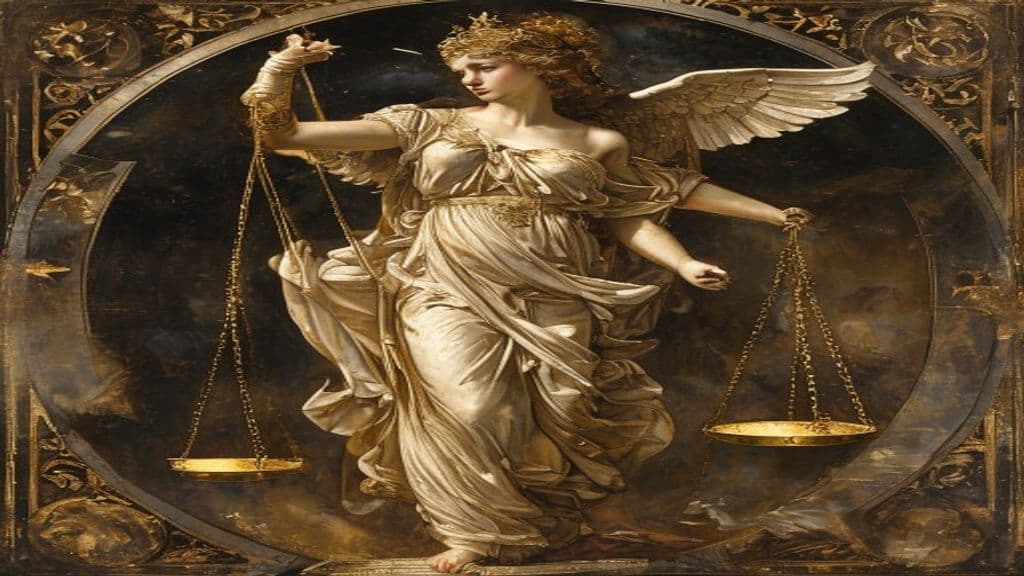
In Greek literary tradition Astraea is presented as an immortal goddess who personifies justice and who lived among humans during the mythic Golden Age. As human morality declined through the successive Ages of Man she abandoned humanity and was taken into the sky as the constellation Virgo. Sources vary on her parentage and identity: some strands connect her etymologically and genealogically to Astraeus and Eos (linking her to stars and dawn), while other authors identify her with Dike (who in some accounts is daughter of Zeus and Themis); the tradition therefore preserves variant genealogies rather than a single fixed origin.
Astraea is classically portrayed as a virgin/maiden figure (the Maiden of the constellation Virgo) and is represented holding a pair of scales, the emblem of impartial justice. In ancient celestial imagery the star Spica is associated with the ear of corn she holds; beyond these emblematic items the surviving literary summaries emphasize her maidenly and starry character rather than detailed garments or corporeal description.
As a mythic personification Astraea functions as the embodiment of justice, modesty, and good faith. Literary sources depict her as a moral arbiter who presided over virtue among humans in the Golden Age and—according to some poets—watched human conduct and reported serious wrongdoing to the higher gods (e.g., Zeus). Her principal transformational action in the myths is withdrawal from the human world in response to moral decay and relocation to the celestial sphere as the constellation Virgo; later poets also use her as a symbolic herald whose prophesied return would signal restoration of a Golden Age.
Weaknesses
- otherNot attested in sources
Wards
- otherNot attested in sources
Themis
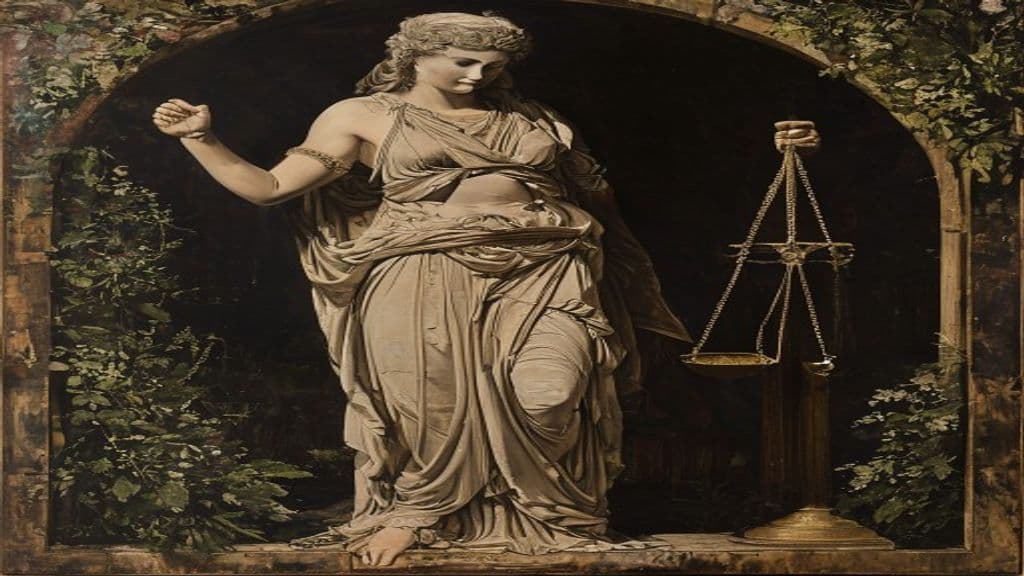
Themis is the ancient Greek Titaness who personifies themis — the divinely instituted ordering of custom, law, and proper procedure. She functions as an oracular figure, a presider over assemblies and oaths, a counselor in divine councils, and a maternal source of personified moral and cosmic forces.

Aidos
Aidos (Ancient Greek: Αἰδώς) is the personification of shame, modesty, and reverent restraint in classical Greek thought. Treated variously as an ethical feeling, a moral force, and occasionally as a goddess with local cults, Aidos embodies the inner reverence that restrains wrongdoing and governs social propriety.
Nemesis
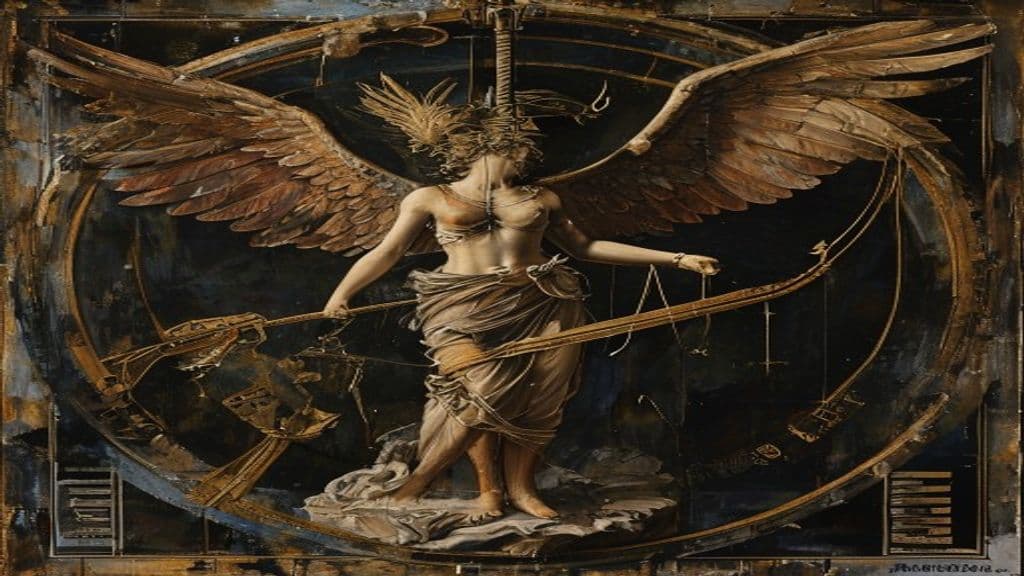
Nemesis (Greek: Νέμεσις), also called Rhamnousía in her local cult, is the personified goddess of distributive justice and retributive balance in ancient Greek religion and myth. She functions to restore due measure—rewarding or withholding according to desert—and punishes hubris and excessive fortune.
Asterodeia
Asterodeia (also Asterodia, Asterodea) is a name applied to several female figures in Greek myth: an Oceanid (a nymph daughter of Oceanus and Tethys) and various mortal royal women used in regional genealogies, including a Phocian princess and possible consorts of Endymion and Icarius.
Asterodia
Asterodia is a personal name found across multiple Greek mythic genealogies rather than a single coherent supernatural agent. The name appears for an Oceanid (daughter of Oceanus and Tethys) and for several mortal or near-mortal women (princesses or wives) used to explain descent, marriage alliances, and local eponymy in regions such as Phocis, Elis, and Colchis.
Asteropaios
Asteropaios is a named Homeric Paeonian leader and warrior in the Iliad, grandson of the river-god Axios (son of Pelagon), noted for ambidexterity (throwing two spears at once), who wounds Achilles' forearm before being slain and whose arms are later awarded as prizes at Patroclus' funeral games.
Asterope
Asterope is a name used in Greek myth for one of the Pleiades — the seven daughters of Atlas and Pleione who are identified with the stars of the Pleiades cluster — and appears in variant traditions as the name of a Hesperid. In modern usage the name Asterope has been applied to the star 21 Tauri (IAU-approved name), an asteroid (233 Asterope), and a genus of butterflies (Wikidata).
Asteropeia
Asteropeia is primarily a botanical genus of evergreen shrubs and small trees endemic to Madagascar (family Asteropeiaceae). Separately, a brief classical mythographic notice records a mortal woman named Asteropeia — a daughter who, with her sisters, murdered her father and was later commemorated by tomb-mounds in Arcadia. The sources treat these as distinct usages of the same name rather than a single supernatural entity.
Astghik
Astghik (older orthography Astłik) is a prominent goddess of pre-Christian Armenian religion, personifying beauty, love, fertility, and water. She is etymologically linked to the Old Armenian word for "star" and is described in sources as the bride of the warrior god Vahagn; later identifications connect her with Aphrodite and the planet Venus.
Astraeus
Astraeus is an ancient Greek divine figure whose name means 'starry.' In standard theogonic genealogies he is son of Crius and Eurybia, consort of Eos (Dawn), and father of the winds, Eosphorus (the morning star) and the stars; in later literature he appears as an oracular figure. A minority late tradition (via Hyginus and echoed by Servius) treats him as counted among the Gigantes, a divergent identity.
Astrape and Bronte
Personified embodiments of lightning (Astrape) and thunder (Bronte) in Greek literary and iconographic tradition, depicted as ministerial attendants of Zeus who manifest the flash and roar that accompany divine epiphany.
Astrild
Astrild is a late Nordic literary name or personification used for the classical Amor/Cupid in Swedish and broader Scandinavian poetry from the early modern period onward. The name, rendered in sources as deriving from Old Norse meaning 'love-fire,' appears in Baroque and Rococo poetic contexts and is not attested in pre-Christian Norse mythology.
Astris
Astris is a minor figure in Greek literary tradition, named among the Heliades in Nonnus's Dionysiaca; she is presented as a daughter of Helios who marries the river-god Hydaspes and becomes mother of the Indian king Deriades. Her attestation in the supplied material is primarily genealogical rather than cultic or narrative.
Astyanax
In classical Greek and Roman literature Astyanax is the infant son of Hector and Andromache whose survival or death symbolizes the potential continuity of Troy's royal house. He is depicted as a mortal child whose fate is contested in the immediate aftermath of the sack of Troy; later medieval and Renaissance traditions sometimes recast him as a legendary founder-figure who survives.
Astydameia
Astydameia (Ancient Greek Ἀστυδάμεια) is not a single supernatural being but an ancient Greek personal name borne by several mortal women in mythic tradition — queens, wives, and mothers who appear as genealogical and narrative nodes in the heroic age (figures associated with Peleus, Heracles, Acastus, Pelops, etc.). The name literally evokes civic rulership, and the bearers act within social and political roles rather than as spirits or deities.
Community Record
- [1]Astraea - Wikipedia. Wikipedia, 'Astraea' (summary and quotations as cited in research notes)wiki
- [2]Astraea - Wikidata. Wikidata entry for 'Astraea' (taxonomic reuse noted in metadata)other
- [3]Selected literary receptions and archive items (poems and later uses). Collection entries referenced in research notes (e.g., later poems invoking Astraea; used to attest continued literary reception but not ancient cultic detail)literary