
There is no single mythic origin in the sources; rather the gift-bringer role is a mutable office formed by syncretism. In many Christianized regions the role was overlaid onto or associated with the hagiography of Nicholas of Myra (fourth century) because his acts of charity provided a model for seasonal gift-giving. Pre-Christian antecedents include household spirits, Yule personifications, and farmstead guardians (e.g., tomten, kobolds) whose seasonal visibility and association with the winter calendar were reinterpreted in Christian and later secular frames. Nineteenth-century print culture and mass media produced a standardized, secularized North American variant (Santa Claus) that then influenced European forms.
Appearances vary by regional tradition: a bearded old man figure appears widely (e.g., Saint Nicholas, Father Christmas); Scandinavian forms include an elf-like tomten or Yule-associated goat figure in some localities; the Christkind is portrayed as a young child or angelic being in parts of Central Europe; Italian Befana is described as an old woman who rides a broom and brings sweets at Epiphany. The modern North American Santa is a standardized jovial, red-suited, reindeer-and-sleigh chimera formed through nineteenth-century cultural production and mass media.
Primary functional attribute is seasonal gift delivery to children and the poor on culturally specified dates (December 6, Christmas Eve, Epiphany/January 6, or Yule period), often embedded in rituals of petition (letters, offerings) and communal performance (parades, household exchanges). Traditions may pair the gift-bringer with punitive companions (e.g., Krampus, Belsnickel) who embody sanction for misbehavior; scholarly interpretation (Jacob Grimm) traces these punitive figures to Christianized household-spirit motifs. Sources describe cultural and narrative mechanisms for mobility and gift distribution (reindeer + sleigh motif, etc.) as literary and visual conventions rather than uniform supernatural mechanics.
Weaknesses
- conditionNot specified as hostile — no folkloric vulnerabilities recorded for primary gift-bringers
- otherCompanion-based sanction: traditions preserve punitive counterparts (Krampus, Belsnickel) whose presence functions as social threat rather than a vulnerability of the gift-bringer
Wards
- otherNone traditionally specified for the gift-bringer class — sources emphasize celebration and petitioning rather than warding
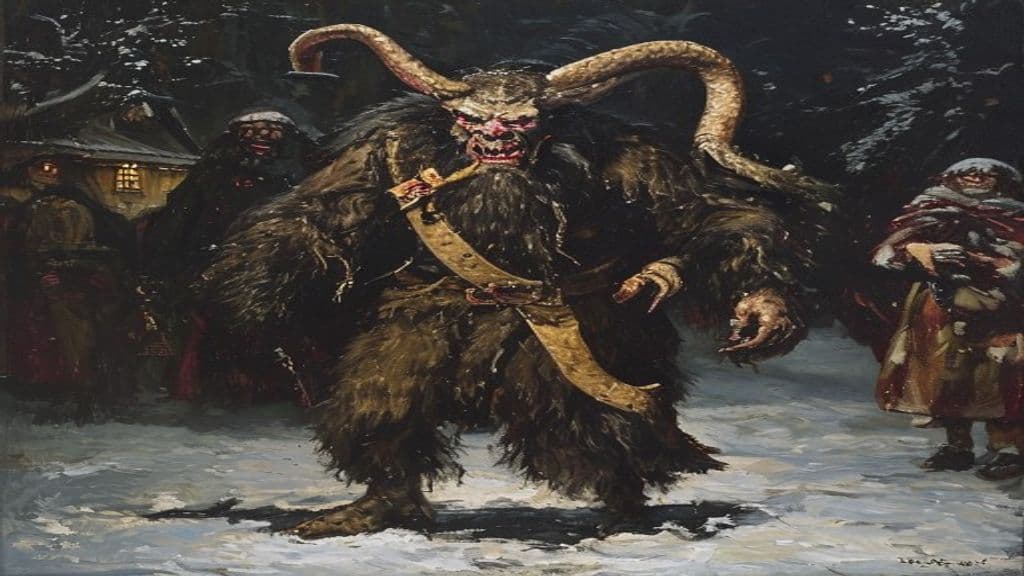
Krampus
Krampus is a horned, hairy, anthropomorphic figure from Central and Eastern Alpine folk practice who serves as the punitive companion to Saint Nicholas during the winter festival cycle; he appears on Krampusnacht (5 December) and in public Krampuslauf/Perchtenlauf processions to threaten or punish badly behaved children.

Belsnickel
Belsnickel is a traditional fur-clad Yuletide visitor from the Palatinate region of southwestern Germany who inspects children's behaviour, disperses sweets to the well-behaved, and threatens or administers punishment (often symbolically) to the naughty. The figure survives in Pennsylvania Dutch and other diaspora communities and appears both as a solitary domestic visitor and as part of boisterous communal processions called 'Belsnickling' or 'Klausentreiben'.

Christkind
The Christkind is a Central European cultural personification of the Christ Child who functions as the traditional bringer of Christmas gifts in many domestic and civic seasonal practices. Originating in Reformation-era promotion of the infant Jesus as focus of Christmas giving, it persists in diverse regional forms (e.g., Ježíšek, Jézuska) and in civic pageantry such as the Nuremberg Christkindlesmarkt.

Befana
In Italian popular and folk culture, the Befana is a witch‑like old woman associated with the Feast of the Epiphany who, on Epiphany Eve (night of January 5), brings sweets to good children and coal to bad children. She is an ambivalent household/seasonal figure involved in domestic and communal Epiphany rituals such as mumming, effigy‑making and bonfires, and her origins are debated between liturgical personification and survivals of older household goddess offerings.

Baba Yaga
Baba Yaga is an ambivalent female figure of East Slavic folktale tradition, depicted variously as a fearsome, child-eating crone or as a helpful, maternal donor. She is associated with the deep forest, a hut described as standing on chicken legs, and the motific accoutrements of a mortar and pestle.
Chremetes
Chremetes is the Greek name of a river in Libya and the river's divine personification (a Potamos). He appears in classical geographical and mythographic lists and as the father of the naiad Anchiroe, serving a primarily local genealogical and toponymic role in Greek sources.
Christ Child
The Christ Child (also Baby Jesus, Infant Jesus, Divine Child) is the figure of Jesus Christ in his infancy and childhood (up to about age 12). In Christian textual and devotional traditions he is not a separate being but the incarnate Jesus during early life, the focus of nativity narratives, apocryphal infancy stories, liturgical feasts, and widespread devotional images.
Christ Pantocrator
Christ Pantocrator is an iconic Eastern Christian depiction of Jesus emphasizing his sovereignty, judgment, and sustaining rule. It is a visual-theological image used in liturgy and church architecture (domes, apses, iconostasis) rather than a folkloric autonomous being.
Christian God
In Christian tradition, God is the single supreme divine reality believed to be eternal, the creator and preserver of all things, both transcendent over and immanent within creation; many Christians conceive this one God as three Persons (Father, Son, Holy Spirit). Christian sources also teach that the Son assumed human nature in the Incarnation.
Christkind
The Christkind is a Central European cultural personification of the Christ Child who functions as the traditional bringer of Christmas gifts in many domestic and civic seasonal practices. Originating in Reformation-era promotion of the infant Jesus as focus of Christmas giving, it persists in diverse regional forms (e.g., Ježíšek, Jézuska) and in civic pageantry such as the Nuremberg Christkindlesmarkt.
Christmas elf
A modern English-language folkloric figure: a diminutive humanoid helper associated with Santa Claus, depicted as Santa's workshop workforce who assist in toy-making, reindeer care, and seasonal logistics. The figure is a syncretic, commercialized descendant of older household-spirit traditions (álfar, tomte/nisse, kobolds, brownies).
Chromia
Chromia (Ancient Greek: Χρωμία, Khrōmía) is a minor mythological woman in Greek genealogies, identified as daughter of Itonus (son of Amphictyon, grandson of Deucalion) and in some traditions named as consort of Endymion and mother of Aetolus, Paeon, Epeius, and Eurycyda. The same modern lexical form 'Chromia' is also used as a name for a public blockchain platform, a Miraheze project wiki, and as the English mineral/oxide term (Cr2O3), but these are homonymous and not conflated with the mythic figure in the available sources.
Chromios
Chromios is an ancient Greek personal name attested for several human figures in classical literary and historical sources (not a single supernatural being). Attestations include Chromios of Aitna, victor in a chariot race celebrated by Pindar (Nemean I, c. 473 BCE); a warrior/captain name found in epic/Homeric indices and scholia; an Argive survivor in the tradition of the Battle of the 300 Champions; and the modern asteroid 32726 Chromios, a Jupiter Trojan named from the Greek onomastic repertoire.
Chromis
Chromis (Ancient Greek Χρόμις) is an anthroponym attested across multiple ancient Greek and Roman mythic episodes. The name is borne by several distinct minor figures — including at least one centaur at the Centauromachy and several mortal warriors in epic war-lists — rather than a single supernatural species or cult figure.
Chrysanthius of Sardis
Chrysanthius of Sardis (Ancient Greek: Χρυσάνθιος; died AD 505) was a late-antique Greek Neoplatonist philosopher and the high-priest of Lydia. A pupil in the lineage of Iamblichus via Aedesius, he is recorded as devoted to the mystical side of Neoplatonism and noted for moderation in his priestly office.
Chrysanthus and Daria
Chrysanthus and Daria are venerated Christian martyrs of the early Church, remembered in liturgical calendars and by the cult of relics. Their legend places them in late third-century Rome, where they converted others and suffered martyrdom; their Acts survive in later Greek and Latin versions judged historically unreliable, while relics attributed to them were translated and enshrined in several medieval sites.
Chrysaor
Chrysaor is a figure from Greek myth born from the beheading of the Gorgon Medusa; traditionally presented as the brother of Pegasus and the father of Geryon, he functions chiefly as a genealogical and etiological link within Hesiodic and related traditions.
Community Record
- [1]Christmas gift-bringer. Wikipedia, 'Christmas gift-bringer' entry (summary of traditions, appearances, dates, and syncretism)wiki
- [2]List of Christmas and winter gift-bringers. Wikipedia, compilation of regional gift-bringers and local nameswiki
- [3]Deutsche Mythologie (interpretation cited). Summary referencing Jacob Grimm's interpretation linking punitive companions (Krampus) to household spirits (via Wikipedia article)folk
- [4]The Santa Mutation: How One Meme Conquered Winter. Archive essay summarizing cultural-evolutionary account of Santa's standardization in the 19th century (Washington Irving, Clement Clarke Moore, Thomas Nast cited as agents)other
- [5]Christine Kringle (archive record). Fictional archive text cited in research notes illustrating modern literary reimaginings; used only as an example of contemporary narrative inventionliterary
- [6]Who is the Christkind? (University of Hamburg). University of Hamburg account describing Christkind as a young-child/angelic gift-bringer in Central Europeother
- [7]Christkind: How this Christmas Gift-Bringer Differs from Santa Claus. Ancient-Origins article contrasting Christkind and Santa Claus and describing regional practicesother
- [8]Spanish Los Reyes Magos practices (summary). Wikipedia summary noting children write to the Wise Men and leave out treats for them and their camels; references to Cabalgata de Reyes and Epiphany dateswiki