
Guanyin is the Chinese name and local manifestation of the Indian bodhisattva Avalokiteśvara. In Buddhist accounts she is a vow-bound bodhisattva who, upon attaining enlightenment, swore to help those who most needed mercy; the Chinese form developed through processes of indigenization, becoming widely integrated into Taoist and popular-religious practice and adapting gendered and cultural characteristics to local contexts.
Representations vary by time and place: early Avalokiteśvara forms were male in Indian Buddhism, while by about the 12th century Guanyin in China is frequently depicted as female; portrayals may also be androgynous or vary regionally. Modern temples commonly display a recognizable statue or image used as focus of devotion, but the provided sources do not supply a single canonical iconographic formula or consistent list of attributes.
Sources characterize Guanyin primarily as a compassionate, salvific intercessor who 'perceives the sounds of the world'—hearing cries and responding with mercy. Devotees seek her blessing, rescue from danger, and general protection via recitation, petition, and temple practice. The literature emphasizes merciful intervention and devotional efficacy rather than enumerating combative or grimoire-style powers.
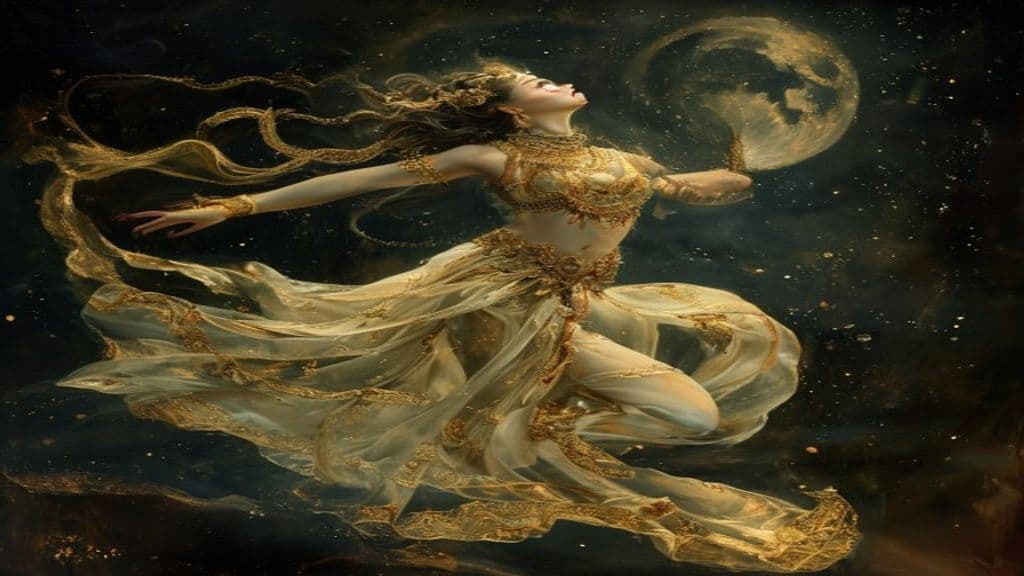
Apsara
Celestial dancers and water nymphs of Hindu cosmology — beautiful semi-divine beings who dance at the court of Indra and, by his command, descend to earth to distract sages from excessive asceticism.
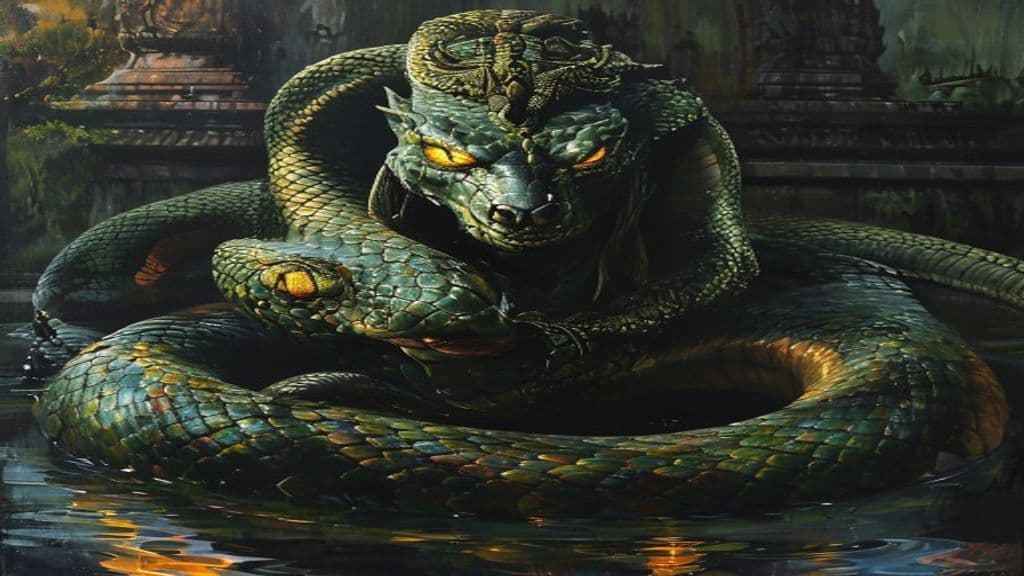
Naga
Divine serpent beings of Hindu, Buddhist, and Jain cosmology — powerful guardians of water, earth, and underground treasures. Revered as deities in South and Southeast Asia.
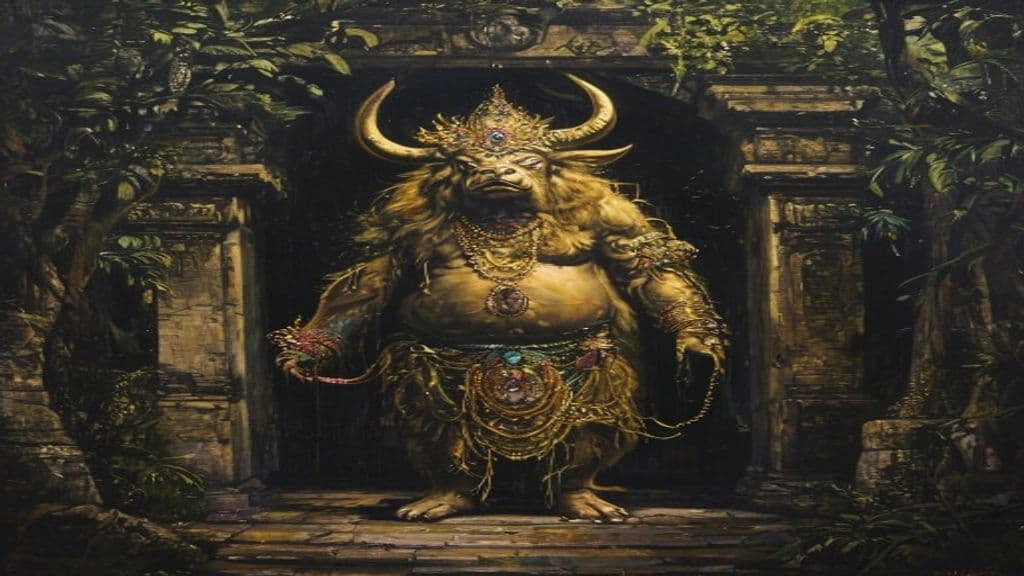
Yaksha
Nature spirits of Hindu, Buddhist, and Jain cosmology — guardians of forests, treasures, and wilderness. Ambivalent beings, capable of great benevolence to the respectful and terrible harm to the greedy.
Ao Kuang
Ao Kuang (also attested as Ao Guang) is the Dragon King of the East Sea in Chinese mythology and folk religion, one of a quartet of sea-dragon sovereigns associated in folklore with the cardinal seas. He appears in classical literature and later popular media as a ruler of maritime waters whose favor or displeasure is connected to tides, rain, floods and storms.
Bai Ze
Bai Ze (白澤, Báizé; Japanese Hakutaku) is a legendary sacred creature in Chinese tradition famed as an authoritative recorder of ghosts and gods whose illustrated compendium (Bái Zé Tú) was employed as a household prophylactic against spirit-world harm. The creature’s image and diagrams were used in China and later Japan to identify, ward off, and prescribe avoidance of spectral calamities.
Bi'an
Bi'an is attested in the provided sources primarily as a named member of the traditional roster called the Nine Sons of the Dragon, appearing in catalogues of mythic names. The figure is also present as a name-form within the broader lexical field of Chinese folk religious beings (for example, appearing alongside death-escort deities in separate sources), but the supplied materials do not furnish an independent, detailed myth or cultic biography for Bi'an.
Chang'e
Chang'e (嫦娥), originally attested as Heng'e and linked to the older name Chang Xi, is the female lunar immortal of Chinese myth who resides in the Moon Palace (廣寒宮). Best known from the elixir-of-immortality tale in which she ascends to the Moon and is accompanied there by the Jade Rabbit, she functions across religious and literary contexts as a lunar goddess/immortal and a poetic symbol of solitude and longing.
Chenghuangshen (City God)
Chenghuangshen (城隍神), commonly called the City God, is a tutelary deity in Chinese folk religion tied to a specific settlement. Historically associated with a city's walls and moat, the deity functions as protector of local affairs and as a local official in the postmortem ordering of souls for that place.
Chinese dragon (long / loong)
A central legendary zoomorphic being in Chinese myth and culture (Chinese: long / loong), the dragon embodies auspicious cosmic and ancestral power, especially mastery over water and weather, and functions as an imperial and communal emblem across material culture, ritual performance, and state iconography.
Chinese ghosts
Spirits of deceased persons in Chinese folk belief, integrated with ancestor-worship and syncretic Buddhist ideas; often conceived as potentially malevolent if neglected or provoked, while some deceased become honored ancestral spirits through proper ritual care.
Chinese gods and immortals (shenxian)
A heterogeneous corpus of deities (shen) and immortals (xian) in Chinese religious and mythic thought, understood as manifestations or localizations of the cosmic principle (Tian/Tao/qì). They include celestial gods, local tutelaries, deified culture-heroes, and Taoist immortals formed and sustained by temples, ancestral ritual, and popular cult.
Daji
Daji (妲己, Dájǐ) is a figure in Chinese narrative and popular religious-cultural materials who blurs human and spirit categories: historically remembered as the favorite consort of King Di Xin of Shang but in later legend and fiction identified as a fox‑spirit (often a nine‑tailed or thousand‑year fox) that possessed or impersonated the woman and precipitated moral and political decline.
Dragon King
A high-ranking serpent/dragon ruler associated with water, weather, and territorial guardianship across East, South and Southeast Asian folk-religious traditions. Treated as a divine or semi-divine authority (Nāgarāja / lóng / Ryū / Yongwang) who presides over seas, rivers, wells and rainfall and is an object of ritual supplication, especially in rainmaking and agricultural contexts.
Erlang Shen
Erlang Shen (二郎神) is a Chinese folk-religious and Daoist divine warrior associated with flood control, justice, hunting, and the subdual of demons. Venerated as a local river/irrigation protector who was later incorporated into Daoist pantheons and popular literary cosmologies, he is commonly depicted as a third-eyed spear-wielding hero accompanied by a celestial hunting dog.
Five Poisons (五毒, wǔ dú)
A culturally defined set of five hazardous animals in Chinese (and related Vietnamese) folk belief associated with the Dragon Boat Festival/Duanwu (the fifth day of the fifth lunar month). The term names a seasonal cluster of perceived dangers (snakes, scorpions, centipedes, toads, spiders) and denotes traditional prophylactic and talismanic responses; in modern usage the phrase is also repurposed as a political metaphor for five perceived threats to state security.
Community Record
- [1]Guanyin - Wikipedia. Wikipedia, 'Guanyin' articlewiki
- [2]Dating the Divine Guan Yin - by Rich Tseng. Rich Tseng, 'Dating the Divine Guan Yin'other
- [3]Guan Yin And The Indigenization Of Buddhism In China. Gwongzau Kung Fu, 'Guan Yin And The Indigenization Of Buddhism In China'folk
- [4]Song For Guan Yin. Song For Guan Yin, 'Guān Yīn... is the bodhisattva of compassion... Guanyin is also reverenced by Chinese Taoists as an Immortal.'other
- [5]City of 10,000 Buddhas - Guan Yin Bodhisattva’s Blessing amidst a Blazing Fire. City of Ten Thousand Buddhas, 'Guan Yin Bodhisattva’s Blessing amidst a Blazing Fire'other
- [6]Tie Guan Yin tea listing (legend reference). Tie Guan Yin tea product listing referencing the 'Iron Goddess of Mercy' legendother
- [7]Erick Heroux essay (Thirteen Ways of Looking at Guan Yin). Erick Heroux, essay noting gender variability and popular images of Guanyinother
- [8]Travelfish - Guan Yin temple, Kuala Lumpur — Visitor guide & review. Travelfish visitor guide referencing modern temple sites venerating Guanyinother