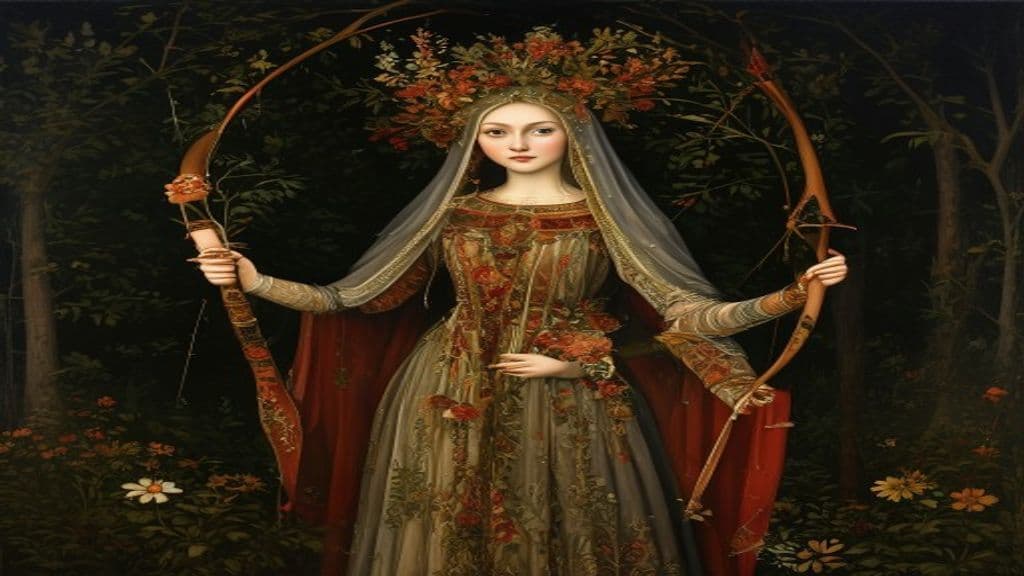
Medieval and early modern chroniclers record Devana as a named sacred personage of Western Slavic tradition; Jan Długosz explicitly equates the local figure called Dziewanna with the Roman Diana and records popular rites in which her image appears. Source material is fragmentary and filtered through interpretatio and later folklore collection; some documentary attestations cited historically (e.g., entries associated with Mater Verborum) have contested reliability, while Długosz remains the principal medieval documentary witness in the supplied sources. Modern scholars debate etymology and layers of meaning (maidenhood, wildness, plant-name Verbascum, possible archaic sky-root connections), so the figure’s deep mythic origins remain uncertain in the available texts.
Surviving sources do not provide a single, uniform physical portrait. Medieval chronicler Jan Długosz primarily equates her function with Diana rather than supplying iconographic detail. Later folkloric reports (Oskar Kolberg’s southern Sorbs account) describe a 'beautiful woman with a bow and arrow' accompanied by greyhounds. Ritual practice represents her in effigy: a sheaf of straw or hemp dressed in human clothes (as recorded in Marcin Bielski and Długosz) used in processions and drowning rites.
Primary attestations attribute to Devana domainal authority over forests, groves and hunting grounds: Długosz reports that people believed forests were inhabited by Diana (called Dziewanna in their language) and that she held power over them. The supplied sources do not catalogue concrete miracle-like acts, spells, or powers; interpretative parallels to Diana/Artemis (huntress, protector of wild places, possible lunar associations) are made by chroniclers and later commentators but direct claims beyond domain association and ritual presence are not recorded in the provided material.

Marzanna
Marzanna (Polish form of Morana/Morė/Mara) is a pre-Christian Slavic seasonal goddess/personification representing winter, decay, and the death-aspect of the vegetation cycle. Her ritual 'death'—commonly enacted by destroying a humanlike effigy—marks the communal transition from winter to spring and is paired in tradition with separate spring figures (e.g., Vesna, Lada, Kostroma).
Baba Yaga
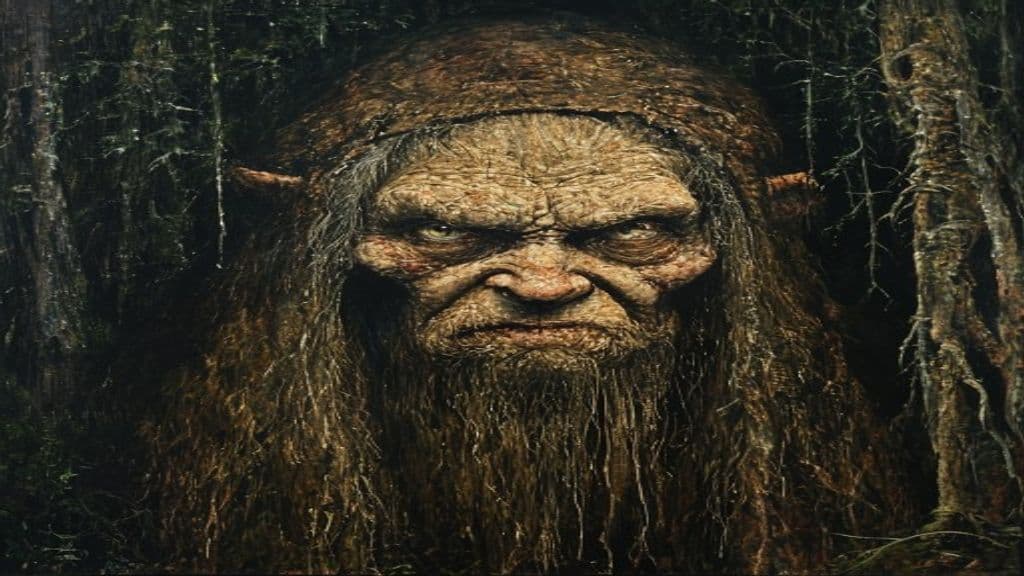
Baba Yaga is an ambivalent female figure of East Slavic folktale tradition, depicted variously as a fearsome, child-eating crone or as a helpful, maternal donor. She is associated with the deep forest, a hut described as standing on chicken legs, and the motific accoutrements of a mortar and pestle.
Destroying angel
A divinely commissioned heavenly agent in the Hebrew Bible and later Jewish traditions sent by God to execute judgment, death, or punishment. The figure functions as an instrument of divine justice (mal'āḵīm / memitim / mashḥit) and appears in narrative episodes of plague, wartime slaughter, and in rabbinic and Enochic writings connected to postmortem or eschatological punishment.
Deucalion
Deucalion (Ancient Greek: Δευκαλίων) is a mortal culture-hero in Greek myth who survives a divinely-sent primeval flood and, with his wife Pyrrha, re-populates the world by throwing stones that become humans. He is portrayed as a king, founder of cities and temples, and son of Prometheus in many traditions.
Deucalion of Crete
Deucalion of Crete is a mytho-historical Cretan king in Greek tradition, named among the Argonauts and the Calydonian Hunters and placed in genealogies as a son (often eldest) of Minos. He functions as a heroic/dynastic figure within the Age of Heroes rather than as a divine or supernatural being.
Deutsche Mythology
A collection of mythological narratives representing the collective myths, legends, and beliefs of ancient Germanic cultures. (Note: 1. Power tier: Primordial (Deutsche Mythology as a collective mythological narratives does not have supernatural abilities and behaviors attributed to it; rather, it contains those of individual Germa)
Dev (Dēw / Div)
A class of hostile supernatural beings in Persian and wider Middle Eastern/Iranian-related lore; in Persian popular tradition labeled monstrous creatures or fiends, and in Zoroastrian scripture (as Avestan daeva) explicitly framed as 'gods that are (to be) rejected.'
Deva (Buddhism)
In Buddhist cosmology a deva is a class of celestial being or heavenly rebirth occupying higher planes than humans; devas are longer‑lived, more powerful, and generally happier than humans but remain impermanent and subject to karma. The category spans formless meditative beings through subtle form devas to sensual gods, and maps onto the three dhātus (Ārūpyadhātu, Rūpadhātu, Kāmadhātu).
Devaraja
Devaraja (Sanskrit: deva-rāja) is a religious-political concept of sacred kingship in ancient and medieval India and Southeast Asia in which a living monarch is ritually invested as a divine or deified ruler and thereby linked institutionally to a temple cult and specific deities (notably Shiva or Vishnu). It functions as an office and state ideology that sacralizes royal authority and integrates the kingdom with a cosmic order.
Devata
Devata denotes a class of divine or godlike beings in South and Southeast Asian Hindu and Buddhist traditions. The term covers specialized, often localized presences (village, household, forest, directional guardians) and in some contexts overlaps with the broader category deva; devatas are integrated into lived ritual practice across India, Sri Lanka, Bali, and neighboring regions.
Devi
Devi (Sanskrit: Devī) is the general term for goddess in Indian religious thought, signifying the divine feminine or Shakti; in different texts and traditions she appears as individual goddesses (e.g., Parvati, Lakshmi, Saraswati) or as the supreme reality (notably in Shaktism and certain Upanishads). Sources treat Devi both as a class/category of female divinities and as a philosophical identification with ultimate reality.
Devil
A cross-cultural mythic personification of evil and hostile forces, used in religious, literary, and popular contexts to explain temptation, moral corruption, disease, death, and misfortune. Its exact cosmological status varies by tradition, ranging from an independent principle of evil to a created being that became evil or a symbolic embodiment of human wickedness.
Devil Dinosaur
Devil Dinosaur is a red-skinned, Tyrannosaurus-like prehistoric creature from Marvel Comics, native to the alternate-Earth 'Dinosaur World' (Earth-78411). Created by Jack Kirby, he forms a close partnership with Moon-Boy and later befriends Moon Girl in modern stories; he appears both in his home continuity and occasionally in Earth-616 and crossover narratives.
Devil Hulk
An internal, personified alternate personality within Bruce Banner's mind in Marvel Comics that embodies his deepest resentment, self-hatred, and desire for a punitive father-figure; chiefly active in Banner's mental landscape but, when dominant, capable of manifesting physically with destructive gamma-augmented powers.
Community Record
- [1]Devana — Wikipedia. Wikipedia entry 'Devana' (accessed source list supplied)wiki
- [2]Jan Długosz — accounts of Dziewanna and Marzanna. Quoted material attributed to Jan Długosz: statements equating Dziewanna with Diana and describing the carrying and drowning of images on Laetare Sunday (as supplied in research notes).folk
- [3]Marcin Bielski — White Sunday effigy account. Marcin Bielski's account describing the sheaf of hemp/straw dressed as Marzana (Ziewanna) shown around the village and drowned at the nearest lake/puddle (as supplied in research notes).folk
- [4]Oskar Kolberg — southern Sorbs Dživica report. Oskar Kolberg's summary reporting a southern Sorb tradition of 'Dživica, goddess of forests and hunting' described as a beautiful woman with a bow and arrow and greyhounds; fragmentary note about someone who stayed in the forest at noon (as supplied in research notes).folk