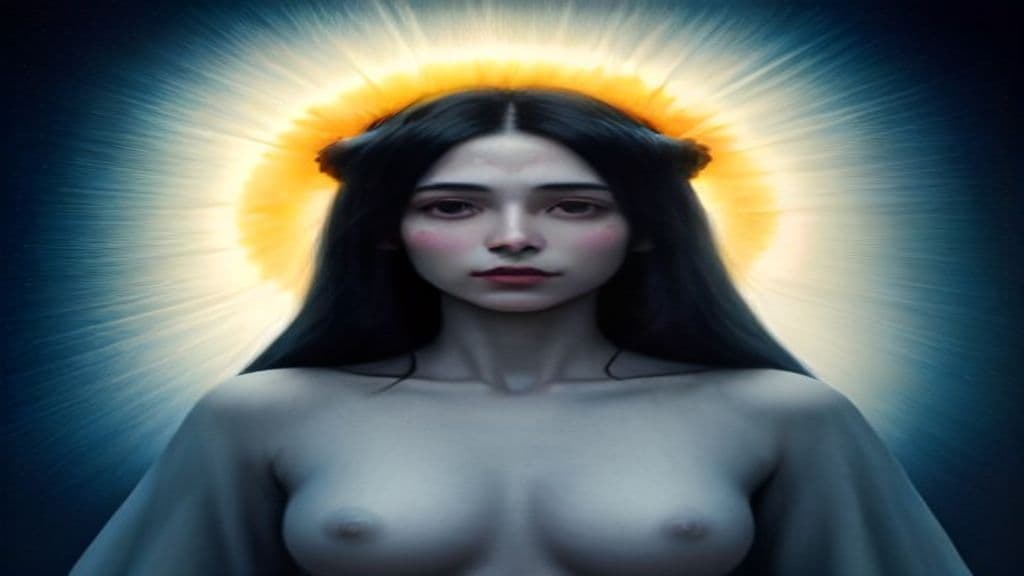
The supplied sources do not present a single, detailed cosmogonic tale for Eguzki Amandrea. Instead, ethnographic and mythographic accounts cited treat the sun as a long-recognized animate body within Basque cosmology and place it in familial relations—most notably as a daughter or mother in relation to Mother Earth and alongside the Moon (see Buber's Basque pages and the ASWM Scholar Salon framing). One interpretive source (ASWM Scholar Salon announcement) uses the heading "When the Moon and Sun are Daughters of Mother Earth," indicating a familial origin motif in some presentations; Buber's overviews repeatedly identify the sun as a personified, gendered celestial being without supplying an extended origin narrative. A broader primordial-religion overview referenced in the corpus situates personified celestial motifs within long historical discussions of Basque mythic elements but does not provide a specific origin myth for Eguzki Amandrea.
The sources do not furnish a detailed anthropomorphic description of Eguzki Amandrea (no clothing, facial, or bodily attributes are recorded in the provided materials). Descriptions in the corpus emphasize her manifestation as the brightest visible object in the heavens and as the source of warmth and light. Buber's Basque pages and the "Basque Fact of the Week" piece characterize the sun primarily by its luminosity, prominence in the sky, and life-giving presence rather than by particular humanlike visual traits.
Across the cited materials, Eguzki Amandrea's principal functions are life-giving: providing warmth, enabling growth, and sustaining visible life. The sun's brightness and warmth are repeatedly linked to its central role in the natural order (see Buber's "The Sun in the Basque Cosmos" and Basque Mythology overview). The supplied sources do not record hostile behaviors, magical trickster actions, direct speech to humans, healing or exorcistic rituals specifically performed by or to the sun, nor specific cultic liturgies; where ritual attention is implied, details are not provided in the available excerpts. The sun is therefore presented as a beneficent cosmic actor embedded in social/familial relations with other celestial beings.
Galtxagorri (Galtzagorris)
Galtxagorri (also spelled Galtzagorris in the cited tourism material) are described in the supplied source as tiny elfin beings from Basque mythology who are presented in a local Zarautz tourism experience where they are hidden around the town's historic monuments for families to find.
Intxixu (Intxisua)
A class of small mischievous beings in Basque folklore described in available sources as 'little creatures that make mischief' that can both help people and cause problems. Mentioned in modern English-language summaries of Basque mythology as part of a variety of such creatures.
Orko (Basque Thunder God)
Deity associated with thunder and the forces of nature in ancient Basque mythology. (Note: * Power tier: Greater (not Ancient), as there's no indication of deity-level powers. * Abilities: Specify exactly what abilities related to weather control are associated with Orko, instead of making )
Eglė the Queen of Serpents (Žilvinas)
A central figure of a Lithuanian folktale in which a speaking serpentine ruler—called the grass-snake/serpent prince Žilvinas—marries the human maiden Eglė, keeps an underwater palace and household, can be summoned by a secret chant, and whose story culminates in human→tree metamorphoses after betrayal.
Ego the Living Planet
Ego the Living Planet is a fictional sentient planet created for American comic-book mythology (Marvel Comics) by Stan Lee and Jack Kirby. Presented as an individual, planetary-scale organism, Ego appears across Marvel cosmic stories as a thinking, willful celestial body that can interact with gods, heroes, and galactic civilizations.
Egregore
A polyvalent Western‑esoteric concept naming an emergent, non‑physical collective form produced by sustained coordinated thought, will, ritual, or activity of a group. Usage ranges from a descriptive term for a 'collective mind' to a belief in a semi‑autonomous spiritual entity nourished by group devotion, and in contemporary discourse is often used metaphorically for organized online or political phenomena.
Egremus
Egremus is a named mortal figure in Greek myth attested only as a combatant who fell in the war between Eumolpus and Eleusis. He is identified by the patronymic 'son of Eurynomus' and appears only in genealogical/war-list context in the cited source.
Egungun (ancestral masquerade spirits)
Egungun refers both to Yoruba masked, costumed masquerades and to the collective force of departed ancestors who manifest through those masquerades. In performance the layered costumes are treated as a dwelling for ancestor presence; egungun appear periodically—especially at annual festivals—to remember the dead, bless the community, and mediate between the living and the otherworld.
Egyptian Pool
A symbolic representation of water in Egyptian mythology, depicted as a rectangular shape with seven equally spaced vertical zigzag lines. (Note: 1. Power tier should be "Minor Spirit" since the Egyptian Pool appears to be more of a symbolic representation without explicit abilities or behaviors. 2. Origin story should mention that it is not pr)
Egyptian Supernatural Beings
In Egyptian mythology, various supernatural entities inhabit different realms, including gods, goddesses, demons (uncertain), and spirits. They are considered Primordial beings, with cosmic-level powers. (Note: 1. Remove the claim that demons are considered Primordial beings (Source 1 does not mention this). 2. Update the power tier to Ancient, as Egyptian gods have cosmic-level powers but the text describes)
Egyptian goddesses
A category of divine female figures in ancient Egyptian religion who embody, sustain, or control particular natural forces, social roles, cosmic functions, or ritual powers. They are objects of cultic worship with temples, priesthoods, hymns, prayers, and magical spells that maintain their functions within maat.
Eheieh (Ehyeh Asher Ehyeh)
Eheieh (Hebrew: אֶהְיֶה אֲשֶׁר אֶהְיֶה, Ehyeh Asher Ehyeh) is a biblical divine self-designation rendered in English as variants of "I Am that I Am" or "I will be what I will be." In later Jewish esoteric (Kabbalistic) discourse the name is associated with the highest Sephirah, Keter, and denotes the primal self-manifestation or mode of being from which emanation and sustenance proceed.
Community Record
- [1]Basque Fact of the Week: The Sun in the Basque Cosmos. Buber's Basque Page, "Basque Fact of the Week: The Sun in the Basque Cosmos" (2020).folk
- [2]On Basque Astronymy: The Grammatical Gender of the Celestial Bodies. Buber's Basque Page, "On Basque Astronymy: The Grammatical Gender of the Celestial Bodies."folk
- [3]Basque Mythology. Buber's Basque Page, "Basque Mythology" overview.folk
- [4]Subterranean Mythology and Primordial Religion of the Basque People. Biblioteca Pleyades, "Subterranean Mythology and Primordial Religion of the Basque People."other
- [5]Announcing Scholar Salon 15: Register for October 21 – ASWM. Association for the Study of Women and Mythology (ASWM) Scholar Salon announcement, referencing "When the Moon and Sun are Daughters of Mother Earth."other
- [6]News – Page 69 – ASWM. ASWM News page referencing related program material.other