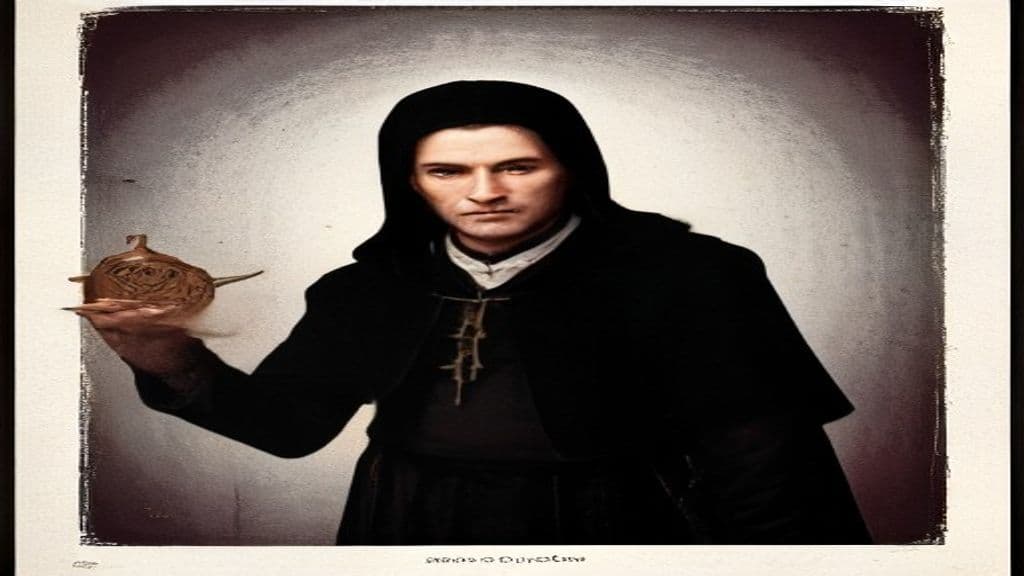
Surviving editions present Friar Rush as a non-human, disruptive agent who arrives at a monastery posing as a friar (named in early texts Broder Rusche/Bruder Rausch) and is hired as a kitchen servant. The figure is framed in the narratives as an other-than-human intruder — in summaries often identified as 'the devil' — who exploits clerical disguise to undermine monastic order. The tale appears in print from at least 1488 (Low German) and was adapted across Germany, Scandinavia, the Netherlands and England through the 16th–17th centuries.
Narrative sources give no detailed non-human physical description; the central identifiable appearance is his assumed clerical guise — he appears and is accepted as a friar or kitchen servant. Editions emphasize his role in posing as 'Bruder Rausch' rather than describing distinct monstrous features.
Friar Rush infiltrates religious houses by disguise, serves undetected (notably as a cook for seven years), commits violent acts (e.g., throwing the cook into a boiling cauldron and taking his place), incites sexual immorality among monks (procuring women nightly for the abbot and others), causes continual commotion and strife, and in some versions travels and possesses laypersons (the High German variant has him possessing the king's daughter). He resists ordinary discipline and is expelled only by formal ecclesiastical rites performed by authoritative clerics (mass and exorcism by an abbot).
Weaknesses
- ritualThe sacred mass (performed by an abbot)
- ritualExorcism by an authoritative cleric/abbot
- conditionExposure and decisive ecclesiastical authority (vigilant oversight)
Wards
- ritualSacred mass performed by an abbot
- ritualExorcism by a summoned abbot or cleric
- conditionInstitutional vigilance and moral reform within the monastery
Freawaru
Freawaru is a legendary human royal woman in Old English and Scandinavian traditions, presented in Beowulf as the daughter of King Hroðgar and Queen Wealhþeow and married to Ingeld as a freoðuwebbe (peace-weaver) intended to settle a blood-feud. Scandinavian prose (Gesta Danorum) preserves a cognate episode in which an old warrior (Starkad) incites renewed vengeance, reversing the marriage's peacemaking purpose.
Freedom Beast
Freedom Beast (Dominic Mndawe) is a fictional comic-book superhero published by DC Comics. A South African activist-turned-powered figure, he gains animal-themed abilities from an elixir and an ancient helmet and operates in narratives that link political resistance (apartheid-era origins) with animal protection and superheroic alliances.
Fresno nightcrawler
A contemporary American cryptid and internet-era urban-legend originating from CCTV footage in Fresno, California (2007). Described in footage and fandom as very long-legged, white, semi-humanoid figures often seen in pairs; treated in media and fan communities as a viral 'cute' cryptid rather than a being embedded in a traditional cosmology.
Freybug
The Freybug (also Fray‑bug) is a named monstrous Black Dog from English folklore, recorded in association with Norfolk. Cited in early modern letters and later antiquarian commentary, it is described chiefly as a large black canine apparition that wanders country roads and terrifies travellers.
Freyja
Freyja is a major Vanir goddess in Norse mythology associated with love, beauty, fertility, gold, war, and the seiðr form of magic. She rules the field Fólkvangr and the hall Sessrúmnir, where she receives half of those slain in battle, and is attested across the Poetic Edda, the Prose Edda, skaldic poetry, and later Scandinavian folklore.
Freyr
Freyr is a major Vanir deity in Old Norse myth associated with kingship, fertility, prosperity, fair weather, peace, and good harvests; he is attested in medieval Icelandic sources (Snorri) and continental reports (Adam of Bremen) and figures in myths of courtship, possession of magical artifacts, and eschatological death at Ragnarök.
Frigg
Frigg is an Old Norse goddess of the Æsir, foremost among the pantheon as Odin's wife, associated with marriage, motherhood and foresight. She dwells in Fensalir and is attested across North and West Germanic traditions (Old Norse Frigg; Old English Frīg; Old High German Frīja; Lombardic Frea). Her name survives in the weekday Friday and persisted in Scandinavian folklore after Christianization.
Frijjō (Hypothetical Love Goddess)
Reconstructed epithet of a hypothetical Common Germanic love goddess, spouse of Wōdanaz. (Note: - Power tier: should be "Ancient" instead of "Primordial", as a love goddess is more likely to be on a deity-level power tier. - Sensory cues: no information provided in source material - Weaknesses a)
Froslass
Froslass is a fictional creature-species from the Pokémon franchise, presented in the provided sources as part of Generation IV (the Sinnoh set introduced in the 2006 Nintendo DS games Pokémon Diamond and Pearl). The sources treat it as a designed franchise species appearing in game and fan-media contexts rather than as an entity from a real-world spiritual tradition.
Fráech
Fráech is a Connacht hero of the Ulster Cycle in early Irish narrative tradition, portrayed as a handsome warrior of semi-divine kinship whose adventures include a love-quest, the slaying of a river-monster, otherworldly healing by Sidhe maidens, and long-range cattle-and-family recovery episodes. He is commemorated in place-name lore (Carnd Fraich / Sid Fraich) and appears in prose and metrical sources of medieval Ireland.
Frédégonde
Frédégonde (also Fredegonde, Fredegund, Fredegundis) is a historical and legendary Merovingian queen of the 6th century, remembered in later French historiography and literature as a ruthless court figure associated with intrigue and alleged crimes. She functions in cultural memory as an archetype of royal female ambition and has been adapted repeatedly in novels, plays, operettas and opera from the 18th century through modern revivals.
Fuath
Fuath are a class of malevolent, uncanny spirits in Scottish Highland and Irish Gaelic folklore, especially associated with water (streams, mills, lochs) but not confined to it. The term functions both as a label for particular water-spirits in local tales and as a broader category of hostile spectres or goblins in Gaelic tradition.
Community Record
- [1]Friar Rush - Wikipedia. Wikipedia article 'Friar Rush' (summary and nomenclature, publication history, plot elements, parallels to kobold tales)wiki
- [2]Broder Rusche (1488) and subsequent editions (summarized). Early Low German verse edition (Broder Rusche, 1488) and later High German (1515) and English (1620/1626) editions as cited in summaries of the traditionliterary
- [3]George Lyman Kittredge analysis (1900) — cited in summaries. Kittredge's comparative discussion of origins and parallels (kobold, Icelandic analogues) as cited in supplied notesacademic
- [4]Reginald Scott, Discoverie of Witchcraft (1584) — cited. Reginald Scott's recognition of parallels with the kobold Hödeken as cited in the supplied notesliterary
- [5]The Historie of Frier Rush (1626 edition). Early English printed edition (1626) digitized; representative English chapbook formliterary