
Sources do not provide a cosmogonic origin narrative for the gohō dōji. The figure is attested in medieval Japanese literary and visual culture (for example, Uji Shui Monogatari and illustrated emaki) as a cultic attendant and protector of the Law rather than as a being with a foundational mythic origin in surviving summaries.
Medieval textual and visual traditions represent the gohō dōji as a young boy (dōji) bearing martial accoutrements: commonly shown with a collar or necklace of swords, a large sword in one hand, and a noose in the other. In iconography the figure is sometimes depicted riding a Wheel of Dharma to fly, combining a childlike form with protective implements.
Sources present the gohō dōji functionally as an attendant devoted to serving followers of the dharma and defending the Law. Illustrated motifs (sword, noose, collar of swords, Dharma wheel) and narrative roles in medieval stories indicate a protective and servitor character that intervenes for practitioners; specific supernatural powers beyond these attestations are not enumerated in the provided sources.
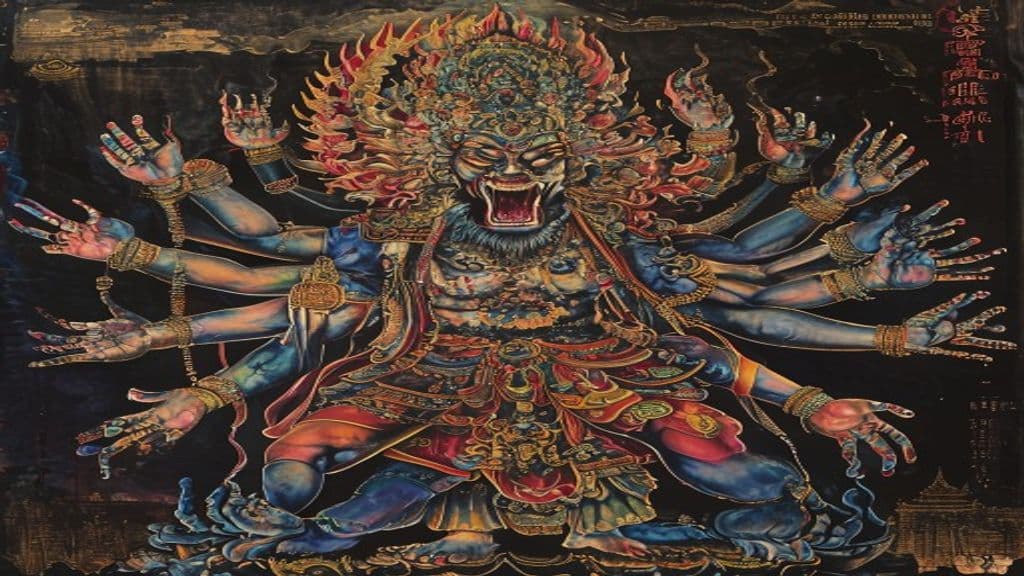
Akuma
Akuma (悪魔/あくま) in Japanese sources is an evil spirit, devil, or demon associated with misfortune and mental disturbance. The term appears in Buddhist texts and Heian-period literature and was later used to translate the Christian figure of Satan, as well as the Buddhist Mara.
Datsue-ba
A supernatural old-woman ogress figure in Japanese Buddhist underworld imagery who sits by the Sanzu River and strips the deceased of their garments (or, in some accounts, their skin) as part of post-mortem judgement. She functions as a liminal, procedural agent within Ten Kings / Six Realms iconography rather than as a creator or cosmic force.
Five Wisdom Kings
A class of wrathful, mantric protector-deities in East Asian Mahāyāna (notably Japanese) Buddhism, identified with the Sanskrit Vidyārāja and Japanese Myō-ō and described in sources as guardians of the cosmic Buddha Dainichi (Vairocana) and of esoteric teachings.
Japanese dragon
A class of large serpentine beings in Japanese myth that function variously as water deities, regional kami, Buddhist nāga/dragon kings, and shapeshifting supernatural creatures associated with seas, rivers, rain and related powers.
Kalaviṅka
A Buddhist fantastical creature described as a human-headed, bird-bodied being famed for its exquisite, Dharma-preaching voice; represented across South, East, and Southeast Asian Buddhist art and liturgical contexts with regional iconographic variation.
Karura
A Japanese Buddhist divine creature with a human torso and avian head, derived from the Sanskrit garuḍa. Portrayed as an enormous, fire-breathing predator of serpents and incorporated into Buddhist guardian retinues and ritual-iconographic contexts in Japan.
Otake Dainichi Nyorai
Japanese manifestation of Vairocana, embodying wisdom and compassion. (Note: 1. Power tier should be Ancient (deity-level) rather than Primordial (cosmic). 2. Appearance should be noted as "Not specified" due to lack of source material. 3. Abilities, sensory_cues, weaknesses, )
Tennin
Tennin (天人) are celestial, person-like beings in the Japanese Buddhist framework who serve as heavenly attendants, dancers, and companions to Buddhas and bodhisattvas. The concept derives from an Indo-Chinese-Buddhist lineage (compare apsaras) and appears widely in Japanese religious art, Noh theater, and local narrative motifs such as the hagoromo (feather-robe) story.
Tentōki and Ryūtōki
Tentōki (天燈鬼) and Ryūtōki (龍燈鬼) are small demon‑like attendant figures in Japanese Buddhist temple iconography. Typically shown as oni‑like beings carrying lanterns, they function as subjugated attendants who offer light to the Historical Buddha and symbolize the Shitennō’s power to repel evil.
Yūrei
Yūrei (幽霊) are spirits of the dead in Japanese folklore who remain bound to the world of the living rather than having completed transition to an afterlife. They are a culturally specific category of ghost/spirits, often discussed alongside related terms such as bōrei and shiryō and appearing widely in literary, visual, and local legend contexts.
Gogmagog
Gogmagog (also Gog-Magog) is a named giant of British folklore and appears in collections of giant‑tales as an example of the very large humanoid figures that populate myth and legend. In the supplied sources he functions as a legendary giant figure referenced in compendia rather than as a fully described character with a single, detailed tradition.
Gold Duck (Złota Kaczka)
A Warsaw folktale figure — an enchanted human (often a princess in versions) trapped in the form of a duck in the lake beneath Ostrogski Castle. In recorded versions she can be restored to human form only if a person meets a specific economic test involving spending a large sum over consecutive days without sharing it.
Community Record
- [1]Gohō dōji. Wikipedia, article 'Gohō dōji' (summary and iconographic details)wiki
- [2]Child Guardian Spirits (Gohō Dōji) in the Medieval Japanese Imaginaire. Medievalists.net, 'Child Guardian Spirits (Gohō Dōji) in the Medieval Japanese Imaginaire' (notes rise of a cult and medieval visual-literary context)other
- [3]Gohō | 國學院大學デジタルミュージアム. Kokugakuin Digital Museum, entry rendering gohō as 'Protector of Dharma' and noting attendant figure statusacademic
- [4]Uji Shui Monogatari (medieval collection references). Medieval narrative collection cited in source summaries as containing classic stories depicting gohō dōjiliterary