
Tennin are the Japanese cultural-religious continuation of a class of celestial attendants first attested in Indian religious literature (apsaras) and transmitted into East Asia via Buddhist textual and artistic traditions. Japanese sources describe tennin as mentioned in Buddhist sutras and incorporated into the visual and ritual culture of Japanese Buddhism; over time the figure appears in painting, sculpture, and theatrical narratives (notably the Noh play Hagoromo) that localize their descent to earthly sites such as beaches or groves.
In religious art and theater tennin are most commonly depicted as extraordinarily beautiful, often female-presenting figures adorned with exquisite jewelry and long, flowing stole-like scarves or robes. Iconographic regalia include chányī / tenne (纏衣, wrapping raiment), yǔyī / hagoromo (羽衣, feathered raiment or mantle), and a gokō (後光) aureole; they are frequently shown carrying lotus blossoms or playing musical instruments such as the biwa or flute. Older iconography and theatrical conventions may show partially bare-breasted figures, while flight is visually indicated by the flowing feathered or multi-coloured kimono.
Tennin function as heavenly attendants and celestial dancers/musicians who dwell in Buddhist heavens alongside Buddhas and bodhisattvas and who may descend to the human world in narrative settings. Flight is a defining ability as presented in art and stories; flight is commonly signaled by feathered or flowing garments (hagoromo/tenne), and in some legends the garment itself is necessary for a tennin to fly and return to heaven. Their behavior in folklore and theater is typically non-hostile and aesthetic — dancers, musicians, and attendants — rather than predatory, and they participate in narratives exploring human-divine encounters (for example the Hagoromo tale where concealment of a hagoromo binds a tennin to earth).
Weaknesses
- conditionLoss or concealment of hagoromo (feathered robe / yǔyī / hagoromo)
Wards
- otherAmulets or garments/jewelry containing spirit power (folk practice of capturing spirit benefit)
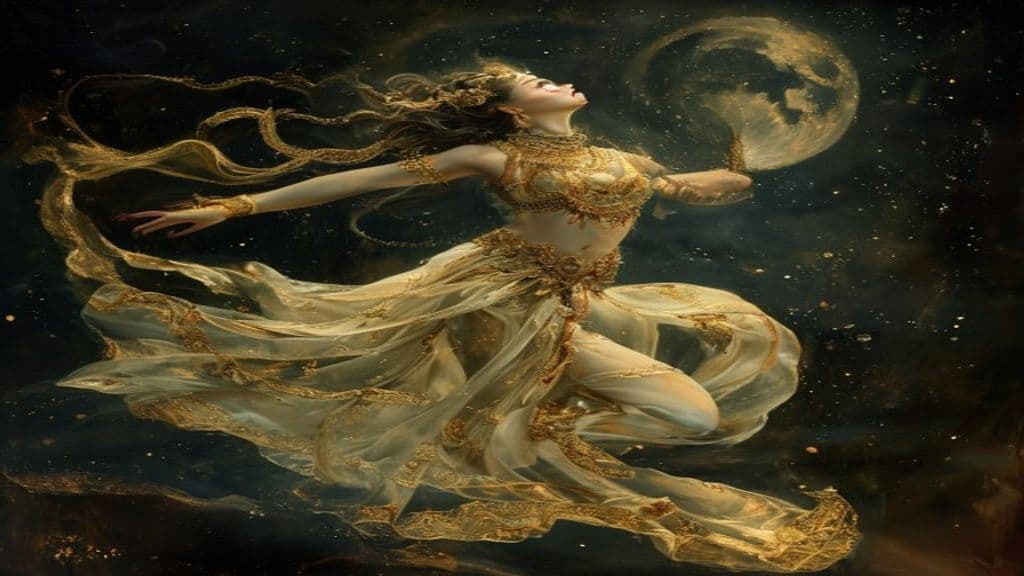
Apsara
Celestial dancers and water nymphs of Hindu cosmology — beautiful semi-divine beings who dance at the court of Indra and, by his command, descend to earth to distract sages from excessive asceticism.
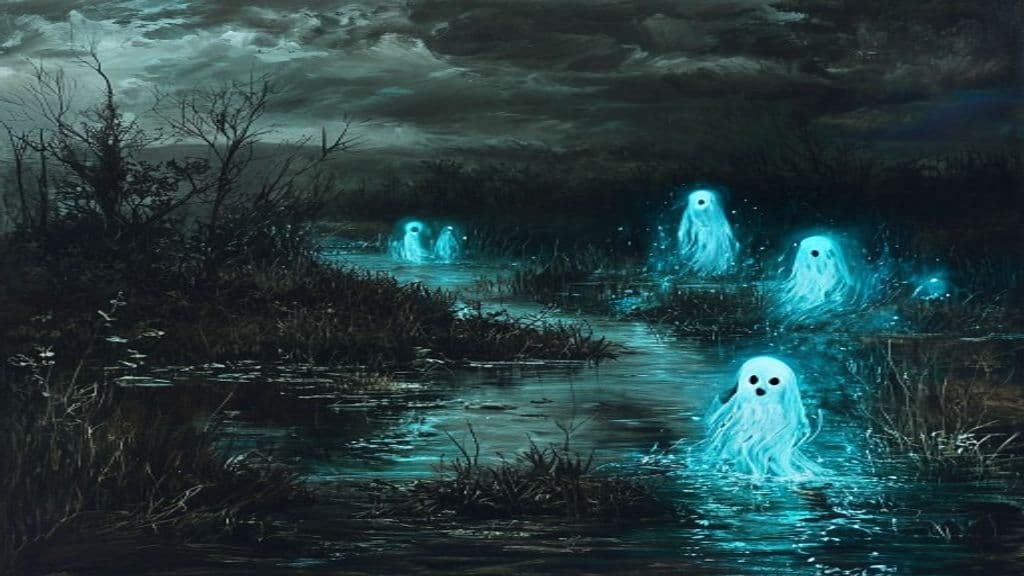
Will-o'-the-Wisp
A wandering light seen over marshy ground at night, leading travellers astray into bogs and fens. Possibly a spirit, possibly the soul of the unbaptised dead, possibly the devil himself.
Akuma
Akuma (悪魔/あくま) in Japanese sources is an evil spirit, devil, or demon associated with misfortune and mental disturbance. The term appears in Buddhist texts and Heian-period literature and was later used to translate the Christian figure of Satan, as well as the Buddhist Mara.
Datsue-ba
A supernatural old-woman ogress figure in Japanese Buddhist underworld imagery who sits by the Sanzu River and strips the deceased of their garments (or, in some accounts, their skin) as part of post-mortem judgement. She functions as a liminal, procedural agent within Ten Kings / Six Realms iconography rather than as a creator or cosmic force.
Five Wisdom Kings
A class of wrathful, mantric protector-deities in East Asian Mahāyāna (notably Japanese) Buddhism, identified with the Sanskrit Vidyārāja and Japanese Myō-ō and described in sources as guardians of the cosmic Buddha Dainichi (Vairocana) and of esoteric teachings.
Gohō dōji
A guardian attendant spirit in Japanese Buddhist folklore depicted as a youthful protector devoted to defending the Dharma and assisting followers of Buddhist teaching. Attested in medieval narrative collections and illustrated emaki, the figure appears as a cultic attendant associated with dharmapāla-type protection.
Hannya (般若)
Hannya is a traditional Japanese Noh mask type and the theatrical/folkloric embodiment of a woman transformed into a resentful, jealous spirit. The mask represents a stage of metamorphosis into an onryō-like figure, visually marked by horns and a leering mouth, and is situated at the intersection of Noh theatre, ritual dance (kagura), and Buddhist-influenced folk belief.
Japanese dragon
A class of large serpentine beings in Japanese myth that function variously as water deities, regional kami, Buddhist nāga/dragon kings, and shapeshifting supernatural creatures associated with seas, rivers, rain and related powers.
Kalaviṅka
A Buddhist fantastical creature described as a human-headed, bird-bodied being famed for its exquisite, Dharma-preaching voice; represented across South, East, and Southeast Asian Buddhist art and liturgical contexts with regional iconographic variation.
Karura
A Japanese Buddhist divine creature with a human torso and avian head, derived from the Sanskrit garuḍa. Portrayed as an enormous, fire-breathing predator of serpents and incorporated into Buddhist guardian retinues and ritual-iconographic contexts in Japan.
Otake Dainichi Nyorai
Japanese manifestation of Vairocana, embodying wisdom and compassion. (Note: 1. Power tier should be Ancient (deity-level) rather than Primordial (cosmic). 2. Appearance should be noted as "Not specified" due to lack of source material. 3. Abilities, sensory_cues, weaknesses, )
Tentōki and Ryūtōki
Tentōki (天燈鬼) and Ryūtōki (龍燈鬼) are small demon‑like attendant figures in Japanese Buddhist temple iconography. Typically shown as oni‑like beings carrying lanterns, they function as subjugated attendants who offer light to the Historical Buddha and symbolize the Shitennō’s power to repel evil.
Yama-uba
A Japanese yōkai of the mountains variously depicted as an old mountain crone, a mountain mother/princess, or an ambivalent mountain spirit who may harm travelers or aid the kind. She appears across folktales, Noh drama, and ukiyo-e, occupying roles from man‑eating hag to guardian linked to household fortune in some regions.
Yūrei
Yūrei (幽霊) are spirits of the dead in Japanese folklore who remain bound to the world of the living rather than having completed transition to an afterlife. They are a culturally specific category of ghost/spirits, often discussed alongside related terms such as bōrei and shiryō and appearing widely in literary, visual, and local legend contexts.
Community Record
- [1]Tennin. Wikipedia: Tenninwiki
- [2]Hagoromo (Noh play) — summary and text. University of Virginia Japanese Theatre Institute — Hagoromoliterary
- [3]Certain Noble Plays of Japan (Hagoromo translation) — Ezra Pound collection. Ezra Pound / translation of Hagoromo (archive site)literary
- [4]Wikidata: Tennin. Wikidata entry Q37501667other