In the Kojiki narrative Izanagi is one of the final generations of primordial deities who, instructed by earlier gods, solidifies and shapes the chaotic watery world. He and his sister-wife Izanami stand upon the newly formed island of Onogoro, erect a heavenly pillar (ama no mihashira), perform a ritual circuit about it and conceive the eight principal islands of the Japanese archipelago and a host of kami. His role in cosmogony also places him as progenitor of major deities—Amaterasu, Tsukuyomi, Susanoo—and situates him at the head of divine genealogies foundational to later political and religious claims.
Primary sources do not supply a detailed anthropomorphic portrait of Izanagi; the Kojiki emphasizes his ritual acts and instruments rather than bodily description. Narrative scenes describe him wielding a jewelled spear in the churning of the primordial sea and later using a sword in the slaying of the fire-god Kagutsuchi (an episode-specific weapon), but there is no sustained account of his attire, height, or facial features. Mythic emphasis rests on his role as ritual actor, ancestor, and boundary-maker rather than on visual particulars.
As a creator-being Izanagi effects world-formation: he and Izanami churn the primordial sea with a jewelled spear whose brine congeals into the first island (Onogoro), and their ritual union births islands and deities. He enforces and exemplifies correct ritual procedure (the marriage circuit and the importance of correct speech). After Izanami's death in childbirth he slays the fire-god Kagutsuchi with a sword, from whose blood and the dismembered remains further deities are produced. Izanagi descends to Yomi to retrieve Izanami, where he encounters and provokes underworld beings; on return he performs misogi (ritual bathing) to cleanse the pollution of contact with death, uses ordinary items transformed into food (his hair-vine and comb that become grapes and bamboo shoots) and three peaches plucked at Yomotsu Hirasaka to repel pursuers, and seals the entrance to Yomi with a boulder that becomes a guardian deity.
Weaknesses
- conditionRitual contamination by contact with the dead (necessitates misogi purification)
Wards
- otherPeaches (three peaches plucked at Yomotsu Hirasaka) — in the Kojiki narrative used by Izanagi to repel Yomi's pursuers and subsequently declared divine and protective for the living
- otherBoundary stone (huge boulder used to seal Yomi) — becomes a guardian deity (Yomido ni Sayarimasu no Ōkami / Chigaeshi no Kami) marking and protecting the threshold
- otherOrdinary items used as distractions (vine and comb that become grapes and bamboo shoots) — narrative means to delay pursuers
Izanami (Izanami-no-Mikoto)
Izanami is a primordial female creator deity in ancient Japanese cosmogony and Shinto worldview, portrayed as co-creator of the Japanese islands and many kami and as the originator of death after dying in childbirth and taking residence in the land of the dead (Yomi).
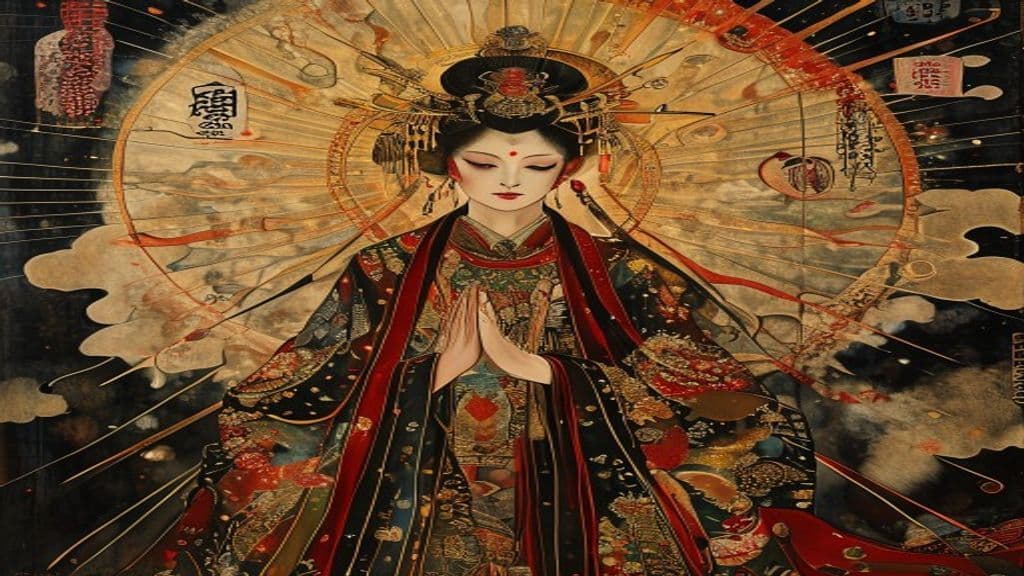
Amaterasu Ōmikami
Amaterasu Ōmikami is the sun deity and a principal kami in Shinto tradition, presented in classical Japanese sources as ruler of Takamagahara (the High Celestial Plain) and the mythic ancestress of the Imperial House through her grandson Ninigi. She is central to shrine cult at Ise and to ritual nomenclature and practice within institutional Shinto.
5 Ronin
5 Ronin is a 2011 Marvel Comics five-issue limited series that reimagines five Marvel superhero archetypes as rōnin (masterless samurai) in a fictionalized post‑Sekigahara feudal Japan. The work places Wolverine, Hulk, Punisher, Psylocke, and Deadpool analogues into period roles to explore displacement, revenge, and identity in an era of political upheaval.
Abumi-guchi
A Japanese yōkai classed as a tsukumogami: an animated stirrup (abumi) depicted in Sekien Toriyama's Gazu Hyakki Tsurezure Bukuro. Traditional accounts say it is formed from a stirrup that belonged to a soldier who fell in battle and that it waits where the stirrup lies for its dead owner to return.
Abura-akago
An Edo-period yōkai depicted as an oil‑licking infant or a ball of flame. First recorded in illustrated compendia (notably Toriyama Sekien's Konjaku Gazu Zoku Hyakki), the Abura-akago is tied to tales of oil‑stealing fires and functions in part as an etiological warning about wasting or stealing oil.
Abura-sumashi
A yōkai spirit from the Amakusa region of Kumamoto Prefecture, Japan, said to inhabit mountain passes. Traditionally explained as the ghost of a person who stole oil, it appears to surprise travelers and is represented in modern media with a straw-coat body and a potato- or stone-like head.
Aburabō / Abura-bōzu / Aosaginohi (traditions)
Two distinct Japanese traditions appear under related flame imagery: Aosaginohi/Aosagibi is presented as a will-o'-the-wisp type luminous night phenomenon interpreted as reflections from herons; aburabōzu (abura bōzu, "oil monk") appears in a separate anecdote as a reported fire-breathing apparition in a 12th-century Yasaka Shrine tale. The sources treat them as separate portrayals rather than a single unified being.
Acala
Acala (Sanskrit: अचल, 'The Immovable') is a wrathful protective deity (dharmapala) in Vajrayāna and East Asian esoteric Buddhism, classed among the Wisdom Kings (Vidyārāja). He functions as a ritual focus for visualization and mantra practice intended to remove obstacles and bind or destroy hostile forces.
Agaru
Agaru (attested historically as Agarum) appears in the supplied sources as a Bronze Age Near Eastern toponym—often identified with Failaka Island—and as a modern personal or media name. The provided material contains no evidence that Agaru is a supernatural being in any traditional cosmology.
Ajisukitakahikone
Ajisukitakahikone is a kami in Japanese mythic literature (Kojiki/Nihon Shoki). He appears in the transfer-of-rule cycle between heaven and earth, is described as a son of Ōkuninushi, associated with the Kamo cult (called Kamo no ōmikami in some modern museum/catalog entries), and features in narratives that explain landscape formation and meteorological genealogy.
Aka Manto
Aka Manto (赤マント, "Red Cloak") is a Japanese urban legend and schoolyard ghost-story about a masked, cloaked figure who appears in public or school toilet stalls and forces occupants to choose between colored toilet paper; each choice in the tale produces a violent supernatural consequence. The legend is part of modern popular folklore recorded in school contexts from the 1930s onward rather than a formal religious myth.
Akaname
Akaname is a Japanese yōkai associated with baths, bathtubs, toilets, and other places where scum and filth accumulate. Traditionally depicted as a child-like creature that licks grime, it functions in folklore as a cautionary figure tied to cleanliness; a few narrative variants cast it as dangerously predatory.
Akashaguma
Akashaguma is presented in the available sources as a child-like house guardian spirit in the Japanese yokai tradition, closely comparable to the regional zashiki-warashi. It is associated with domestic interiors (parlors or storage rooms) and with bringing prosperity to households where it dwells.
Akashita
Akashita (赤舌, lit. “red tongue”) is an Edo-period pictorial yōkai commonly represented as a hairy, clawed face emerging from dark clouds with a wide open mouth and a conspicuous red tongue. The figure appears in yōkai emaki and Toriyama Sekien’s Gazu Hyakki Yagyō; Sekien’s plate shows it atop a sluice, but the original pictorial tradition provides no explanatory caption. Later folklorists and popular writers (Shōwa and later) have variously interpreted the image as a punitive spirit linked to irrigation/floodgate justice or as a kidnapper in evening skies, though these narrative roles are post-hoc.
Community Record
- [1]Izanagi - Wikipedia. Wikipedia: 'Izanagi' article (Kojiki summary and etymology notes)wiki
- [2]Izanagi - Wikidata Q813858. Wikidata item Q813858 (metadata and labels for Izanagi)wiki
- [3]Izanagi Online Wiki (archived). Izanagi Miraheze wiki (archival material referenced in research notes)other