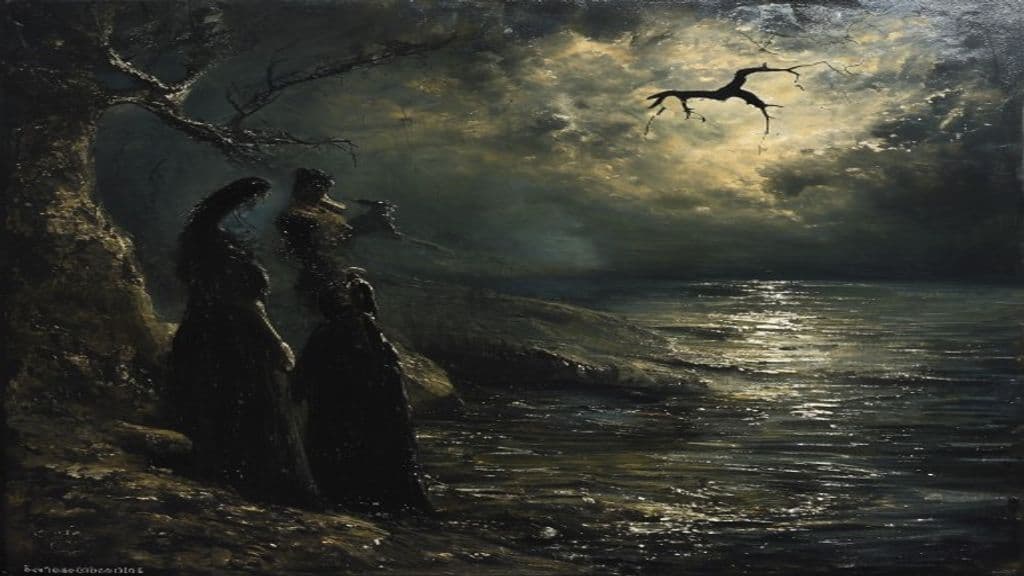
Les Lavandières are associated with the triple goddess of death and slaughter in Celtic cosmology, possibly embodying aspects of this deity.
No specific physical description provided.
Facilitate the transition from life to death by washing shrouds or bloodstained clothing at midnight.
Weaknesses
- unknown
Wards
- unknown
Lemures
The malevolent restless dead of Roman religion — spirits of those who died without proper burial or with unresolved grievances, haunting their former homes until appeased.
Leonteus
Leonteus is a personal name borne by several human figures in Greek mythic tradition, most prominently a Thessalian/Lapith commander who led contingents to Troy in the Iliadic cycle. He functions as a mortal heroic leader and occasional genealogical ancestor in variant traditions rather than as an independent supernatural being.
Leprechaun
A diminutive, solitary supernatural being from Irish folklore, commonly depicted as a shoemaker who delights in mischief and is associated with hidden or buried treasure. Prominent in later folkloric collections and the 19th‑century literary revival rather than central early mythic cycles.
Leraie
Leraie (also spelled Leraje, Leraye, Leriac, Loray, Oray, Zoray) is a named high-ranking spirit in the Western Goetic/grimoire tradition, described as a 'Great Marquis' who appears as a green-clad archer and is held responsible for causing battles, putrefying arrow-wounds, influencing lovers, and commanding numerous legions of subordinate spirits.
Leraje
Leraje (also spelled Leraie, Loray, Oray, Leriac) is a named spirit in the Goetic/grimoire tradition, described as a 'mighty Great Marquis' who commands thirty-three legions of lesser demons. In the grimoire corpus he is depicted as a green-clad archer and is credited with causing battles, producing arrow-wounds that fester or gangrene, and influencing lovers to come or to go.
Lernaean Hydra
A multi-headed serpentine chthonic water-monster of Greek myth associated with the marshes and spring of Lerna; famed as the adversary slain by Heracles in his second Labour, notable for poisonous breath and blood and for regenerative heads (accounts vary).
Lesbian vampire
A literary and cinematic trope that fuses traditional vampire motifs with eroticized female same‑sex desire. Originating in 19th‑century Gothic fiction and developed through 20th‑century cinema, the figure functions narratively to explore, sensationalize, or critique sapphic desire and female sexual transgression.
Leshy
A tutelary forest being in Slavic folklore; an embodied, territorial power of the woods that can protect, mislead, or punish humans depending on their behaviour toward the forest. Highly variable in form and described across many regional variants and names.
Lete
Lete is not attested in the provided sources as a supernatural being. The attested uses of the form 'Lete' are lexical and onomastic: a Basque toponym and surname, an ancient city (Lete in Mygdonia), a modern village in Nepal, an entry-word in the constructed language Toki Pona meaning 'cold' (with an associated glyph), an esoteric programming language (esolang) called Lete, an ICAO airport code (LETE for Morante Airfield), and a proper name applied to an exoplanet. No sources in the consulted corpus describe Lete as a spirit, demon, deity, or monster.
Lethus
Lethus is not attested as a single traditional supernatural being in the supplied sources; the lexical form appears in multiple unrelated contexts: as a Greek mythic personal name (father of Pylaeus), as a taxonomic label in entomology, as modern personal/user names, and as a single modern fan-made fictional monster (the "Lethus Dragon" on a D&D wiki). No coherent folkloric ontology, rituals, or traditional powers are documented for an entity called Lethus.
Leto
Leto (Ancient Greek: Λητώ / Λατώ; Latin: Latona) is an ancient Greek goddess best known as the mother of the Olympian twins Apollo and Artemis. She functions in myth and cult as a kourotrophic (mother‑or nurse‑goddess) figure with important sanctuaries at Delos and the Letoon in Lycia, and appears in narratives that emphasize both mildness and the capacity to call down retribution when insulted.
Leucosia
Leucosia is a name applied in the source corpus to multiple distinct referents: a possible name for one of the Sirens of Greek mythology (a sea-associated, singing female figure), a modern taxonomic genus of small 'pebble' crabs (family Leucosiidae), and several modern/pop-cultural uses. The supplied sources do not preserve a standalone ancient narrative or ritual corpus specifically attached to a Siren named Leucosia.
Community Record
- [1]