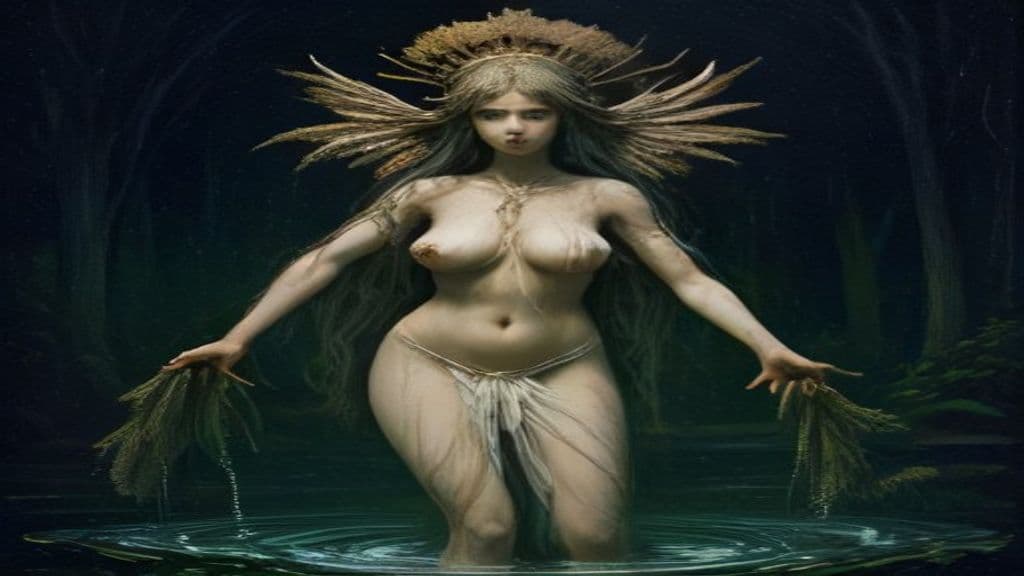
Classical literary and encyclopedic sources present Limnades not as a single origin myth but as a taxonomic category of nymphs tied to lakes. Within that classical model they are described as the offspring or attendants of particular lake gods or goddesses: for example, the Macedonian lake-goddess Bolbe is explicitly said to have Limnades as her offspring. The supplied sources treat Limnades as resident female spirits generated or associated with named freshwater divinities rather than presenting a single, uniform cosmogonic origin.
The supplied sources do not record standardized physical descriptions of individual Limnades. They are classified as nymphs in the same family as other localized female nature-spirits in Greek literature (theocritan and encyclopedic references), and thus in surviving classical imagery and poetry nymphs are often depicted as youthful female figures associated with their natural locale. However, no detailed, source-cited anatomical or costume descriptions for Limnades in particular are given in the provided material; descriptions beyond their status as lake-nymphs are not attested in the cited excerpts.
The provided materials do not enumerate specific supernatural powers or a catalogue of behaviors unique to Limnades. What is recorded in the sources is taxonomic: Limnades are lake-associated nymphs and are treated as offspring or attendants of lake deities (for example Bolbe). From the citations available, their primary documented role is as resident female spirits bound to lakes; no explicit abilities, interventions in human affairs, or standard mythic actions are specified in the supplied texts.
Aegaeon
Aegaeon is a name used in ancient Greek myth for multiple figures, most notably a Hecatoncheir sometimes equated with Briareus and also borne by several localized personages (an Arcadian prince, a son of Lycaon, and occasional Giants). The name carries maritime and stormy connotations (etymologized as 'goatish', 'stormy', or 'Aegean') and in some traditions marks a primordial, multiform monstrous kin of the gods.
Aleuas
Aleuas (Greek: Ἀλεύας; Modern Greek: Alevas) is a figure in ancient Greek tradition presented as a mythical king and seer of Thessaly and the eponymous ancestor of the noble Aleuadae family of Larissa. The name also appears for distinct historical individuals and as a modern scientific/commercial homonym, but classical sources treat Aleuas as a legendary human ancestor rather than a recurring supernatural class.
Cyclops
In ancient Greek tradition the Cyclopes are one‑eyed giant beings appearing in multiple, sometimes contradictory strands: Hesiodic primordial artisan brothers who forge the gods' arms; Homeric solitary, cave‑dwelling shepherd‑monsters such as Polyphemus; and a legendary explanation for monumental ‘Cyclopean’ masonry.
Erechtheus
Erechtheus is a mythic-heroic foundational figure of ancient Athens whose identity blends an autochthonous, earth-born ancestor-king with a localized cultic name often syncretized with Poseidon; he functions as eponymous progenitor of the Erechtheidai and as the focus of ritual memory on the Acropolis (the Erechtheion).
Inachus
Inachus (Ἴναχος, Inachos) is a mythic ancestral figure of Argos who functions both as the region's eponymous first king/priest and as a river-divinity descended in some accounts from the Titans Oceanus and Tethys. He appears in etiological narratives that tie Argive territory, cult, and seasonal hydrology to a pre-Olympian generation of river-gods and founders.
Prometheus
Prometheus is a Titan of ancient Greek myth credited as a benefactor and culture-bringer to humanity, most famously for stealing fire from the Olympian gods and giving it to people. He is portrayed as intelligent and forward-looking (etymologically associated with 'forethought'), and as punished by Zeus for his transgression.
Salmacis
Salmacis is a naiad — a freshwater nymph tied to a specific spring near ancient Halicarnassus in Caria. In classical literature (notably Ovid) she appears in the Hermaphroditus narrative: her passionate pursuit and prayer are the occasion for the fusion of Hermaphroditus' and her bodies, and the spring acquires a reputation for making men 'effeminate and soft.'
Lilu (lilû) / Lilītu / Ardat-lilî
A class of Mesopotamian nocturnal spirits or demons (lilû, lilītu, ardat-lilî) thought to arise from the unfulfilled spirits of those who died before marriage or conceiving children; attested in Akkadian magical-medical texts and in Sumerian-Akkadian literature (e.g., the ki-sikil-lil-la-ke of the Gilgamesh cycle).
Lime Tree (Germanic Tradition)
The lime tree is a sacred and symbolic plant in Germanic tradition, associated with protection, peace, and healing. (Note: - Power tier: Primordial (Given its association with protection from harm, evil spirits, or negative energies, which suggests a more cosmic level) - Abilities: Remove "good dreams" as it is not suppor)
Liminal deity (category)
A scholarly category of gods and divine figures whose proper sphere is thresholds, borders, and transitions — places and moments where one state gives way to another. The term aggregates culturally specific deities (e.g., Janus, Hecate, Charon, Cheng'huang, Menshen, Jangseung, Bes) that function as guardians, psychopomps, or mediators at crossings of space, time, or condition.
Limnaee
Limnaee (also rendered Limnaíē or Limnaee) is a type of naiad — a freshwater nymph in Greek tradition — conceived as a female nature-spirit presiding over localized bodies of fresh water such as springs, wells, brooks and fountains. She is presented in sources as a place-bound guardian-personification of a water-site, distinct from river-gods who embody whole rivers.
Limokon
A culturally specific omen bird in Mindanao Philippine traditions (notably Mandaya, Bagobo, and Manobo). Its vocalizations are interpreted as messages from the unseen or spirit world and are used to guide immediate practical decisions; in some Mandaya origin tales it also appears as a primordial, speaking dove involved in creation.
Community Record
- [1]Limnades (Wikipedia). Wikipedia: Limnades (entry noting Theocritus' Idylls mention and translation as 'Nymphs of the lake')wiki
- [2]Bolbe (Wikipedia). Wikipedia: Bolbe (states that Bolbe's offspring were Limnades and links the lake-goddess to a Macedonian lake, modern Lake Volvi)wiki
- [3]Wikidata: Limnades (Pauly-Wissowa reference). Wikidata entry referencing a Pauly–Wissowa (Realencyclopädie) article on Limnades (scholarly encyclopedia entry referenced but full text not supplied here)other