
Lucy Pevensie is introduced in The Lion, the Witch and the Wardrobe as the youngest of the four Pevensie children evacuated to the Professor's country house during wartime England. She is the first to discover Narnia by entering a wardrobe and plays a central role in the overthrow of the White Witch alongside her siblings, being crowned at Cair Paravel as Queen Lucy the Valiant. She reappears across the series (notably Prince Caspian and The Voyage of the Dawn Treader) as a returning human who can see and interact with Narnia and its spiritual center, Aslan; in The Last Battle the narrative reports that after dying in a train crash in England the Pevensie children are taken to Aslan's Country, the story's depiction of an afterlife continuation of Narnian reality.
Lewis's sources describe Lucy as fair- or golden-haired and cheerful; a quoted line characterizes her as "always gay and golden-haired," and that all princes desired her as their Queen. Beyond these lines, the prose emphasizes her childlike cheerfulness, friendliness toward animals, and open disposition rather than detailed physical metrics.
Lucy is a mortal child whose distinguishing qualities in the narrative are faith, compassion, courage, and spiritual receptivity—she is repeatedly the sibling closest to Aslan and sometimes perceives Aslan when others do not (e.g., she is the first to see Aslan in Prince Caspian). She receives narrative-gifted items: Father Christmas gives her a small vial of a "magical cordial" capable of healing nearly any injury (intended for sparing, impartial use) and a small dagger for defense; these items are the source of specific supernatural effects in the story rather than Lucy being innately supernatural. Adaptations (for example the archived video-game demo) reframe Lucy as a playable hero with combat skills, but that representation is adaptation-specific and not a depiction from Lewis's original prose.
Weaknesses
- conditionmortality (human limitations)
- otherreliance on others' testimony and persuasion (e.g., needs siblings' acceptance of Narnia)
- otherlimited magical agency (her healing power derives from Father Christmas's cordial rather than innate supernatural ability)
Wards
None recorded.
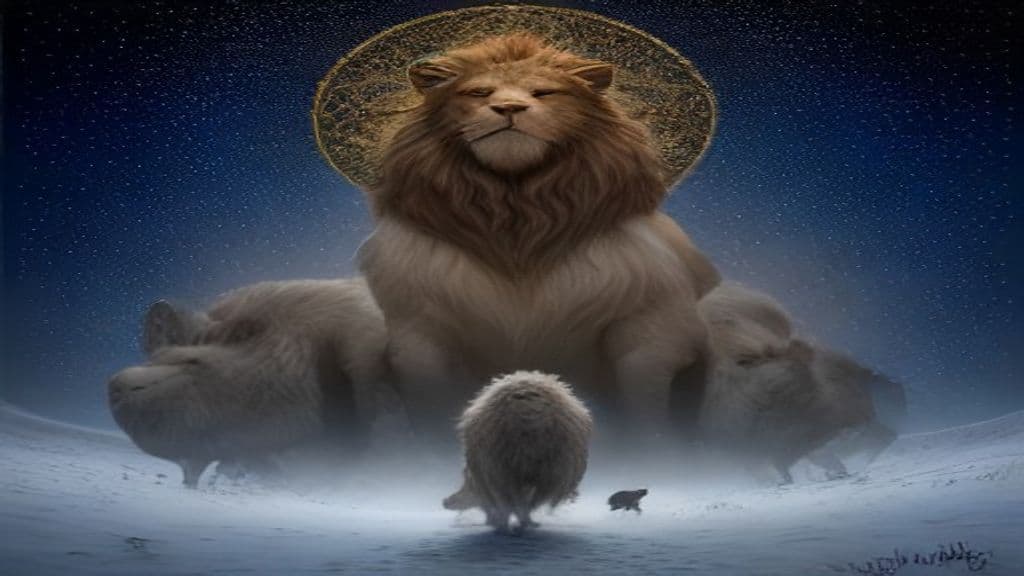
Aslan
Aslan is the singular, talking lion figure at the center of C. S. Lewis's The Chronicles of Narnia, functioning as creator, king, judge, savior, and moral authority within that fictional cosmology. The name also appears in unrelated contexts (personal names, a lion-like alien in Traveller RPG) but those are distinct referents.

Edmund Pevensie
Edmund Pevensie is a fictional English schoolboy created by C. S. Lewis who appears as a principal human character in The Chronicles of Narnia. He begins as a spiteful, selfish child, betrays his siblings under the influence of the White Witch, is redeemed through Aslan's sacrificial intervention, and later reigns as King Edmund the Just in Narnia before returning to England.
Lover jinn (Parī / Peri)
A supernatural being from Persian-origin tales commonly called parī or peri, depicted as a winged and beautiful creature that appears in supernatural narratives, including motifs of supernatural beings forming romantic attachments to humans. Sources contrast parīs with jinn by noting parīs typically feature in supernatural-tale contexts.
Loviatar
Loviatar is a figure attested in modern reference works as part of Finnish mythic material associated with death and illness; one database entry describes her as a blind daughter of Tuoni. Source material in the supplied corpus also shows nearby or overlapping traditions (notably Louhi) linked to death, disease, and wolves, but the documents provided do not settle whether Loviatar and Louhi are identical, conflated, or distinct in older tradition.
Lua-o-Milu (Hawaiian tradition)
A spiritual realm or land of the dead, ruled by Milu, serving as a transition space between life and death. (Note: - Power tier: Primordial seems too high, considering the ability to only turn people to stone by staring at them; it should be revised to Greater or Lesser. - Sensory cues: while an unsettling feeling)
Luanniao (luan bird)
The luan (luanniao) is a mythological, auspicious bird in Chinese tradition described in classical lexica and mythographic sources as a divine or semi-divine bird whose appearance and song are omen-bearing and ritually significant to rulers and paradisiacal realms.
Lucifer
A multilayered figure whose core identity in the cited sources is the planet Venus as the brilliant morning star (Latin lucifer, 'light-bringer' / Hebrew hêlêl, 'shining one'). In later Jewish and especially Christian exegesis the Isaiah image Helel ben Shachar is reinterpreted as a mythic fall motif and becomes associated with a rebellious heavenly being identified with the adversary; this development overlays the earlier astronomical and poetic personification.
Lucifuge Rofocale
A named infernal official in grimoire and modern occult tradition, presented in later sources as a high-ranking Prince or minister of Hell often associated with oversight of Hell’s government, finances, and secret material power on Earth. The figure appears primarily in the context of the Grand Grimoire tradition and subsequent occult reinterpretations and invocations.
Lugal-Marada
Lugal-Marada is the tutelary city god of Marad (Sumerian Marda) in Mesopotamian tradition, attested as a martial patron invoked in temple-building inscriptions and Old Babylonian oath formulas and subject to syncretic identification with other deities in scribal/theological lists.
Lugala'abba
Lugala'abba (dlugal-a-ab-ba) is a Mesopotamian theonym attested in god lists, an Akkadian incantation (Šurpu), an Old Babylonian seal, and a possible temple entry from Nippur. He is associated with the sea and in some textual contexts with the underworld, while in an incantation he is called "the exorcist of the gods, the pure god" and implored to "cast a spell of life."
Lugalbanda
Lugalbanda is a deified Sumerian royal-hero from the Uruk cycle who appears as a soldier and adventurer in early epic narratives and later as a holy ancestor-god invoked by kings and cults in Mesopotamia.
Lugal‑irra and Meslamta‑ea
A paired divine duo in Mesopotamian religion, Lugal‑irra and Meslamta‑ea function as warrior guardian gods of thresholds and gates—especially gates of the underworld—and are identified in astronomical tradition with the 'Great Twins' (Alpha and Beta Geminorum). They were cultically paired (Maštabba, "the divine twins") and honored in temple and apotropaic contexts across multiple Mesopotamian cities.
Lugh
Lugh is a prominent figure of Irish myth, a member of the Tuatha Dé Danann variously portrayed as a warrior, king, master craftsman and saviour. Epithets (e.g., Lámfada, Samildánach) stress his long arm and polyvalent skill; medieval texts place him centrally in the mythic history of Ireland (notably the Battle of Mag Tuired) and later comparative traditions identify him with the pan‑Celtic Lugus and, by interpretatio romana, with Mercury.
Luit Xuri
The spirit of the Brahmaputra river itself — 'Luit' being the Assamese name for the Brahmaputra and 'Xuri' meaning spirit or essence. One of the few major rivers in Hindu tradition that is male (Brahma's son), his spirit in Assamese folk belief is unpredictable, powerful, and must be addressed before any seasonal beginning.
Community Record
- [1]Lucy Pevensie - Wikipedia. Wikipedia contributors. "Lucy Pevensie." Wikipedia, The Free Encyclopedia.wiki
- [2]Lucy Pevensie - Wikidata. Wikidata entry Q1640313, Lucy Pevensie.other
- [3]The Chronicles of Narnia: The Lion, the Witch and the Wardrobe Demo (archive). Archived game demo and materials describing an adaptation of The Chronicles of Narnia.other
- [4]Wunderkind: podfic and cover (archive). Archived adaptation/cover materials referencing the Narnia adaptations.other