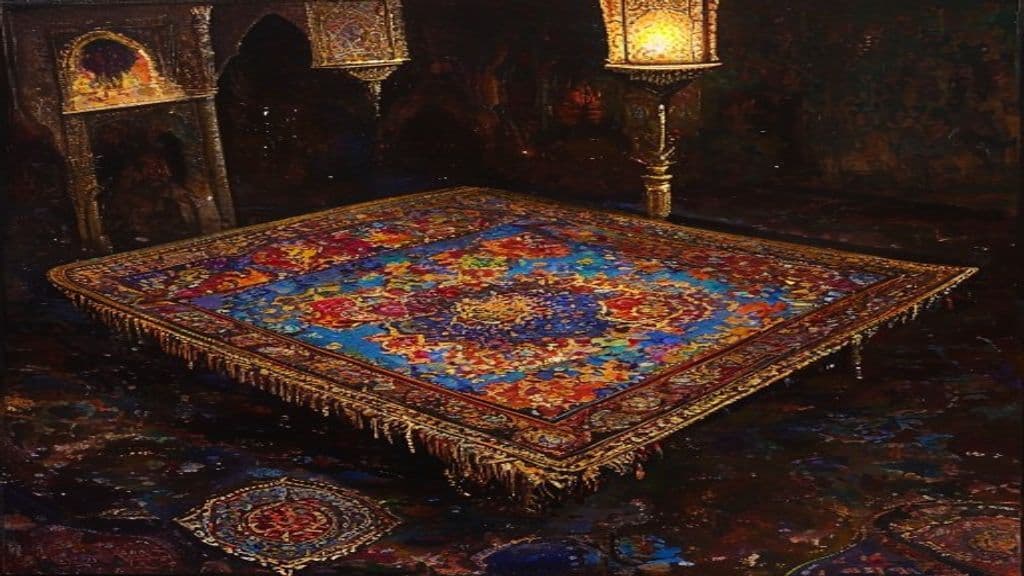
The concept of flying carpets has its roots in Persian literature and folklore, particularly in the stories of One Thousand and One Nights (also known as Arabian Nights).
There is no physical description provided in the source material. A magic carpet is described only as a 'legendary carpet' used for transportation.
A magic carpet can transport its user(s) quickly or instantaneously to their destination, defying physical laws and traversing vast distances at will.
Azhdaha (Aždahā)
Azhdaha (also Aždahā) is a serpentine/draconic monster in Persian literary and folkloric tradition, depicted as a gigantic, often dangerous creature that may inhabit air, sea, or land and appears in epic and cosmological texts.
Daeva
In Zoroastrian and Iranian tradition, a daeva (Avestan daēuua) is a class of supernatural being that the Zoroastrian revelation repudiates; in the oldest texts they are 'gods that are (to be) rejected' and in later tradition they come to be depicted as divinities promoting chaos and, ultimately, as personifications of evil.
Lover jinn (Parī / Peri)
A supernatural being from Persian-origin tales commonly called parī or peri, depicted as a winged and beautiful creature that appears in supernatural narratives, including motifs of supernatural beings forming romantic attachments to humans. Sources contrast parīs with jinn by noting parīs typically feature in supernatural-tale contexts.
Peri (Parī / Pari)
A class of supernatural beings from Persian tale literature and wider Asian folklore, the parī (also spelled peri or pari) commonly appear in narratives involving the supernatural and are often described in sources as winged and immensely beautiful, living in societies likened to human social organization.
Maelstrom (ride)
A fictional theme park attraction inspired by Norse mythological concept of maelstroms, located in the Norway Pavilion at Epcot's World Showcase. (Note: 1. Add Power tier: Greater (the ride has immersive abilities that create an environment for visitors, but its scope is limited to a specific location in Epcot) 2. Include sensory cues from source mate)
Maenad
In ancient Greek religion and myth, maenads (Ancient Greek: μαινάδες, mainádes) are the female followers and ritual participants of Dionysus who enter ecstatic frenzy to commune with the god. They function both as organized cult members in Dionysian worship (the thiasus) and as mythic agents through whom Dionysus' power—sometimes restorative, sometimes destructive—is manifest.
Maeon
Maeon is a recurring personal name in Greek and Roman epic and tragic tradition applied to several distinct mortal figures (Theban, Trojan, Rutulian and other local variants). The name does not denote a single supernatural species but appears across multiple genealogies and episodic narratives where each Maeon’s parentage, role, and fate vary by source.
Mafuiʻe
Mafuiʻe is a Samoan subterranean being who dwells in volcanic regions below the earth, keeper of fire and governor of earthquakes; in origin myths a culture-hero (Tiʻitiʻi / Tietie-i-Talaga or Maui-variant) wrests fire from him, and he is left with only one arm.
Magical creatures (The Chronicles of Narnia)
A collective classification for the many non-human sentient and semi-sentient beings that populate C. S. Lewis's fictional world of Narnia. The group includes enlarged talking animals and figures drawn from Greco‑Roman and northern mythic traditions (fauns, centaurs, dryads, etc.) and functions within the books as courtiers, warriors, prophets, and companions to human protagonists.
Magilum Boat
Supernatural vessel in Mesopotamian tradition associated with the god Ninurta, representing a transitional space between life and death. (Note: * Power tier should be Lesser, as the boat's abilities don't match those of a Primordial entity. * Sensory cues: The sinking of the boat is an implicit cue indicating death has occurred; add this to t)
Magnes
Magnes (Ancient Greek: Μάγνης, Magnēs, literally 'the magnet') is a personal name applied to several mythic men in the Greek tradition. The name functions chiefly as an eponymic and genealogical marker (not as a recurring supernatural class), most notably for a Thessalian prince who became the eponymous first king of Magnesia; other attestations include a son of Argos and a possibly mythological 'shepherd' later linked to the discovery of magnetism.
Magnes the shepherd
Magnes the shepherd is a legendary etiological figure credited in classical and medieval sources with the discovery of magnetic ore when the iron parts of his shoes and staff adhered to a rock. He functions as an eponymous origin-figure linking a person or place-name to the term for magnet and the recognition of magnetism.
Community Record
- [1]Wikipediawiki