
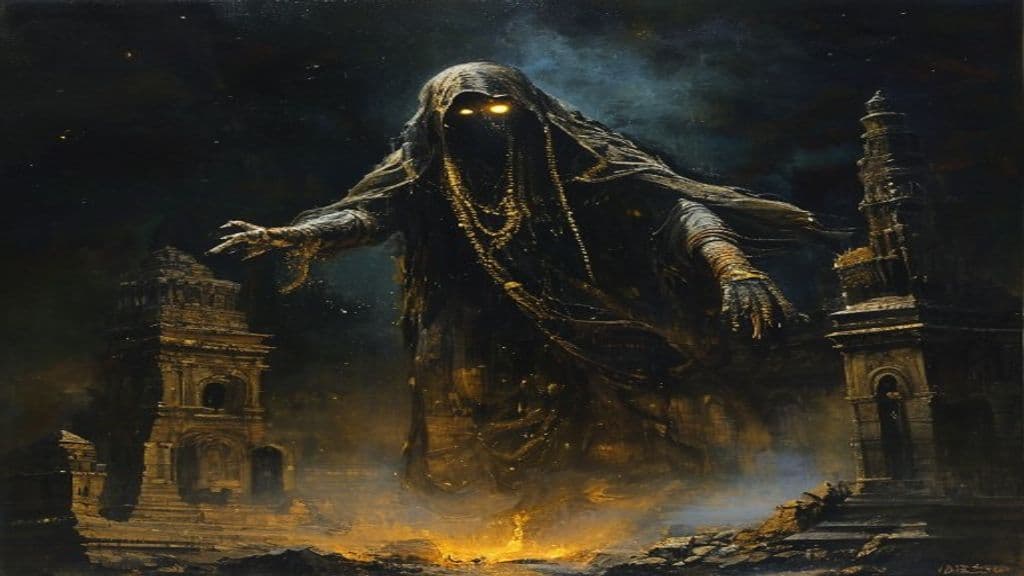
As preserved in later accounts, Mayūrabhaṭṭa was a 7th‑century Sanskrit poet who suffered from leprosy and undertook a penance at the famous Sūrya (Sun) temple at Deo in present‑day Aurangabad district, Bihar. He vowed to compose one hundred verses in praise of Sūrya, tying one hundred threads to the peepal tree in front of the shrine and untieing one thread after composing each verse. The narrative relates that a Brahmarākṣasa on the tree impeded his work by repeating his verses, but that by adapting his chanting he completed the Sūryaśataka; tradition says that, by virtue of the completed devotional corpus and divine grace, he was cured and the Brahmarākṣasa was freed from its phantom form.
Sources do not provide an extended physical description of Mayūrabhaṭṭa; he is attested as a learned poet and is described in the narrative as suffering from leprosy. Verse material from the Sūryaśataka (verse 6, as cited in the account) depicts leprous suffering (bodies festering with wounds, emaciated limbs, indistinct speech), which the tradition links to Mayūra's condition, but no detailed anthropomorphic portrait is given in the source.
Mayūrabhaṭṭa is represented as a skilled poet and ritual supplicant: composing and reciting the Sūryaśataka is portrayed in the tradition as the central devotional/penitential act that, once completed, brought about his cure. In the narrative he also employed a tactical vocal adaptation—chanting 'from his nose'—so that a tree‑dwelling Brahmarākṣasa, said to 'have no nose,' could not mimic and thereby interrupt his recital. These are reported elements of the story rather than independently attested supernatural powers.
Weaknesses
- conditioninability to mimic nasal chanting (narrative detail: 'had no nose')
Wards
- ritualSūryaśataka composition and vow (tying/untieing one hundred threads to the peepal tree)
- ritualnasal chanting (chanting 'from the nose' to prevent imitation by the Brahmarākṣasa)
Valmiki
Valmiki is a legendary maharṣi (great sage) and poet in the Hindu textual and cultural tradition, traditionally credited as the author of the Rāmāyaṇa and revered as Ādi Kavi ('first poet'). He is a canonical literary-religious figure and cultic exemplar rather than an adversarial supernatural being.
Mavuika
Mavuika is a fictional, in‑world divine figure in the video game Genshin Impact who functions as Natlan's Pyro Archon. Presented as a formerly mortal warrior who gained the Archon office, she drew on the power of the Ruler of Death to sacrifice herself to postpone a war for 500 years and is later resurrected in the game's current timeline.
Maximón (San Simón)
Maximón is a syncretic Maya folk deity and folk saint venerated in the Guatemalan Highlands (notably Santiago Atitlán and Zunil). He is an ambivalent, worldly figure—commonly represented by household or community effigies—that receives offerings (cigars, liquor, flowers, bread) and serves as a local mediator for petitions and favors. His identity and stories vary by town and combine pre-Hispanic Maya elements with Christian saint imagery, sometimes including associations with Judas Iscariot or Saint Simon.
Maya Hero Twins (Hunahpu and Xbalanque)
Central culture-hero brothers of the Kʼicheʼ Popol Vuh and Classic Maya iconography, Hunahpu and Xbalanque undergo trials, avenge earlier wrongs, defeat the lords of Xibalba by trickery and a ballgame, transform other beings, and are finally transformed into celestial bodies associated with sun and moon. They mediate between human society, the maize cosmos, and the underworld and appear in both colonial textual tradition and Classic Maya art.
Mayari
Mayari is a Kapampangan moon goddess in Philippine mythology who, after a quarrel with her brother Apolaki, shares rulership of the world by governing the night; she is associated with the moon, beauty, war, revolution, strength, weaponry, and the hunt, and is said to have lost sight in one eye during the fight.
Mayasura
Mayasura (Maya, Mayāsura, Maya Danava) is a legendary master‑builder and king among non‑Vedic supernatural lineages in Hindu narrative tradition, famed as the architect of the Mayasabha (Hall of Illusions) and the three cities Tripura, and as a transmitter/possessor of specialised astronomical knowledge in late mythic accounts.
Maymun
Maymun (Maymun Abanuch / Maymun al‑Shahabi / Abu Nuh) is presented in Islamic folkloric and occult sources as the last of the seven kings of the jinn, a powerful wind‑jinn king associated in those traditions with Saturday, the planet Saturn, the color black, and gold. He appears both as a fearsome, martial, abducing jinn in manuscript imaginaire and as a venerated saintly figure in North African local cults (Sidi Mimun / Lalla Mimuna).
Mazu
Mazu (媽祖) is a deified female protector of seafarers originating in Fujianese popular religion as the historical/legendary Lin Moniang. Venerated across Chinese folk religion, Taoist and Buddhist registers, and in coastal and diasporic Chinese communities (notably Taiwan), she functions as a tutelary sea goddess whose cult includes temples, imperial honorific titles, and large popular pilgrimages.
Mazzikin
In Jewish mythology, mazzikin are described as invisible demons that can cause harm or danger to individuals. (Note: - Power tier: change to Lesser (mazzikin cause "minor annoyances") - Weaknesses & Wards: list should be more specific, e.g., "Incantation bowls made by Aramaic-speaking inhabitants of Mesopotamia and )
Mañjuśrī
Mañjuśrī is a central Mahāyāna bodhisattva who personifies transcendent wisdom (prajñā). He appears as an authoritative figure in sutras, in esoteric mantra/dharani collections, and widely in Buddhist art and temple ritual contexts across South, Central and East Asia.
Mbielu-mbielu-mbielu
A mysterious animal reportedly seen in the Likouala River, Central African Republic/Democratic Republic of the Congo border. (Note: * Power tier: Not specified; needs to be determined based on available information. * Origin story: Omitted entirely; needs to be included if known. * Abilities: No information provided; needs to be e)
Mbombo (Bumba)
Mbombo, also called Bumba, is the creator god of the Kuba people (in what is now the Democratic Republic of the Congo). In Kuba creation myth Mbombo brings the sun, moon, stars, animals and people into being by vomiting them from his body, teaches humans craft (fire), and then retreats to the heavens, leaving an earthly representative (Yima/Loko Yima).
Community Record
- [1]Mayūrabhaṭṭa — Wikipedia. Wikipedia contributors, 'Mayūrabhaṭṭa,' Wikipedia, The Free Encyclopedia, https://en.wikipedia.org/wiki/May%C5%ABrabha%E1%B9%AD%E1%B9%ADawiki