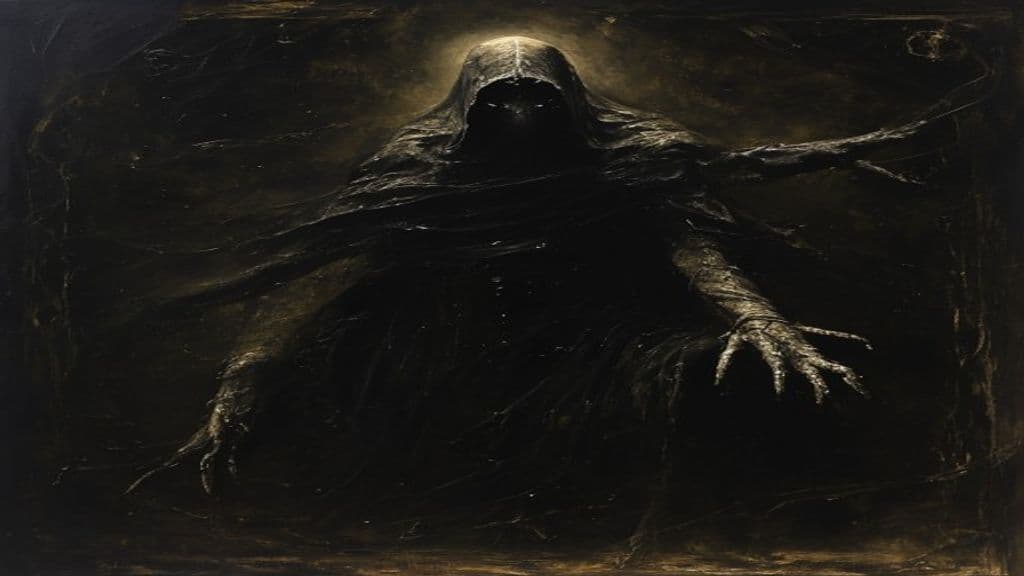
Invisible, no tangible physical form.
Mazzikin are capable of creating minor annoyances or greater dangers for individuals, possessing some kind of malevolent energy or power that can manifest in various ways.
Weaknesses
- ritualincantation bowls made by Aramaic-speaking inhabitants of Mesopotamia and the Levant
Wards
- ritualincantation bowls made by Aramaic-speaking inhabitants of Mesopotamia and the Levant
Chalkydri
Mythical, angelic creatures associated with the solar cycle and dwelling near the Sun. (Note: - Power tier: Primordial (Chalkydri's abilities are described as bringing heat and dew, which is a cosmic-level phenomenon) - Weaknesses: not mentioned in source material - Wards: not mentioned in sou)
Dybbuk
A malicious possessing spirit in Jewish mythology, believed to be the dislocated soul of a dead person. (Note: Power tier should be Lesser or Greater, not Primordial (the entity's power level seems too high for a dislocated soul). Origin story and Appearance sections are missing. Abilities should be more sp)
Leviathan
A giant sea serpent in Jewish mythology, embodying chaos and serving as a metaphor for a powerful enemy. (Note: - Power tier should be Ancient (Leviathan's abilities are often described as deity-level, such as threatening the damned after their lives are over and being annihilated) - Appearance is not mentioned)
Lilith
Lilith is a feminine night‑spirit in Jewish mythic, magical, and folkloric traditions associated with harmful nocturnal activity, especially threats to sleeping people and infants. The figure appears both as a class of night‑spirits (lilit/lilītu) in Near Eastern demonologies and as an individualized dangerous woman in later medieval Jewish narratives and amulets.
Solomon's Shamir
A mysterious entity with the power to cut through or disintegrate stone, iron, and diamond. (Note: - Power tier should be Ancient (deity-level) instead of Primordial. - Weaknesses should not be listed as non-violent means of achieving goals; this seems unrelated to the source material's description)
Mayasura
Mayasura (Maya, Mayāsura, Maya Danava) is a legendary master‑builder and king among non‑Vedic supernatural lineages in Hindu narrative tradition, famed as the architect of the Mayasabha (Hall of Illusions) and the three cities Tripura, and as a transmitter/possessor of specialised astronomical knowledge in late mythic accounts.
Maymun
Maymun (Maymun Abanuch / Maymun al‑Shahabi / Abu Nuh) is presented in Islamic folkloric and occult sources as the last of the seven kings of the jinn, a powerful wind‑jinn king associated in those traditions with Saturday, the planet Saturn, the color black, and gold. He appears both as a fearsome, martial, abducing jinn in manuscript imaginaire and as a venerated saintly figure in North African local cults (Sidi Mimun / Lalla Mimuna).
Mayūrabhaṭṭa
Mayūrabhaṭṭa (Sanskrit: मयूरभट्ट) is a 7th‑century Sanskrit poet and Hindu scholar traditionally credited with composing the Sūryaśataka, a one‑hundred‑verse hymn to the Sun (Sūrya). In the narrative preserved in later tradition he performed a vowlike penance at the Sūrya temple in Deo, tied one hundred threads to a peepal tree and composed one verse per day; according to the account, this devotional composition is said to have cured his leprosy and liberated a Brahmarākṣasa that haunted the tree.
Mazu
Mazu (媽祖) is a deified female protector of seafarers originating in Fujianese popular religion as the historical/legendary Lin Moniang. Venerated across Chinese folk religion, Taoist and Buddhist registers, and in coastal and diasporic Chinese communities (notably Taiwan), she functions as a tutelary sea goddess whose cult includes temples, imperial honorific titles, and large popular pilgrimages.
Mañjuśrī
Mañjuśrī is a central Mahāyāna bodhisattva who personifies transcendent wisdom (prajñā). He appears as an authoritative figure in sutras, in esoteric mantra/dharani collections, and widely in Buddhist art and temple ritual contexts across South, Central and East Asia.
Mbielu-mbielu-mbielu
A mysterious animal reportedly seen in the Likouala River, Central African Republic/Democratic Republic of the Congo border. (Note: * Power tier: Not specified; needs to be determined based on available information. * Origin story: Omitted entirely; needs to be included if known. * Abilities: No information provided; needs to be e)
Mbombo (Bumba)
Mbombo, also called Bumba, is the creator god of the Kuba people (in what is now the Democratic Republic of the Congo). In Kuba creation myth Mbombo brings the sun, moon, stars, animals and people into being by vomiting them from his body, teaches humans craft (fire), and then retreats to the heavens, leaving an earthly representative (Yima/Loko Yima).
Community Record
- [1]